-
Graphene Dispersion for Li–S Sulfur Cathodes — Cornell University, 2019
Jun 26, 2026 | ACS MATERIAL LLCHalim, W. et al. (2019). Directly deposited binder-free sulfur electrode enabled by air-controlled electrospray process. *ACS Applied Energy Materials*. https://doi.org/10.1021/acsaem.8b01694
Cornell University · ACS Applied Energy Materials · 2019
Cornell researchers used an ACS Material 4 wt% graphene dispersion in an air-controlled electrospray process to build binder-free sulfur cathodes for Li–S batteries.
About this research
Researchers at Cornell University, working in the Robert Frederick Smith School of Chemical and Biomolecular Engineering, developed a binder-free sulfur cathode for lithium–sulfur (Li–S) batteries by combining their air-controlled electrospray (ACES) deposition technique with a commercial 4 wt% graphene dispersion supplied by ACS Material. Published in ACS Applied Energy Materials in 2019, the study demonstrates that the graphene additive can directly replace polymer binders such as LiPAA, while ACES deposits the sulfur–carbon–graphene composite uniformly onto an aluminum current collector in a single dry-spray step. The resulting ACES-Gr electrode delivered higher sulfur utilization and improved cycling behavior than both conventional slurry-coated electrodes and ACES electrodes without graphene.
Li–S batteries are attractive because elemental sulfur offers a theoretical capacity of roughly 1675 mAh g⁻¹ and operates at a low cost, but practical cells are limited by the insulating nature of sulfur, large volume changes, and the dissolution of lithium polysulfide intermediates that shuttle between electrodes. A central challenge is constructing a cathode architecture that simultaneously anchors polysulfides, maintains electronic conduction across the porous matrix, and tolerates the volumetric strain over many cycles. Most prior work relies on slurry-cast electrodes with PVDF or LiPAA binders, which introduce electrochemically inactive mass, hinder ion transport, and can crack during drying. Strategies that combine graphene oxide, conductive carbons, and porous scaffolds have shown promise but rarely integrate deposition and binding into a single scalable step suitable for thin-film electrode manufacturing.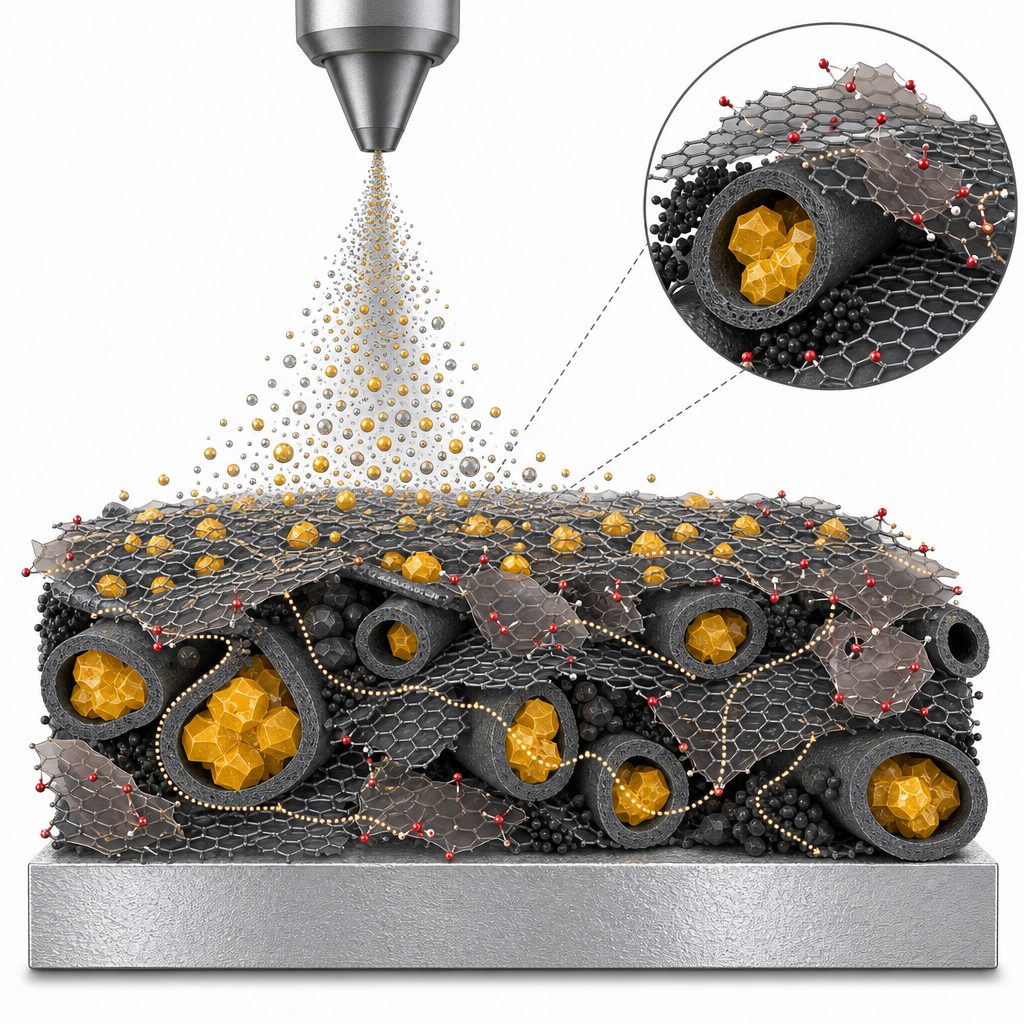
In this work, the authors used ACS Material's commercial 4 wt% graphene solution as the conductive binder phase inside the ACES-Gr formulation. The cathode slurry was prepared by combining active sulfur, Ketjen Black, and a mesoporous carbon nanofiber/graphene oxide (MPCNF+GO) composite, heat-treating at 155 °C to drive sulfur infiltration and partially reduce the GO, and then adding 2.5 g of the ACS Material graphene dispersion. The mixture was dissolved in an 8:2 water/isopropanol solvent at 10 mg mL⁻¹ and electrosprayed at 25 kV with a 15 cm tip-to-collector distance, 25 psi convective airflow, and a 0.1 mL min⁻¹ feed rate. The dry-spray process eliminated the cracking common in conventional drying and produced a homogeneous film with about 1 mg cm⁻² sulfur loading. The final electrode composition was 56% sulfur, 34% Ketjen Black/MPCNF+rGO carbon, 0% LiPAA binder, and 10% graphene from the ACS Material dispersion.
Electrochemical performance was assessed in 2032-type coin cells with a lithium metal anode, 1 M LiTFSI plus 0.1 M LiNO₃ in DME:DOL (1:1) electrolyte, and an electrolyte-to-sulfur ratio of 10 mL g⁻¹. Galvanostatic cycling between 1.8 and 2.8 V showed that the ACES-Gr electrode containing the ACS Material graphene outperformed both the slurry-cast reference (with 10% LiPAA binder) and the binder-free ACES electrode without graphene. The graphene-containing cathode delivered higher initial discharge capacities, better rate capability at increasing current densities, and improved capacity retention over extended cycling, supporting the role of graphene in promoting electron pathways and enhancing sulfur utilization. Cyclic voltammetry and electrochemical impedance spectroscopy confirmed lower charge-transfer resistance for ACES-Gr, consistent with a more interconnected conductive network. FTIR, TGA, XRD, SEM/EDS mapping, and XPS verified successful sulfur infiltration, GO reduction during heat treatment, and uniform distribution of sulfur and graphene across the aluminum substrate. The two-step ACES-plus-heat-treatment workflow also avoids the polymer adhesives typically required for stable adhesion to aluminum.
The results have practical implications for the manufacturing of next-generation Li–S batteries. Dry electrospray deposition combined with a graphene-based binder is compatible with roll-to-roll processing and could simplify the cathode coating step while reducing solvent use. The same ACES platform has previously been applied to Li-ion electrodes and high-loading sulfur cathodes, suggesting that it is generalizable to other active materials and current collectors. Beyond Li–S, the binder-free architecture described here could inform research on lithium–selenium batteries, sodium–sulfur cells, and other conversion-type chemistries where binder swelling and polysulfide shuttling limit cycle life. The authors point to higher sulfur loadings and pairing with protected lithium anodes as logical next steps.
For researchers working on Li–S cathode formulation, conductive coatings, or binder-replacement strategies, the commercial 4 wt% graphene dispersion from ACS Material used in this study is available in ACS Material's Graphene Series catalog. The same graphene dispersions and related single-layer and reduced graphene oxide products can support development of conductive composite electrodes, dry-deposition coatings, and binder-free architectures for energy-storage research.How ACS Material products were used
- Commercial 4 wt% Graphene Solution (Graphene Series) — “2.5 g of commercial 4% wt graphene solution (ACS Material) is added to the mixture.”
Product Performance in this StudyThe 4 wt% graphene dispersion replaced the conventional polymer binder in the ACES-Gr cathode, providing electron-transport pathways and improving sulfur utilization. Cells incorporating this graphene additive delivered higher capacity and better rate performance than both binder-based slurry electrodes and binder-free ACES electrodes without graphene.
Related product categories
Frequently asked questionsCan graphene dispersion replace polymer binder in lithium–sulfur battery cathodes?
Yes. In this Cornell study, a commercial 4 wt% graphene dispersion replaced LiPAA polymer binder in the sulfur cathode. The graphene provided both adhesion-like cohesion within the deposited film and continuous electron-transport pathways. The resulting binder-free ACES-Gr electrode showed higher sulfur utilization, lower charge-transfer resistance, and better cycling stability than slurry-cast electrodes containing 10 wt% LiPAA, demonstrating that conductive graphene can function as a multifunctional binder substitute.
What is the air-controlled electrospray (ACES) process for battery electrode fabrication?
Air-controlled electrospray (ACES) is a dry deposition technique developed at Cornell that uses a coaxial nozzle: solution flows through the inner needle while convective air flows through the outer shell, with a high voltage (typically 25 kV) drawing charged droplets toward a metal current collector. The fast solvent evaporation prevents crack formation, and the method deposits sulfur, conductive carbon, and graphene simultaneously onto aluminum, eliminating the need for conventional slurry casting and drying.
Why is graphene oxide useful in lithium–sulfur battery electrodes?
Graphene oxide serves two roles in Li–S cathodes. Its oxygen-containing functional groups chemisorb lithium polysulfides through polar–polar interactions, suppressing the polysulfide shuttle effect and improving capacity retention. Its 2D structure also acts as a physical barrier and, when reduced, provides electronic conductivity. In this study, GO additionally anchors the active sulfur–carbon composite onto the aluminum current collector through interactions with the native aluminum oxide layer, enabling binder-free electrode architectures.