-
Graphene Dispersion Passivation for Perovskite Cells - UKM, 2021
Jul 10, 2026 | ACS MATERIAL LLCRamli, N. et al. (2021). Graphene dispersion as a passivation layer for the enhancement of perovskite solar cell stability. *Materials Chemistry and Physics*. https://doi.org/10.1016/j.matchemphys.2020.123798
Materials Chemistry and Physics · 2021
UKM researchers used ACS Material single-layer graphene dispersion as a passivation layer that improved perovskite solar cell stability by ~90% over 60 hours.
About this research
Researchers at Universiti Kebangsaan Malaysia (UKM) demonstrated that an ACS Material single-layer graphene dispersion, applied as a thin passivation layer on top of the Spiro-OMeTAD hole transport layer, improved perovskite solar cell (PSC) stability by approximately 90% over a 60-hour ambient exposure test. The team dispersed graphene in isopropanol and deposited it by spin coating between the Spiro-OMeTAD and the silver counter electrode, where it acted as a hydrophobic barrier against moisture, oxygen and chemical ingress. Five graphene concentrations (0.6, 0.8, 1.0, 5.0 and 10.0 mg/ml) were compared, revealing a trade-off between stability gains and power conversion efficiency. The work offers a facile, low-cost route to extend perovskite device lifetimes without complex encapsulation.
Stability remains the dominant obstacle to commercial perovskite photovoltaics, even as efficiencies have climbed past 23%. The organometal halide absorber CH3NH3PbI3 and the widely used Spiro-OMeTAD hole transport layer are both vulnerable to degradation: lithium salts and tert-butyl pyridine additives draw moisture and corrode the perovskite, while pinholes in the Spiro-OMeTAD film let oxygen and water reach sensitive interfaces and corrode the silver electrode. Graphene, a chemically inert, hydrophobic two-dimensional carbon sheet with high carrier mobility and transparency, is an attractive permeation barrier. Prior studies have used reduced graphene oxide and nitrogen-doped graphene frameworks as encapsulants or hole transport materials. This paper addresses the comparatively underexplored use of solution-processed graphene dispersions, which are simpler and cheaper to deposit but prone to agglomeration at high concentration. The long-tail relevance spans perovskite encapsulation, moisture-barrier coatings, and stability engineering for next-generation photovoltaics.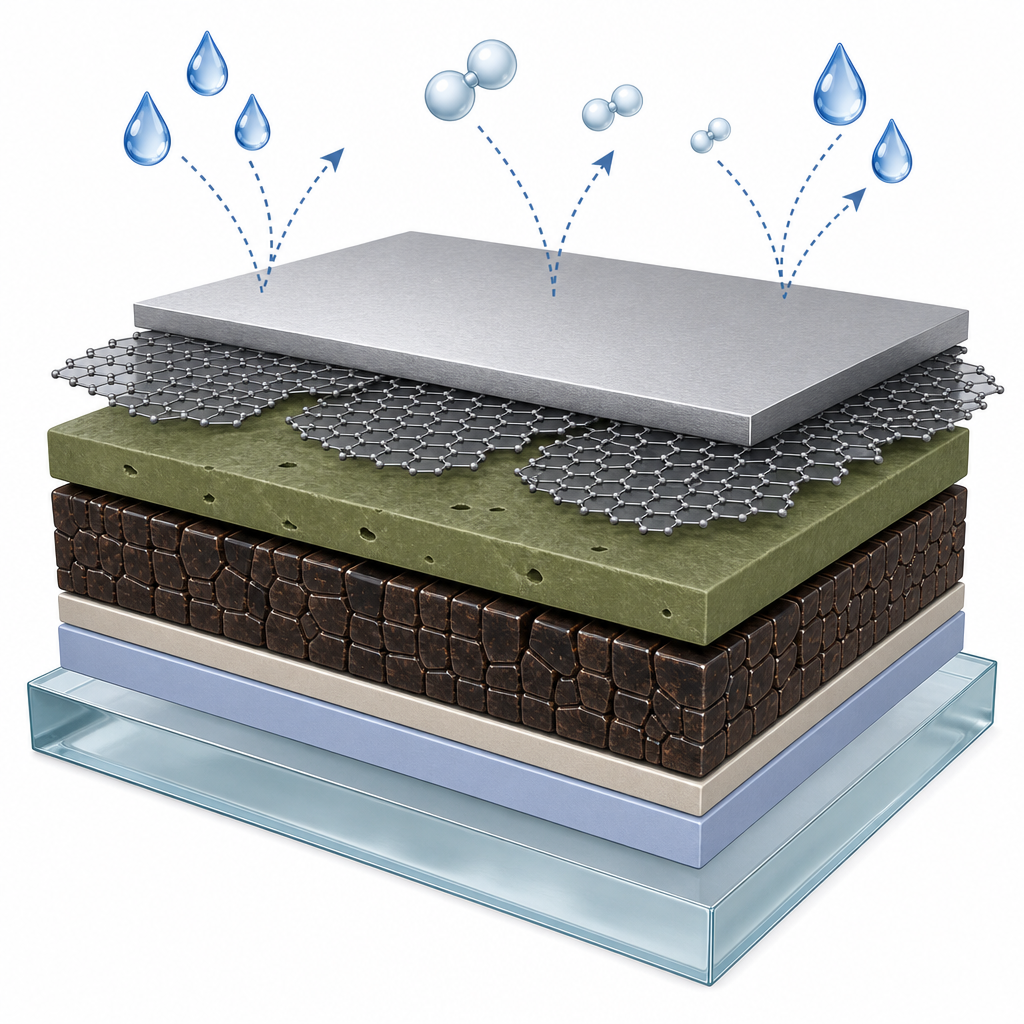
The central material was a single-layer graphene dispersion in water at 1.0 mg/ml purchased from ACS Material. To make it compatible with the perovskite stack, the aqueous dispersion was dried on a hotplate at 60 °C into graphene flakes, ground in a mortar, then re-dispersed in isopropanol and sonicated for 5 hours to obtain homogeneous solutions. Isopropanol was chosen because its low boiling point allows rapid evaporation and it does not corrode the perovskite or hole transport films. The dispersion was diluted to five working concentrations (0.6–10.0 mg/ml). In device fabrication, 100 µl of graphene dispersion was dropped onto the Spiro-OMeTAD surface and spin-coated at 1500 rpm for 60 s before thermal evaporation of the silver top electrode, giving an active area of 0.07 cm². The graphene layer was confirmed by transmission electron microscopy, which showed the characteristic sixfold diffraction symmetry and a 0.37 nm lattice spacing, and by Raman spectroscopy, where D and G bands at ~1340 and ~1580 cm⁻¹ scaled with concentration. ID/IG ratios of 1.19–1.36 indicated sonication-induced edge defects.
The reference cell without graphene delivered 9.5% PCE (Voc 0.974 V, Jsc 17.1 mA cm⁻², FF 56.82%). Adding graphene reduced efficiency in proportion to concentration: 0.6 mg/ml gave 7.9%, 0.8 mg/ml 7.4%, and 1.0 mg/ml 7.1%, while 5.0 and 10.0 mg/ml dropped to 5.3% and 3.9% respectively. FESEM showed thin, non-uniform coverage at low concentration and thicker, multilayer stacking at high concentration; the thicker layers increased opacity and reduced light absorption, particularly at 10.0 mg/ml. Electrochemical impedance spectroscopy showed the charge-transfer resistance Rct rising from around 400 Ω (reference and 0.6–1.0 mg/ml) to roughly 800 Ω at 5.0 mg/ml and 1000 Ω at 10.0 mg/ml, explaining the reduced Jsc from delayed hole mobility. Despite lower initial efficiency, the stability benefit was clear. Over 60 hours at ~85% humidity, the reference device PCE fell to 79% of its starting value, whereas graphene-protected devices retained far more performance: PCE diminished only about 49%, 30% and 41% at 0.6, 0.8 and 1.0 mg/ml, and the high-concentration 5.0 and 10.0 mg/ml layers sealed roughly 90% of the film. The authors identified 1.0 mg/ml as the best compromise between efficiency and durability.
This work points toward simple, scalable passivation strategies for perovskite photovoltaics, where extending operational lifetime is as important as raising efficiency. Graphene dispersion coatings could complement existing encapsulation approaches in flexible and rigid solar modules, and the spin-coating workflow is readily transferable to other moisture-sensitive optoelectronic devices. The authors note that further optimization of graphene surface morphology and layer thickness is needed to recover the photovoltaic performance lost at higher concentrations, suggesting improved coating methods and dispersion control as next steps. The findings are relevant to researchers in perovskite stability engineering, barrier coatings, and carbon-based interlayer design.
For researchers pursuing similar work, the single-layer graphene dispersion used here is available from ACS Material, alongside related graphene oxide, reduced graphene oxide and graphene dispersion products in the Graphene Series catalog. The paper shows both the promise and the practical limits of solution-processed graphene as a passivation layer: it reliably improves stability but requires careful concentration and morphology control to avoid sacrificing efficiency. That balanced, evidence-based picture is the most useful guidance for groups evaluating graphene interlayers in their own device stacks.How ACS Material products were used
- Single Layer Graphene Dispersion in Water (1.0 mg/ml) (Graphene Series) — “A single-layer graphene dispersion in water (1.0 mg/ml) was purchased from ACS Material.”
Product Performance in this Study
The ACS Material single-layer graphene dispersion was processed into flakes and re-dispersed in isopropanol to form a passivation layer in perovskite solar cells. It sealed the Spiro-OMeTAD/perovskite interface against moisture and oxygen, improving device stability by roughly 90% over 60 h, though high concentrations reduced power conversion efficiency.
Related product categories
Frequently asked questions
How does a graphene dispersion improve perovskite solar cell stability?
A spin-coated graphene layer sits between the Spiro-OMeTAD hole transport layer and the metal electrode, acting as a hydrophobic barrier that blocks moisture, oxygen and chemical ingress. In this study it sealed the Spiro-OMeTAD/perovskite interface, retaining roughly 90% of device performance over 60 hours of ambient exposure, compared with the reference cell that fell to 79%.
Why does higher graphene concentration reduce power conversion efficiency?
Higher graphene concentrations (5.0 and 10.0 mg/ml) produce thicker, multilayer stacked films that increase opacity and reduce light absorption in the active layer. They also raise the charge-transfer resistance from about 400 Ω to 800–1000 Ω, delaying hole mobility and lowering short-circuit current. Efficiency dropped from 9.5% in the reference to 3.9% at 10.0 mg/ml.
What concentration of graphene dispersion is best for perovskite passivation?
The authors identified 1.0 mg/ml as the optimal balance. It achieved 7.1% efficiency with meaningful stability improvement, while higher concentrations sacrificed too much efficiency and lower ones gave uneven coverage. The 1.0 mg/ml sample offered uniform particle size distribution and the best compromise between durability and photovoltaic performance.