-
Graphene Nanoplatelets for Plasmonic Pickering Emulsions - Queen's University Belfast, 2023
May 21, 2026 | ACS MATERIAL LLCZhang, Y., Ye, Z., Li, C., Chen, Q., Aljuhani, W., Huang, Y., Xu, X., Wu, C., Bell, S. E. J., & Xu, Y. (2023). General approach to surface-accessible plasmonic Pickering emulsions for SERS sensing and interfacial catalysis. *Nature Communications*. https://doi.org/10.1038/s41467-023-37001-1
Nature Communications · 2023
Queen's University Belfast researchers use ACS Material graphene nanopellets to build modifier-free plasmonic Pickering emulsions for SERS and catalysis.
About this research
Researchers at Queen's University Belfast, together with collaborators at East China University of Science & Technology and Fudan University, used graphene nanopellets purchased from ACS Material to demonstrate a general modifier-free approach for building plasmonic Pickering emulsions that retain surface-accessible metal nanoparticles. Published in Nature Communications (2023), the work introduces a co-assembly strategy in which a carbonaceous stabilizer such as graphene nanopellets or carbon nanotubes is paired with a second, unmodified population of plasmonic nanoparticles. The result is a stable emulsion droplet whose metal surfaces remain chemically clean, enabling both surface-enhanced Raman scattering (SERS) sensing and interfacial catalysis on the same platform.
Pickering emulsions stabilized by solid particles have long been used in food, cosmetics, and increasingly in catalysis and sensing, because they place active particles at the interface between two immiscible liquids. The conventional route to building these systems relies on molecular modifiers that adsorb to the nanoparticle surface to tune wettability and charge. Although effective for emulsion stability, modifier shells block the very surface needed for analyte adsorption, plasmonic field enhancement, or substrate access to catalytic sites. This trade-off has limited the use of Pickering emulsions in high-value applications such as trace SERS detection and clean-surface heterogeneous catalysis. A general way to keep nanoparticle surfaces accessible while still stabilizing curved oil-water interfaces has been missing.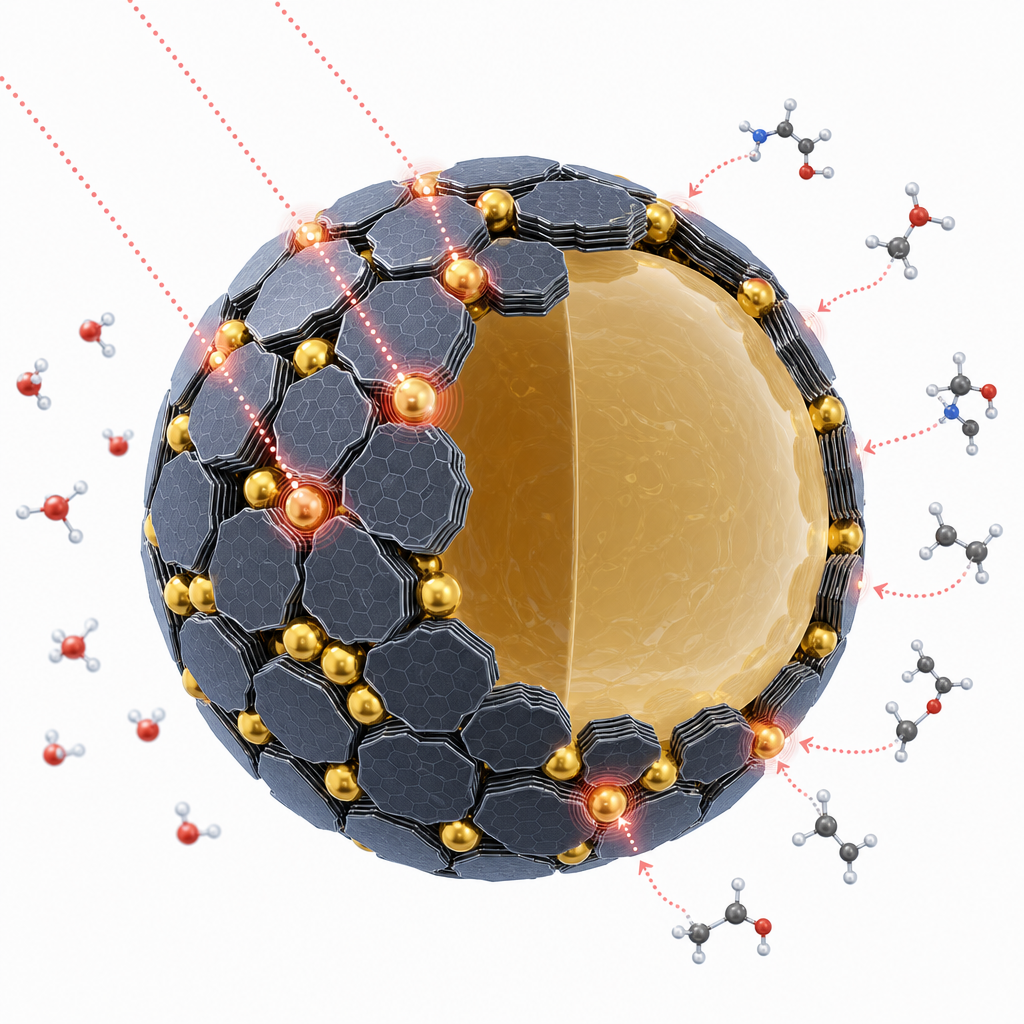
In the methodology, the graphene nanopellets from ACS Material were dispersed in dichloromethane by ultrasonication. Specifically, 10 mg of graphene nanopellets were sonicated in 10 mL of dichloromethane, and 4 mL of this suspension was vigorously shaken for 30 seconds with 0.5 mL of citrate-reduced gold colloid and 100 µL of 1 mM TBA+NO3- promoter solution. The tetrabutylammonium nitrate acts as a co-assembly promoter that screens charges and drives both the graphene stabilizer and the unmodified plasmonic AuNPs to the oil-water interface together. The graphene nanopellets fulfil the role normally played by silica or polymer particles, providing mechanical stabilization of the droplet, while leaving the citrate-capped gold nanoparticles free to adsorb analytes. The authors also extended the same protocol to carbon nanotubes, pentacene crystals, and CuO/Cu2O microparticles, confirming that the strategy is general.
The Pickering emulsions formed with graphene nanopellets and AuNPs were stable and produced clear droplets with densely packed interfacial particle layers, as confirmed by SEM-EDX, optical microscopy, TEM, and three-phase contact angle measurements. For SERS, the authors demonstrated detection of a broad analyte panel including crystal violet, thiram, aniline, naphthalene, biphenyl, pyrene, nicotine, and the anti-cancer drug panobinostat, using a 785 nm excitation laser at 10-15 mW with 20-30 s accumulation. Because the gold surfaces remained unmodified, analytes from both the aqueous and oil phases could adsorb directly onto the plasmonic hotspots at the curved interface, yielding strong and reproducible SERS spectra averaged from at least three independent droplets. For interfacial catalysis, SiO2NP-metal NP analogues of the system were used to perform the model reduction of 4-nitrophenol by NaBH4 at room temperature (~15 °C) without stirring. The Pickering emulsion catalysts with clean AgNP, AuNP, or PtNP surfaces showed efficient conversion monitored by UV-vis spectroscopy, whereas equivalent modifier-capped controls were essentially inactive, highlighting the importance of keeping the metal surfaces accessible.
The modifier-free Pickering emulsion concept opens several application pathways. In analytical chemistry, the emulsions provide a high-surface-area liquid-liquid SERS platform suitable for trace detection of pesticides, polycyclic aromatic hydrocarbons, and pharmaceuticals partitioned between aqueous and organic phases. In green chemistry, they function as biphasic microreactors that combine catalyst recyclability with intimate contact between substrates in immiscible solvents, useful for selective hydrogenation, dehalogenation, and pollutant remediation. The strategy also generalizes to organic nanocrystals, MXenes, oxides, and other 2D building blocks, expanding the design space for plasmonic, magnetic, and photocatalytic emulsion systems. Follow-up work pointed to by the authors includes extending the platform to enantioselective catalysis and to in-situ mechanistic SERS studies of interfacial reactions.
For researchers working on SERS substrates, 2D nanomaterial composites, or interfacial catalysis, the take-away is practical: thin-layer graphene nanoplatelets supplied by ACS Material can serve directly as a carbonaceous stabilizer for modifier-free plasmonic Pickering emulsions, without further chemical functionalization. ACS Material's graphene series, including industrial thin-layer graphene nanoplatelets and graphene dispersions, is available to research groups exploring similar liquid-liquid interfacial systems, plasmonic sensing, and heterogeneous catalysis at biphasic boundaries.How ACS Material products were used
- Graphene Nanoplatelets (Industrial Thin Layer) (Graphene Series) — “Graphene nanopellets were purchased from ACS Material®.”
Product Performance in this Study
Graphene nanopellets from ACS Material were dispersed in dichloromethane and used as a non-metallic, carbonaceous stabilizer for water-in-oil Pickering emulsions co-assembled with citrate-reduced Au nanoparticles. They successfully formed stable modifier-free plasmonic Pickering emulsions, demonstrating the generality of the approach across different 2D carbon stabilizers.
Related product categories
Frequently asked questions
How do graphene nanoplatelets stabilize Pickering emulsions without molecular modifiers?
Graphene nanoplatelets are intrinsically amphiphilic 2D sheets that adsorb strongly at the oil-water interface once electrostatic repulsion is screened by a co-assembly promoter such as TBA+NO3-. They form a dense mechanical layer that pins the curved meniscus while allowing a second population of unmodified plasmonic nanoparticles to co-locate at the interface, providing emulsion stability without coating the active metal surfaces.
Why are surface-accessible plasmonic nanoparticles important for SERS sensing?
SERS relies on analyte molecules sitting within nanometers of a plasmonic hotspot to experience the enhanced electromagnetic field. Conventional Pickering emulsions use modifier shells that occupy adsorption sites and block hotspots, suppressing signals from target analytes. Keeping the metal surface bare lets pollutants, drugs, and other trace molecules adsorb directly, producing strong and reproducible Raman spectra at trace concentrations.
What types of analytes can be detected with graphene-stabilized plasmonic Pickering emulsions?
The Queen's University Belfast team demonstrated detection of crystal violet, thiram, aniline, naphthalene, biphenyl, pyrene, nicotine, and the anti-cancer drug panobinostat. Because the emulsion exposes a clean gold surface at the curved oil-water interface, both water-soluble and oil-soluble analytes can adsorb directly to plasmonic hotspots, making the platform broadly applicable to pesticides, polycyclic aromatic hydrocarbons, pharmaceuticals, and environmental contaminants.