-
Graphene Oxide for Antibiotic Removal — University of Florida, 2014
Jun 01, 2026 | ACS MATERIAL LLCChen, H., Gao, B., & Li, H. (2015). Removal of sulfamethoxazole and ciprofloxacin from aqueous solutions by graphene oxide. *Journal of Hazardous Materials*.
Journal of Hazardous Materials · 2015
Single-layer graphene oxide from ACS Material adsorbs up to 379 mg/g ciprofloxacin and 240 mg/g sulfamethoxazole from water under varied pH and ionic strength.
About this research
Researchers at the University of Florida, working with collaborators at Michigan State University, used single-layer graphene oxide (GO) supplied by ACS Material (Medford, MA) to remove two widely detected antibiotics — sulfamethoxazole (SMX) and ciprofloxacin (CIP) — from aqueous solution, reaching maximum sorption capacities of 240 mg/g and 379 mg/g, respectively. Published in the Journal of Hazardous Materials in 2014, the study by Chen, Gao, and Li also identifies the dominant sorption mechanisms, the influence of solution chemistry (pH, NaCl, CaCl2), and how sorbed antibiotic molecules destabilize the GO suspension to enable cost-effective separation after treatment.
The broader research context is the growing concern over antibiotic residues in surface and waste waters. SMX and CIP are heavily consumed in human medicine and veterinary practice, are poorly metabolized, and resist environmental degradation, which leads to chronic exposure of microbial communities and ecosystems and contributes to antibiotic resistance pressure. Conventional carbonaceous adsorbents work, but the active-site density, dispersibility, and tunable surface chemistry of GO offer a more attractive platform. The paper addresses a clear gap: although GO has been studied for dyes and aromatic pollutants, only a handful of systematic studies have examined its behavior toward pharmaceutical antibiotics in environmentally realistic aqueous matrices that vary in pH and ionic strength.
The ACS Material single-layer GO is the central material of the study. According to the manufacturer's specifications cited in the Materials section, the product is prepared by the Hummers method, has a lateral flake size of 1–5 µm, and a thickness of 0.8–1.2 nm, consistent with single-layer sheets bearing hydroxyl, carboxyl, and epoxy functionalities. The authors prepared a 200 mg/L GO stock suspension in deionized water by 2 h of sonication and stored it at 4 °C in darkness; previous work cited in the paper confirms that GO from this source remains colloidally stable. FTIR characterization on a Bruker spectrometer verified the oxygen-rich surface chemistry. The GO was used as the adsorbent in batch sorption kinetics and isotherm experiments in 15 mL polytetrafluoroethylene centrifuge tubes, with antibiotic concentrations of 20 mg/L (CIP) or 40 mg/L (SMX) at pH 5, and across a range of pH (2–9) and ionic strengths (NaCl and CaCl2 backgrounds).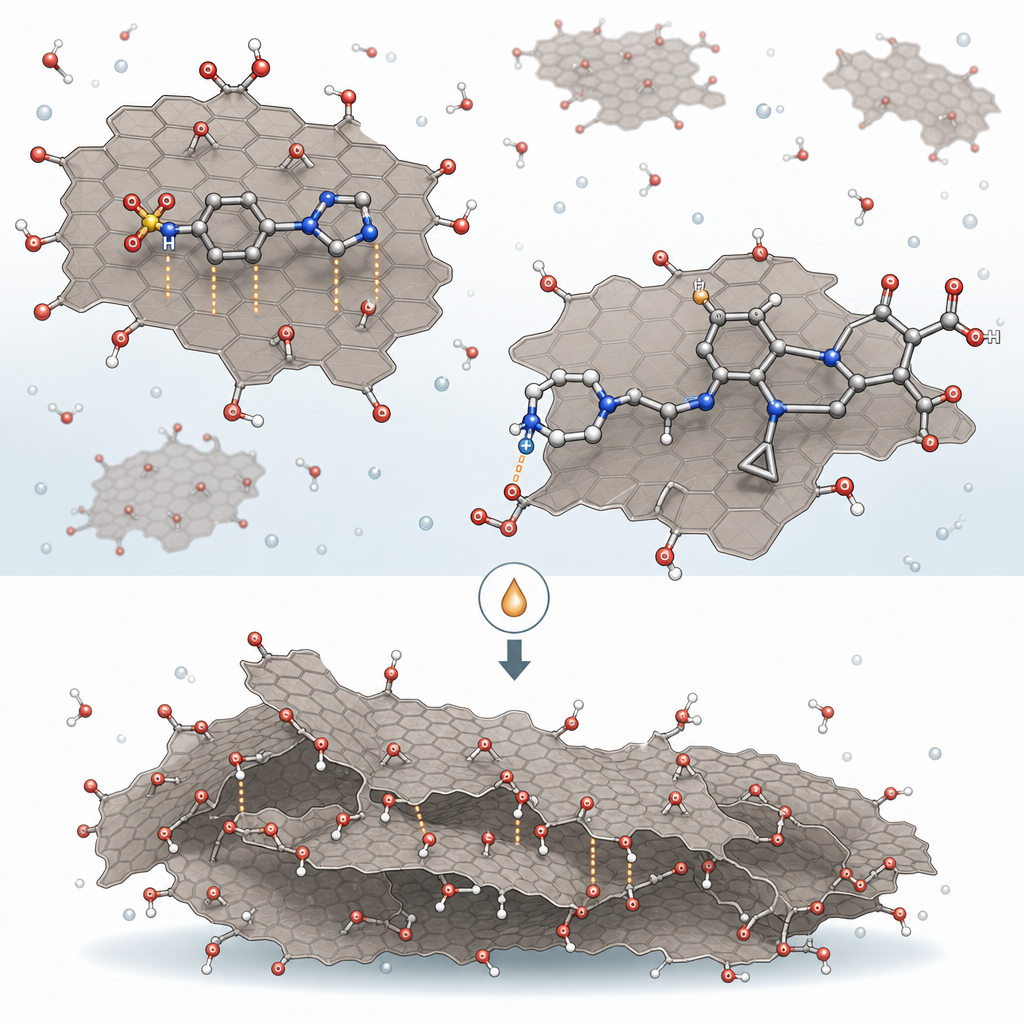 The quantitative results highlight how effective and how chemistry-dependent GO sorption is. Maximum sorption capacities reached 379 mg/g for CIP and 240 mg/g for SMX, placing this GO grade among the stronger sorbents reported for fluoroquinolone and sulfonamide antibiotics. Mechanistic interpretation indicates that CIP sorption is dominated by electrostatic attraction between the protonated piperazinyl group of CIP and the negatively charged carboxyl groups on GO, whereas SMX sorption is dominated by π–π electron donor–acceptor (EDA) interactions on the basal planes of the GO sheets. Solution pH had a strong, asymmetric effect: at pH 2, sorption of both antibiotics decreased, and at pH 9 GO completely lost SMX sorption but still strongly adsorbed CIP. Increasing ionic strength reduced CIP sorption markedly, with CaCl2 more effective than NaCl even at low concentrations — consistent with charge screening and Ca2+ bridging of GO carboxylates. SMX sorption was less sensitive to ionic strength. Importantly, at pH 2 the sorption of CIP destabilized the GO colloid, causing aggregation into settleable flocs — a useful behavior because it points to a built-in separation pathway after treatment.
These findings have direct applications in water and wastewater remediation. GO is positioned as a high-capacity, tunable adsorbent for pharmaceutical micro-pollutants, with operating windows definable by pH and counter-ion choice. The pH-triggered aggregation of spent GO suggests a low-cost recovery route that avoids ultrafiltration or centrifugation steps. The mechanistic split between electrostatic (CIP) and π–EDA (SMX) sorption gives engineers a framework for predicting GO performance against other ionizable versus aromatic micro-pollutants, including additional fluoroquinolones, sulfonamides, tetracyclines, and endocrine disruptors. Future work pointed to by the paper includes regeneration cycles, behavior in real water matrices containing natural organic matter, and composite forms (GO foams or beads) that retain capacity while easing handling.
For researchers working on environmental remediation, this paper is a strong reference point for benchmarking adsorbent performance against antibiotics in water. The single-layer graphene oxide used here is part of the Graphene Series available from ACS Material, where Hummers-method GO with similar flake size and layer thickness is offered in powder, dispersion, and large-size formats for adsorption, membrane, and composite research. Selecting a well-characterized GO with documented lateral dimensions and oxidation level helps make sorption studies reproducible and comparable across laboratories.How ACS Material products were used
- Single Layer Graphene Oxide Powder (Hummers Method) (Graphene Series) — “Single-layer GO (ACS Material, Medford, MA), as reported by the manufactures, was prepared from the Hummers method with 1–5 µm lateral diameter and 0.8–1.2 nm thickness.”
Product Performance in this StudyThe single-layer graphene oxide from ACS Material served as the adsorbent throughout the entire study, delivering maximum sorption capacities of 379 mg/g for ciprofloxacin and 240 mg/g for sulfamethoxazole. Its uniform 1–5 µm flakes and abundant oxygen functional groups enabled the strong, mechanism-rich sorption behavior the paper reports.
Related product categories
Frequently asked questionsHow much ciprofloxacin can graphene oxide adsorb from water?
In this 2014 Journal of Hazardous Materials study, single-layer graphene oxide prepared by the Hummers method reached a maximum ciprofloxacin sorption capacity of 379 mg/g at pH 5. The interaction is dominated by electrostatic attraction between protonated ciprofloxacin and negatively charged carboxyl groups on the GO surface, making GO one of the higher-capacity adsorbents reported for fluoroquinolone antibiotics in aqueous solution.
Why does solution pH affect graphene oxide sorption of antibiotics so strongly?
Both graphene oxide and the antibiotics are ionizable, so pH controls their charge states. At pH 2, GO carboxyl groups are protonated, reducing electrostatic attraction and lowering uptake of both ciprofloxacin and sulfamethoxazole. At pH 9, sulfamethoxazole becomes anionic and is repelled by negatively charged GO, while ciprofloxacin still binds via π-EDA and partial electrostatic interactions, so GO retains strong sorption for CIP only.
What type of graphene oxide is best for water-treatment sorption studies?
Single-layer graphene oxide prepared by the Hummers method, with lateral flake sizes of roughly 1–5 µm and thicknesses below 1.5 nm, gives the high oxygen functional group density and accessible basal-plane area needed for adsorption work. The paper used ACS Material single-layer GO with 1–5 µm flakes and 0.8–1.2 nm thickness, which provided stable aqueous dispersions and reproducible sorption isotherms.