-
Graphene Oxide for Dye Wastewater Electrochemistry — Vinča Institute of Nuclear Sciences, 2019
Jul 08, 2026 | ACS MATERIAL LLCStanković, D., Ognjanović, M., & Espinosa, A. (2019). Iron oxide nanoflower–based screen print electrode for enhancement removal of organic dye using electrochemical approach. *Electrocatalysis*.
Electrocatalysis · 2019
Vinča Institute researchers used ACS Material graphene oxide to build an IONF@RGO screen-printed electrode achieving 99% Reactive Blue 52 removal in 30 minutes.
About this research
Researchers at the Vinča Institute of Nuclear Sciences (University of Belgrade) used graphene oxide supplied by ACS Material to fabricate an iron oxide nanoflower / reduced graphene oxide (IONF@RGO) coating on a screen-printed carbon electrode (SPCE) that removed 99% of the azo dye Reactive Blue 52 in only 30 minutes at a 3 V working potential. Published in Electrocatalysis (2019), this is the first reported use of disposable screen-printed electrodes as a support for active nanocomposite layers in the electrochemical degradation of an organic dye. The composite combines the high conductivity of microwave-reduced graphene oxide with the magnetically active, high-surface-area iron oxide nanoflowers, producing a low-cost, robust electrode for wastewater treatment.
Why this research matters: the textile, printing, and dyeing industries discharge roughly 280,000 tons of dye per year together with very large volumes of wastewater, and more than 10% of the dye used in production ends up in effluent. Reactive Blue 52 (Drimaren Blue X-3LR) is a sulfonated azo dye that is intensely colored, highly water-soluble, and resistant to light and conventional treatment, which makes it persistent in aquatic environments. Photodegradation, coagulation, and Fenton-type processes have all been explored, but electrochemical treatment is attractive because it can be operated at ambient temperature with simple equipment. The principal limitation is electrode performance: cost, stability, conductivity, and active surface area. Combining carbon nanomaterials with metal-oxide nanostructures on a disposable, mass-producible substrate offers a credible pathway to scalable dye removal.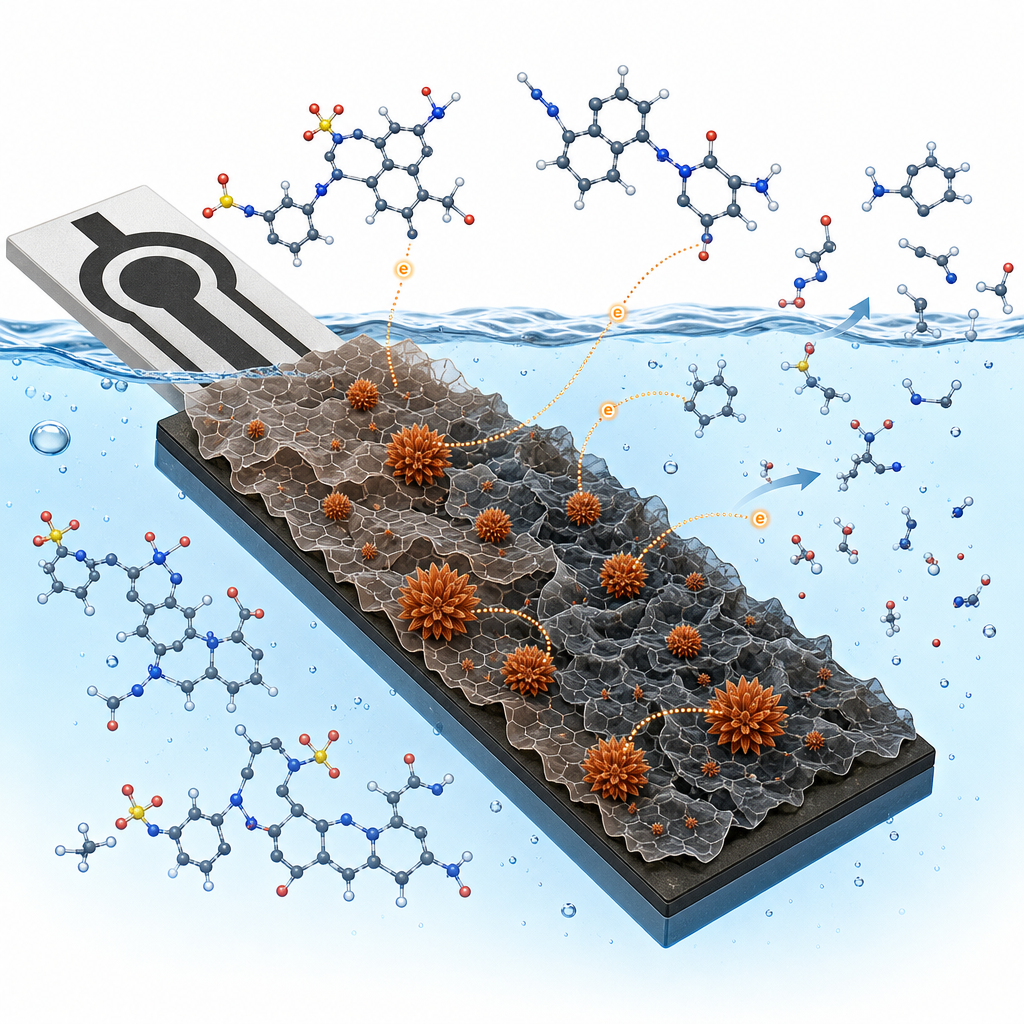
How the ACS Material product was used: the authors state in the Chemicals section that "Graphene oxide was supplied by ACS Material." This commercial GO was used as the carbon precursor for the active layer. Iron oxide nanoflowers were first synthesized by polyol-mediated reduction of FeCl3 in ethylene glycol with PVP40 and sodium acetate at 200 °C for 8 h. The IONFs were then mixed with the ACS Material GO suspension in ethylene glycol, sonicated for one hour, and processed in a microwave synthesis reactor at 160 °C for 10 min, which simultaneously reduced the GO to RGO and decorated it with the iron oxide nanoflowers. The dried IONF@RGO composite (30 µL drop-cast and dried for 3 h) was deposited onto carbon-ink screen-printed electrodes with a 100 mm² active area. A pure-RGO control was prepared by direct microwave reduction of the same ACS Material GO for benchmarking. The role of the GO is therefore central: it provides the dispersible, oxygenated carbon scaffold that, after microwave reduction, becomes the conductive backbone hosting the catalytic IONFs.
Key results: electrochemical impedance spectroscopy confirmed that the IONF@RGO layer significantly reduced charge-transfer resistance compared with the bare SPCE, indicating a synergistic effect between the reduced graphene oxide and the iron oxide nanoflowers. Cyclic voltammetry showed a substantial increase in electrochemically active surface area on the modified electrode. Under optimized galvanostatic conditions (3 V DC, 0.1 M KCl supporting electrolyte, 30 mL of 30 mg L⁻¹ Reactive Blue 52, magnetic stirring), the IONF@RGO/SPCE achieved 99% color removal in 30 minutes, monitored by UV-Vis at λmax = 615 nm. After one hour of treatment, chemical oxygen demand (COD) decreased by more than 40%, total organic carbon (TOC) dropped by about 20%, and the BOD5/COD ratio increased significantly, meaning that the residual organics were converted from recalcitrant azo structures to more biodegradable fragments — an important outcome for downstream biological treatment. Stability tests showed that the IONF@RGO/SPCE retained essentially the same removal efficiency over 50 consecutive cycles, demonstrating that the composite coating adheres well and that the iron oxide phase resists dissolution under operating conditions. The combination of fast kinetics, high decolorization, partial mineralization, and improved biodegradability sets this platform apart from many GO-only or metal-oxide-only electrochemical treatments reported in the literature.
Applications and outlook: the IONF@RGO/SPCE concept is directly relevant to textile, printing, and dyeing wastewater treatment, point-of-use decolorization units, and pretreatment stages that feed into biological reactors where improved BOD5/COD is critical. The same screen-printed electrode platform could be extended to other azo and reactive dyes, pharmaceuticals, and persistent aromatic pollutants, and it can in principle be coupled with photo-assisted electro-Fenton processes for further mineralization. Because screen-printed electrodes are produced by thick-film technology, the approach is compatible with large-scale, low-cost manufacturing and with disposable use in field-deployable water quality systems. Follow-up work pointed to in the paper includes pollutant-specific optimization, durability testing in real industrial effluents, and exploring alternative iron oxide morphologies or doped graphene scaffolds.
Why this matters for researchers: the study illustrates how a commercially available graphene oxide, used as a precursor for in-situ microwave reduction, can underpin a reproducible electrocatalytic composite suitable for environmental electrochemistry. Researchers working on dye degradation, electro-Fenton systems, or RGO-supported metal oxide catalysts can source the same starting material — graphene oxide from ACS Material — from the Graphene Series catalog. Consistent GO quality is important for reproducible reduction and uniform decoration with nanoparticles, both of which directly affect electrode conductivity, active surface area, and long-term stability in wastewater applications.How ACS Material products were used
- Graphene Oxide (Graphene Series) — “Graphene oxide was supplied by ACS Material”
Product Performance in this StudyThe ACS Material graphene oxide served as the precursor for microwave-assisted reduction to RGO and subsequent decoration with iron oxide nanoflowers, forming the active IONF@RGO coating on the screen-printed electrode. The resulting composite delivered 99% color removal of Reactive Blue 52 and stable performance over 50 cycles, confirming the GO precursor was well suited for producing a conductive, high-surface-area electrocatalytic support.
Related product categories
Frequently asked questionsWhat is graphene oxide used for in electrochemical dye degradation research?
Graphene oxide is used as a dispersible, oxygen-rich carbon precursor that can be reduced in situ to highly conductive reduced graphene oxide (RGO) directly on an electrode. In this study, ACS Material graphene oxide was microwave-reduced together with iron oxide nanoflowers to form a composite coating that lowered charge-transfer resistance, increased electrochemically active surface area, and enabled 99% removal of Reactive Blue 52 dye within 30 minutes.
Why combine iron oxide nanoflowers with reduced graphene oxide on a screen-printed electrode?
Reduced graphene oxide alone has high conductivity but limited catalytic activity, while iron oxide nanoflowers provide abundant catalytic sites and large surface area but lower conductivity. Combining them on a screen-printed carbon electrode produces a synergistic interface: RGO transports electrons efficiently while IONFs drive the dye oxidation. EIS and CV in this paper confirmed reduced resistivity and significantly increased active surface area for the composite electrode.
How long does an IONF@RGO screen-printed electrode last during dye removal cycling?
In this work, the IONF@RGO modified screen-printed carbon electrode (IONF@RGO/SPCE) retained essentially unchanged Reactive Blue 52 removal efficiency over 50 consecutive cycles at 3 V in 0.1 M KCl. The composite coating remained adherent and electrocatalytically active, indicating that the iron oxide phase and the reduced graphene oxide scaffold both resist degradation under the applied galvanostatic conditions used for dye decolorization.