-
Graphene Oxide for GO-TiO2 Photocatalysis - INL, 2022
Jul 02, 2026 | ACS MATERIAL LLCDíez, A. M. et al. (2022). GO-TiO2 as a Highly Performant Photocatalyst Maximized by Proper Parameters Selection. *International Journal of Environmental Research and Public Health*. https://doi.org/10.3390/ijerph191911874
International Iberian Nanotechnology Laboratory · International Journal of Environmental Research and Public Health · 2022
Researchers at the International Iberian Nanotechnology Laboratory used ACS Material graphene oxide to build a dual UVA-visible GO-TiO2 photocatalyst reaching 100% drug degradation.
About this research
Researchers at the International Iberian Nanotechnology Laboratory (Braga, Portugal), working with Universidade de Vigo, used graphene oxide (>99%) purchased from ACS Material to synthesize a GO-TiO2 photocatalyst that degraded 100% of the model drug methylthioninium chloride (MC) under optimized conditions at an energy consumption of only 0.12 Wh/mg. By coupling graphene oxide to commercial TiO2 (P25), the team produced a material with a markedly reduced band gap, higher porosity, and improved electron mobility. The work emphasizes that careful parameter selection—catalyst dosage, reactor geometry, lamp distance, and oxidant addition—is as important as the catalyst chemistry itself in achieving real, competitive photodegradation performance.
Photocatalysis is an attractive route for wastewater treatment because it can degrade pollutants non-selectively and can operate under sunlight. However, plain TiO2 is limited by activation only under UVA light and by insufficient adsorption capacity, which restricts its scale-up. To overcome these drawbacks, dopants and porous additives have been explored, but many strategies rely on costly elements (e.g., Ag, Bi) or energy-intensive high-temperature syntheses. Graphene oxide offers an inexpensive way to add porosity, enhance charge transfer, and shift activity toward visible wavelengths. This paper addresses the open challenge of making such GO-TiO2 photocatalysts efficient enough to compete with cheaper alternatives like adsorption, while also tackling under-studied issues such as catalyst reusability and validation in real municipal wastewater—long-tail concerns for environmental engineering practitioners.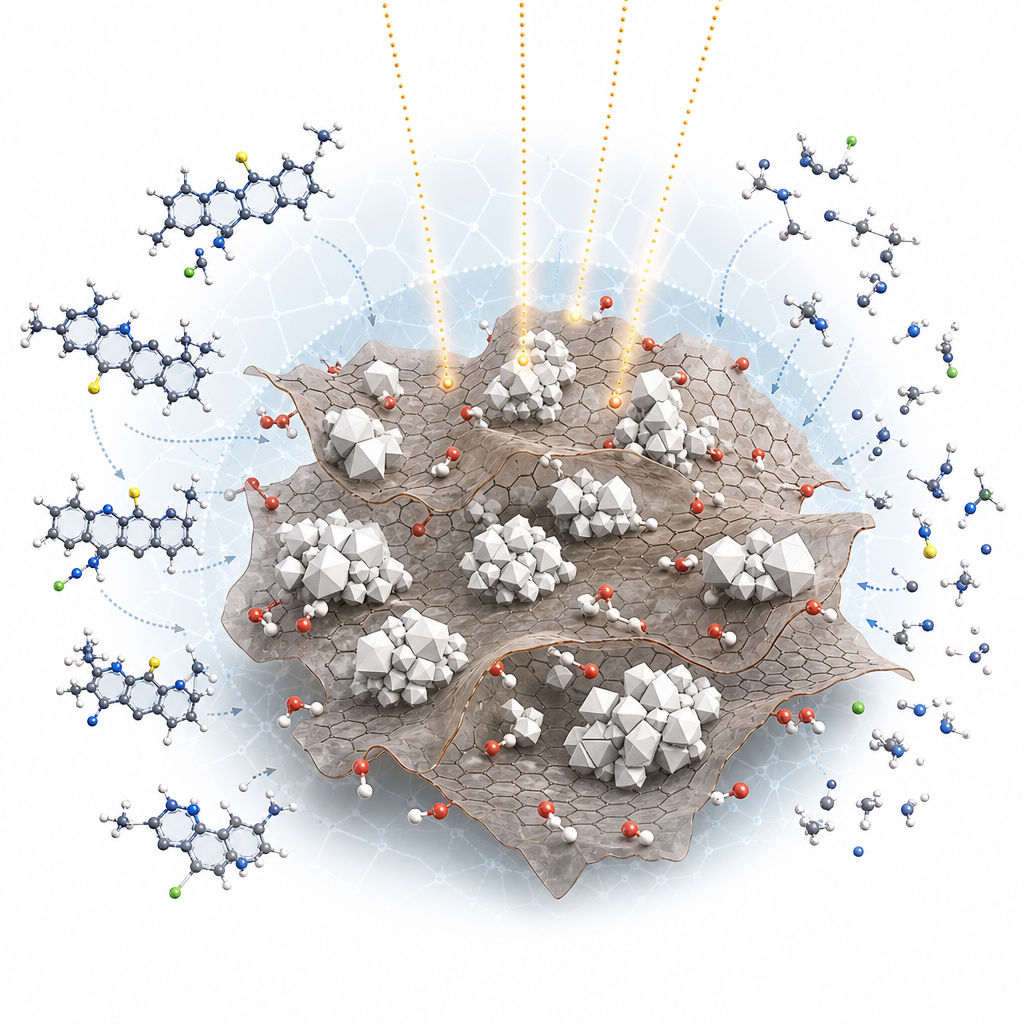
The ACS Material graphene oxide served as the carbon scaffold around which TiO2 was grown. In the synthesis, GO was dispersed at 10 mg/mL in 10 mL of ethanol; 0.1 M (NH4)2TiF6 and 0.3 M H3BO3 were added dropwise under vigorous stirring for 1 h. The mixture was treated hydrothermally at 60 °C for 2 h, then heated in a furnace at 200 °C for 2 h to yield 1GO-TiO2. The GO dosage was systematically varied to produce half-dose (½GO-TiO2) and triple-dose (3GO-TiO2) versions. The half-dose formulation, simply called GO-TiO2, gave the best photocatalytic performance because excessive GO led to over-adsorption of MC in the porous structure, blocking active sites. This relatively mild, low-temperature procedure avoids the dangerous reagents (e.g., NaBH4) and high calcination temperatures used in competing GO-TiO2 routes, making the ACS Material graphene oxide central to a simpler, cheaper synthesis.
Characterization confirmed the advantages imparted by graphene oxide. XRD showed TiO2 (anatase + rutile) remained stable through GO addition, and FTIR confirmed successful coupling via C=C and C=O bonds. The band gap dropped from 3.2 eV for TiO2 to 2.2 eV for GO-TiO2, enabling activation under visible as well as UVA light. N2 isotherms revealed a 19% surface-area increase, and the point of zero charge shifted from 6.55 (TiO2) to 5.19 (GO-TiO2), promoting electrostatic attraction of the positively charged MC. Electrochemical impedance spectroscopy showed a roughly four-fold smaller layer resistance (parallel resistance 17.5 kΩ vs 75.2 kΩ) and a more than doubled double-layer capacitance (Cdl 28.9 vs 14.5 mF cm−2), indicating higher electron mobility and electroactive surface area. Under UVA, GO-TiO2 achieved 100% MC degradation in 30 min versus a 30% performance gain over commercial TiO2, while under simulated solar radiation the degradation roughly doubled relative to TiO2. Reactor optimization mattered: placing the UVA lamp at 2 cm rather than 6 cm improved degradation by more than 30%, and increasing the irradiated surface from 19.6 to 78.5 cm² raised degradation by about 40%. Reusability fell from 100% (cycle 1) to 38% (cycle 3), but adding 0.66 mg/mL H2O2 kept efficiency constant across three cycles. The headline energy consumption of 0.12 Wh/mg outperformed all comparison studies in the literature table.
This research enables more practical, lower-cost photocatalytic wastewater treatment. The dual UVA-visible activity means the catalyst can use daylight as well as low-power lamps, broadening operating windows for treatment plants. Validation with real physically and biologically treated municipal effluents (where degradation dropped 27–38% due to scavenging organic and inorganic matter) provides realistic performance expectations rarely reported elsewhere. The demonstrated reusability with H2O2 assistance points toward reduced waste disposal and simpler plant operation. The authors note that the efficient reactor geometry combined with the GO-TiO2 catalyst opens a path for further studies, including scale-up, treatment of other emerging contaminants and pharmaceuticals, and optimization of oxidant dosing for sustained multi-cycle operation in environmental remediation and water-purification settings.
For researchers working on photocatalysis, adsorption-coupled degradation, or 2D-carbon composites, this study illustrates how high-purity graphene oxide can lower a semiconductor's band gap and enhance charge transport with a straightforward synthesis. The graphene oxide used here was supplied by ACS Material, whose Graphene Series catalog includes graphene oxide grades suitable for similar photocatalyst and nanocomposite work. The results stand on documented metrics—band gap, surface area, impedance, and energy consumption—rather than promotional claims, which is the kind of reproducible evidence that supports confident materials selection for water-treatment and environmental research.How ACS Material products were used
- Graphene Oxide (GO, >99%) (Graphene Series) — “GO (>99%) was bought from ACS Material.”
Product Performance in this StudyThe ACS Material graphene oxide was coupled with TiO2 to form the GO-TiO2 photocatalyst, which lowered the band gap from 3.2 to 2.2 eV, increased surface area by 19%, and roughly doubled the double-layer capacitance, enabling 100% methylthioninium chloride degradation and superior energy efficiency.
Related product categories
Frequently asked questionsHow does graphene oxide improve TiO2 photocatalytic performance?
Coupling graphene oxide with TiO2 lowered the band gap from 3.2 to 2.2 eV, increased surface area by about 19%, and reduced charge-transfer resistance roughly four-fold. These changes enhance electron mobility, suppress electron-hole recombination, and add porosity, allowing the GO-TiO2 catalyst to degrade the model drug under both UVA and visible light far more efficiently than plain TiO2.
What is graphene oxide used for in water treatment photocatalysts?
In this study graphene oxide acts as a conductive, porous scaffold that couples with TiO2 to form a dual UVA-visible photocatalyst for degrading pharmaceutical pollutants such as methylthioninium chloride. It boosts adsorption, shifts activity into the visible range, and improves charge transport, helping the composite reach 100% degradation at a low energy consumption of 0.12 Wh/mg.
Why does graphene oxide dosage matter for GO-TiO2 catalyst design?
Too much graphene oxide causes excessive adsorption of the pollutant within the porous structure, blocking active sites and lowering photocatalytic activity. The half-dose formulation gave only 15% dark adsorption but reached 100% degradation, while the triple-dose version adsorbed 67% yet reached only 83% degradation. Optimal GO dosage balances adsorption and active-site availability.