-
Graphene Oxide for Li-Metal Plating Anodes - Rensselaer Polytechnic Institute, 2014
May 28, 2026 | ACS MATERIAL LLCMukherjee, R. et al. (2014). Defect-Induced plating of lithium metal within porous graphene networks. *Nature Communications*. https://doi.org/10.1038/ncomms4710
Nature Communications · 2014
Rensselaer researchers used ACS Material graphene oxide to build porous graphene networks that cage plated lithium metal, delivering 850+ mAh/g over 1,000 cycles.
About this research
Researchers at Rensselaer Polytechnic Institute, working with collaborators at Brown University and the University of Pennsylvania, used graphene oxide (GO) dispersion from ACS Material as the sole precursor to build porous graphene networks (PGN) that enable defect-induced plating of lithium metal, achieving stable specific capacities above 850 mAh g⁻¹ over 1,000 charge/discharge cycles. Published in Nature Communications (2014) by Mukherjee, Thomas, Datta, Koratkar and co-workers, the study demonstrates that divacancy defects in thermally reduced GO seed reversible lithium metal plating inside a porous graphene cage, suppressing dendrites and enabling an all-carbon full cell where PGN serves as both anode and lithiated-PGN cathode.
Why this research matters: Lithium metal offers a theoretical capacity of 3,842 mAh g⁻¹, roughly an order of magnitude higher than graphite (372 mAh g⁻¹) or conventional LiCoO₂ cathodes (~140 mAh g⁻¹ practical). Yet metallic lithium has been shelved in commercial cells for decades because dendritic projections pierce separators and trigger short circuits. The battery community has therefore relied on layered oxide and phospho-olivine cathodes, which trade safety for energy density. A scaffold that can host plated lithium without dendrite escape would unlock substantially higher energy densities for portable electronics, electric vehicles and grid storage. The PGN concept—storing Li metal inside a defect-rich, nanoporous carbon sponge—offers a route to that goal while also eliminating cobalt, a contested critical mineral, from the electrode formulation.
How the ACS Material product was used: The authors explicitly state in Methods that "GO dispersed in de-ionized water (ACS materials—10 mg ml⁻¹) was diluted to concentrations of ~1 mg ml⁻¹ and sonicated in a Bransonic 1510MT ultrasonic cleaner for ~1 h to ensure homogenous dispersion and centrifuged… at ~6,000 r.p.m. for ~30 min to ensure removal of heavier aggregates." The supernatant was vacuum-filtered through Whatman Anodisc membranes (0.2 µm pores, 47 mm diameter) to yield free-standing GO papers 10–20 µm thick; thicker 80–100 µm films were grown by electrodeposition at ~10 V DC. Free-standing GO paper was then thermally shocked at 700 °C in flowing argon (~500 sccm) for 45–75 s, depending on thickness, producing a binder-free PGN with pores from a few nanometres to a few hundred nanometres and a high density of divacancy defects. A flash-reduction route using a 320 Ws Xenon studio flash was also developed to accelerate cathode fabrication. The ACS Material GO dispersion therefore served as the central precursor for every electrode in the study.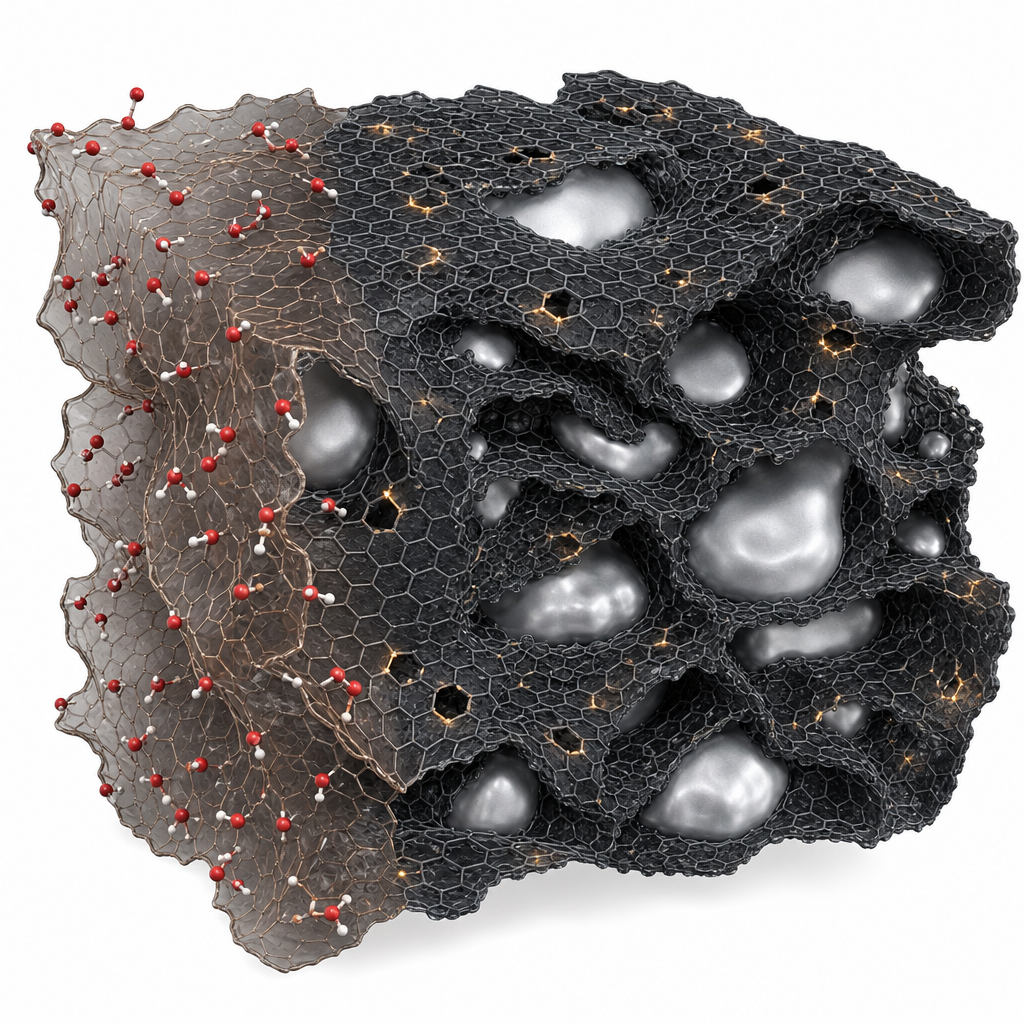
Key results: PGN anodes cycled between 3 V and 0.03 V at 1 C (~0.37 A g⁻¹) reached an initial capacity of ~600 mAh g⁻¹ and climbed steadily over 300 cycles to a stable ~915 mAh g⁻¹, more than 2.5× the theoretical capacity of graphite, with average coulombic efficiency of ~99% sustained out to 1,000 cycles. XPS of fully lithiated electrodes showed a strong metallic Li peak that disappeared on delithiation, while XRD revealed Li ⟨110⟩ and ⟨101⟩ metal reflections together with a Li₃C₈ peak—an unusually Li-rich intercalation state never previously reported. Density functional theory calculations on graphene supercells with divacancy concentrations from 6.25% to 25% confirmed that defects act as preferred Li adsorption sites; 25% DV defects gave a maximum capacity of ~1,675 mAh g⁻¹ and stabilized Li₃C₈ at 0.84 eV vs Li/Li⁺. Cross-sectional SEM showed pores filled with Li metal after lithiation and reopened after delithiation, with no dendrites visible even after 1,000 cycles. As a cathode, lithiated-PGN delivered >850 mAh g⁻¹ stable over 100 cycles at ~300 mA g⁻¹, corresponding to ~637 Wh kg⁻¹—well above LiCoO₂, LiFePO₄ and LiMn₂O₄. A 20 mAh pouch cell with PGN anode and Li-PGN cathode powered an LED, using mass loadings of ~2.5 mg cm⁻² within industrial norms.
Applications and outlook: The work points toward all-carbon lithium-ion batteries that avoid Co, Ni and Mn, simplifying the supply chain and end-of-life recycling. The defect-engineering strategy is relevant to next-generation high-energy anodes, Li-S and Li-air systems that require dendrite-free Li hosting, and to flexible or wearable cells where lightweight binder-free carbon electrodes are advantageous. Controlling thermal-reduction time to tune divacancy density (as shown by Raman ID/IG analysis) gives a practical handle for matching electrode capacity to cell design. The authors also note that flash reduction can shorten cathode pre-lithiation from hundreds of cycles to fewer than ten, improving manufacturing feasibility.
Why this matters for researchers: The graphene oxide aqueous dispersion central to this study is part of ACS Material's Graphene Series catalog, available to battery and 2D-materials groups pursuing similar defect-engineered carbon electrodes, free-standing GO papers, or thermally reduced graphene foams. Because the PGN performance depends sensitively on GO purity, flake size and oxidation state, sourcing a consistent commercial dispersion can accelerate reproduction and scale-up of the defect-induced plating chemistry reported here.How ACS Material products were used
- Graphene Oxide (GO) Dispersion in De-ionized Water (10 mg/mL) (Graphene Series) — “GO dispersed in de-ionized water (ACS materials—10 mg ml−1) was diluted to concentrations of ~1 mg ml−1 and sonicated...”
Product Performance in this StudyThe ACS Material graphene oxide aqueous dispersion was the sole precursor for the porous graphene network (PGN) electrodes. After dilution, vacuum filtration, and thermal-shock reduction, it produced free-standing, defect-rich graphene paper that enabled defect-induced Li metal plating with capacities above 850 mAh g⁻¹ and stable cycling over 1,000 cycles.
Related product categories
Frequently asked questionsHow does defect engineering in graphene enable lithium metal plating without dendrites?
Divacancy defects in thermally reduced graphene oxide act as high-affinity adsorption sites for lithium, forming Li-rich intercalation states such as Li3C8 that locally concentrate charge and seed reversible lithium metal plating. Because plating occurs inside nanopores (tens of nanometres), any growing lithium is physically constrained by pore walls, preventing dendrites from protruding into the electrolyte even after 1,000 charge/discharge cycles.
What capacity can porous graphene network electrodes achieve in lithium-ion batteries?
Porous graphene network (PGN) anodes made from ACS Material graphene oxide reached a stable ~915 mAh g⁻¹ at 1 C, about 2.5 times the theoretical capacity of graphite. As cathodes pre-lithiated with metallic Li, the same PGN structure delivered over 850 mAh g⁻¹ stable for 100 cycles, corresponding to ~637 Wh kg⁻¹, well above LiCoO2, LiFePO4 and LiMn2O4 cathodes.
Why is graphene oxide a preferred precursor for porous graphene battery electrodes?
Aqueous graphene oxide can be vacuum filtered or electrodeposited into free-standing papers of controlled thickness, then thermally shocked in argon to release CO and H2O. The rapid outgassing creates interconnected nanopores and a high density of carbon vacancies, both essential for caging plated lithium. Starting from a uniform, well-dispersed GO suspension ensures reproducible defect density and electrode morphology.