-
Graphene Oxide for Li-S Battery Cathodes - University of Waterloo, 2014
Jun 11, 2026 | ACS MATERIAL LLCHe, G. et al. (2014). Stable cycling of a scalable graphene-encapsulated nanocomposite for lithium–sulfur batteries. *ACS Applied Materials & Interfaces*. https://doi.org/10.1021/am500632b
University of Waterloo · ACS Applied Materials & Interfaces · 2014
University of Waterloo used ACS Material graphene oxide to encapsulate a Ketjen black/sulfur cathode, achieving 0.026% capacity fade per cycle over 200 cycles.
About this research
Researchers at the University of Waterloo, working with collaborators at BASF SE, developed a graphene-encapsulated Ketjen black/sulfur (g-KBC/S) nanocomposite cathode using graphene oxide supplied by ACS Material, and demonstrated lithium–sulfur cells that retained 96.1% of their stabilized capacity over 200 cycles with an average fade of only 0.026% per cycle. The work, published in ACS Applied Materials & Interfaces in 2014 by He, Hart, Liang, Garsuch, and Nazar, combines a low-cost mesoporous carbon host with an outer graphene wrap formed by self-assembly and partial in situ reduction. The result is one of the most stable carbonaceous sulfur cathodes reported at the time and offers a scalable route to long-life Li–S electrodes.
Lithium–sulfur batteries are widely regarded as a leading candidate for next-generation energy storage because of their theoretical capacity of 1675 mAh g⁻¹ and energy density of 2600 Wh kg⁻¹, far exceeding conventional lithium-ion chemistries. The main obstacle is the polysulfide shuttle: soluble Sn²⁻ intermediates (4 < n < 8) diffuse out of the cathode, react with the lithium anode, and cause continuous active-material loss. Porous carbons can confine sulfur in nanopores, while graphene wrappings can act as physical and chemical barriers. Each approach alone has limits — open pores still leak polysulfides into the electrolyte, and graphene-only cathodes typically host submicron sulfur particles too large for efficient utilization. Combining the two strategies into a single composite is therefore an attractive but underexplored direction.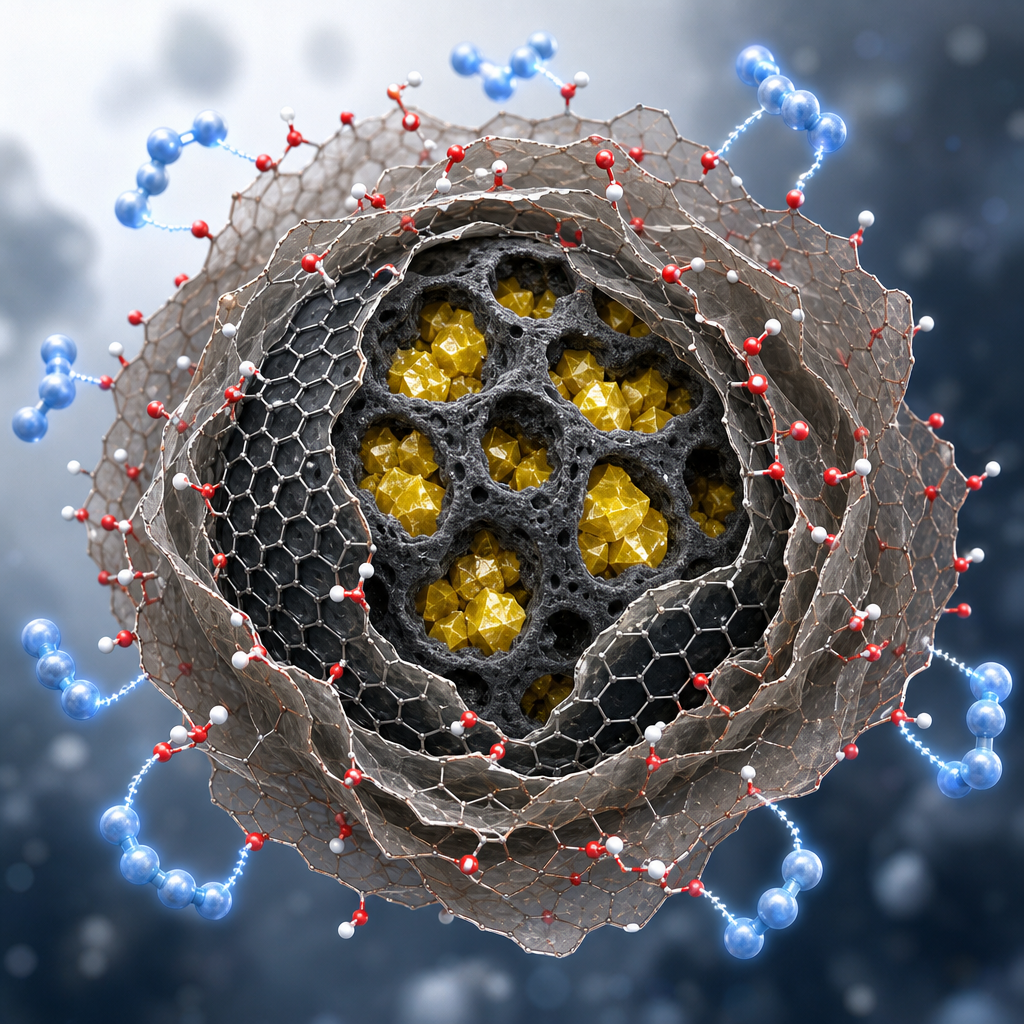
In this work, Ketjen black carbon (BET surface area 1600 m² g⁻¹, intrinsic pore volume ~1.5 cc g⁻¹ in micropores and small mesopores below 6 nm) was loaded with 70 wt% sulfur by ball-milling and melt-impregnation at 155 °C. The KBC/S particles were then functionalized with cationic polyDADMAC to introduce positive surface charges, allowing electrostatic self-assembly with negatively charged graphene oxide sheets sourced from ACS Material. Specifically, 20 mg of ACS Material graphene oxide was dispersed by sonication in deionized water and combined with 100 mg of polyDADMAC-modified KBC/S. The resulting GO-wrapped particles were treated with hydrazine at 60 °C for 30–60 min, a temperature deliberately chosen to partially reduce the GO while preserving oxygen-containing C–O, C–O–C, and C–OH groups confirmed by FTIR. This balance between conductivity and surface chemistry was central to the device performance, because the residual oxygen functionalities chemically bind polysulfides.
Electrochemical testing in coin cells using 1 M LiTFSI in DOL/DME with 2 wt% LiNO₃ revealed the benefits of the dual-protection architecture. At C/10 (168 mA g⁻¹), the g-KBC/S cathode showed a typical two-plateau discharge profile at 2.3 and 2.1 V. After an initial conditioning fade to ~770 mAh g⁻¹ in the first 15 cycles, capacity stabilized remarkably: 740 mAh g⁻¹ was delivered at cycle 200, equal to 96.1% retention versus cycle 15. The average fade between cycles 15 and 200 was just 0.026% per cycle, or 0.167 mAh g⁻¹, with Coulombic efficiency around 98%. At more practical rates the cells delivered 863 mAh g⁻¹ initially at C/2 and 843 mAh g⁻¹ at 1C, retaining 83.4% (720 mAh g⁻¹) and 75.9% (640 mAh g⁻¹) respectively after 250 cycles. Control experiments with bare KBC/S (no graphene wrap) showed severe capacity fading under the same conditions, isolating the graphene shell as the key polysulfide-trapping component. STEM and TEM imaging confirmed multilayer graphene sheets conformally coating the ~50 nm KBC/S nanoparticles, with a looser secondary wrap created by the slight GO excess.
The combination of small-mesopore confinement, hydrophilic surface chemistry on the graphene wrap, and a narrow 1.8–2.7 V cycling window points to a generalizable design strategy for stable sulfur cathodes. The same approach should translate to other porous-carbon/sulfur composites and supports practical Li–S pouch cells for electric vehicles and grid storage where long cycle life is essential. Beyond batteries, the polyelectrolyte-mediated GO self-assembly route is broadly relevant to graphene-encapsulated nanoparticle systems for supercapacitors, catalysis, and selective sorbents. The authors specifically note that all the raw materials, including the commercial KBC and the GO precursor, are inexpensive and available at scale, lowering the barrier to industrial adoption.
For researchers building polysulfide-trapping cathodes, conductive composites, or self-assembled graphene coatings, graphene oxide remains the workhorse precursor. ACS Material supplies graphene oxide in several forms, including single-layer GO dispersions and high-density GO powder, suitable for the kind of aqueous electrostatic assembly demonstrated here. The paper underscores that the oxygen functional density on partially reduced GO — not simply the conductivity of fully reduced graphene — drives polysulfide retention, a useful guide when selecting and processing GO grades for energy-storage applications.How ACS Material products were used
- Graphene Oxide (GO) (Graphene Series) — “Separately, 20 mg graphene oxide (GO, ACS Material) was dispersed in 100 mg of DI water by sonication.”
Product Performance in this StudyGraphene oxide from ACS Material served as the precursor for the graphene encapsulation shell. After electrostatic self-assembly onto polyDADMAC-functionalized Ketjen black/sulfur particles and partial reduction by hydrazine at 60 °C, the GO formed a graphene wrap that retained oxygen-containing groups crucial for polysulfide immobilization, enabling exceptionally stable cycling with only 0.026% fade per cycle.
Related product categories
Frequently asked questionsHow does graphene oxide improve lithium-sulfur battery cycling?
Graphene oxide wrapped around a sulfur-loaded porous carbon acts as both a physical diffusion barrier and a chemical trap for soluble polysulfides. When the GO is only partially reduced, residual C–O, C–O–C, and C–OH groups bind polysulfide intermediates and limit their migration to the lithium anode. In the Waterloo study this dual-protection design produced only 0.026% capacity fade per cycle over 185 cycles at C/10.
Why is partial reduction of graphene oxide preferred for Li-S cathodes?
Fully reduced graphene has high conductivity but few surface oxygen groups, while unreduced GO is poorly conductive. Partial reduction at 60 °C with hydrazine strikes a balance: the sp² network develops sufficient conductivity (rising from ~10⁻⁶ to ~5 S cm⁻¹) while retaining oxygen functionalities that immobilize lithium polysulfides through chemical interactions, which is essential for stable long-term cycling.
What role does Ketjen black play in the g-KBC/S cathode?
Ketjen black provides a mesoporous carbon framework with ~1600 m² g⁻¹ surface area and ~1.5 cc g⁻¹ intrinsic pore volume in micropores and sub-6 nm mesopores. These pores confine 70 wt% sulfur, accommodate volume expansion to Li₂S, and ensure uniform nanoscale sulfur distribution. Its ~50 nm particle size also creates a conductive scaffold ideal for graphene wrapping.