-
Graphene Oxide for NiMo HER Catalysts - University of Belgrade, 2018
Jun 17, 2026 | ACS MATERIAL LLCGutić, S. et al. (2018). Simple routes for the improvement of hydrogen evolution activity of Ni-Mo catalysts: From sol-Gel derived powder catalysts to graphene supported co-Electrodeposits. *International Journal of Hydrogen Energy*. https://doi.org/10.1016/j.ijhydene.2017.11.131
International Journal of Hydrogen Energy · 2018
University of Belgrade researchers used ACS Material graphene oxide to electrodeposit NiMo@rGO composite catalysts, reaching 120 mV overpotential at 10 mA cm⁻² for alkaline HER.
About this research
Researchers at the University of Belgrade, working with collaborators from the University of Sarajevo and the CEST Center of Electrochemical Surface Technology, used ACS Material graphene oxide (S Method) to fabricate NiMo@reduced-graphene-oxide composite electrocatalysts that achieved a hydrogen evolution overpotential of only 120 mV at 10 mA cm⁻² in alkaline media. Published in the International Journal of Hydrogen Energy (2018), the study combines two strategies for noble-metal-free hydrogen evolution: a sol-gel-derived Ni-Mo powder series spanning Ni0.2Mo0.8 to Ni0.9Mo0.1, and a new electrodeposition route in which NiMo and graphene oxide are co-reduced onto copper. The composite electrodes outperform pure Ni and previously reported Ni@rGO benchmarks.
Noble-metal-free hydrogen evolution catalysis is central to making large-scale water electrolysis economically viable for green hydrogen production. Platinum delivers near-ideal HER kinetics but is too scarce and costly for terawatt-scale deployment. Nickel-molybdenum alloys are among the most promising substitutes because alloying spans different branches of the HER volcano curve, combining favorable hydrogen binding with strong corrosion resistance in alkaline media. Yet two practical issues persist: precise control over Ni:Mo composition is difficult with most synthesis routes, and Ni-Mo electrodes are prone to hydride-related deactivation and Mo-oxide accumulation that erode activity over time. Coupling Ni-Mo with conductive carbon supports such as reduced graphene oxide is an attractive way to expand active surface area, stabilize the catalyst, and introduce beneficial metal/carbon interfaces that promote hydrogen spillover.
For the composite electrodes, the authors drop-cast 10 µL of an aqueous-ethanol suspension (0.56 mg cm⁻³) of ACS Material graphene oxide onto cleaned electrolytic copper substrates of 0.2826 cm² geometric area and dried them under vacuum. The product is described in the paper as a single-layer graphene oxide with single-layer ratio above 90%, oxygen content approximately 30 at.% in the form of hydroxyl, phenol, epoxy, carbonyl, and carboxyl groups, and a high level of structural disorder; the authors had previously characterized this same lot by Raman spectroscopy, XRD, and XPS. The GO-coated copper was then immersed in a citrate-based bath containing 0.3 mol dm⁻³ NiSO4·6H2O, 0.2 mol dm⁻³ Na2MoO4·2H2O, and 0.3 mol dm⁻³ sodium citrate at pH 10.5. NiMo was electrodeposited at −1.2 V vs Ag/AgCl for 10, 30, 50, 100, 150, 200, or 400 seconds. During the first seconds of cathodic polarization, the graphene oxide is electrochemically reduced in situ, producing rGO simultaneously with NiMo nucleation and yielding intimately mixed NiMo@rGO composite films.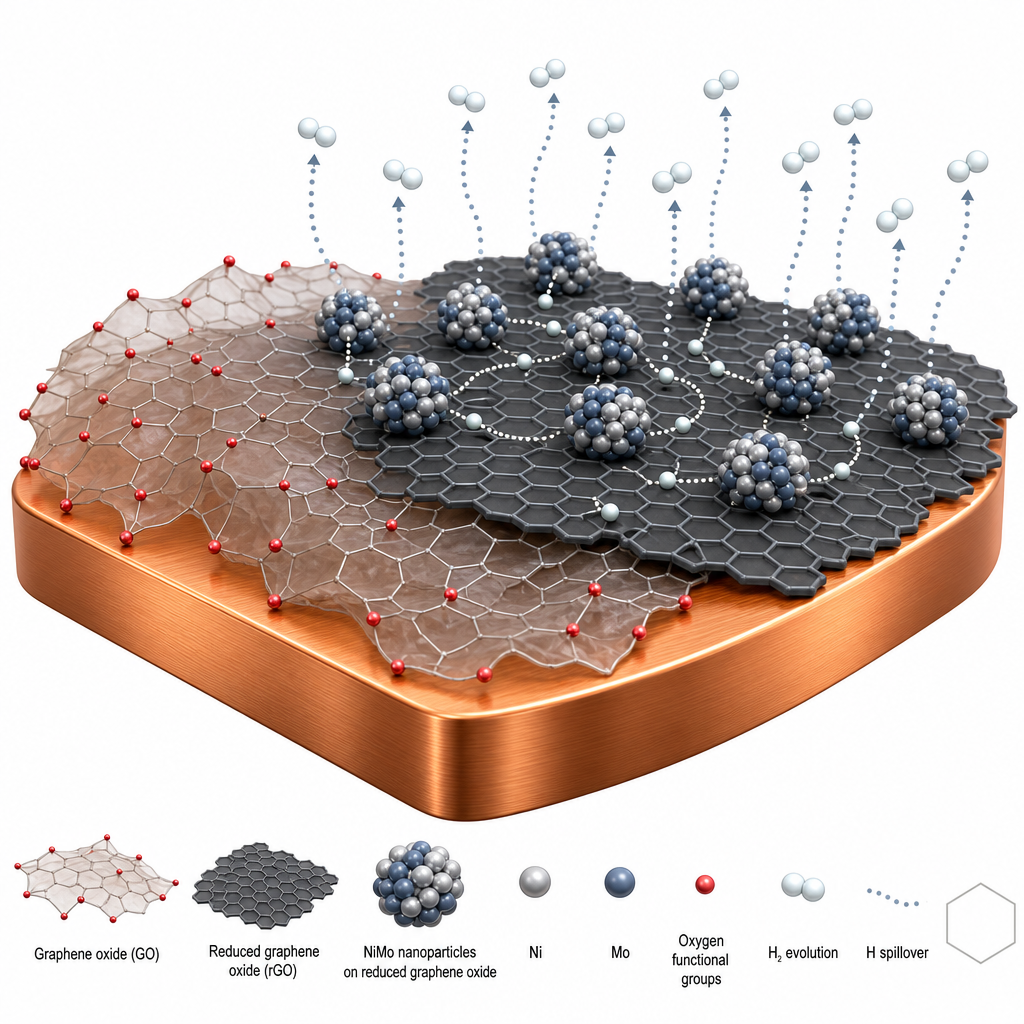
The sol-gel-derived powder series produced a clear volcano-shaped activity-composition relationship in 1 mol dm⁻³ KOH, with maximum HER activity at Ni0.6Mo0.4. DFT calculations on Ni4Mo(001) located several adsorption sites with hydrogen binding energies close to that of Pt(111) (−2.72 eV), supporting the interpretation that destabilized Hads relative to pure Ni explains the enhanced activity. For the electrodeposited series, EDX showed composition stabilizing near Ni0.76Mo0.24 on bare Cu and Ni0.79Mo0.21 on GO-modified Cu, with oxygen content up to 10 at.% from residual Mo-oxides. Average deposition current was 10-15% higher on GO-coated substrates, and DFT predicted stronger Mo binding (−7.41 eV) than Ni binding (−6.78 eV) at graphene monovacancies, consistent with rGO promoting early-stage Mo incorporation. The optimum NiMo@rGO200 electrode required only 120 mV overpotential to reach 10 mA cm⁻² in 1 mol dm⁻³ KOH, comparable to reported Ni-Mo, MoP, and Ni5P4 benchmarks (49-200 mV) and even approaching some Pt-based modified single-crystal surfaces. Activity further improved with successive deep cathodic scans, attributed to gradual removal of residual Mo-oxides.
This combined volcano map and electrochemical composite synthesis gives researchers two design levers for alkaline water electrolysis catalysts: composition optimization around Ni0.6Mo0.4, and rGO interfacial engineering for hydrogen spillover. The approach is directly relevant to alkaline electrolyzer electrode coatings, membrane electrode assemblies for anion exchange membrane (AEM) electrolyzers, and corrosion-resistant cathodes for chlor-alkali processes. The authors note that adapting the bath chemistry to push electrodeposited compositions closer to the Ni0.6Mo0.4 activity apex should yield even higher performance. The methodology can also be extended to other transition-metal-graphene composites (FeMo, CoMo, NiW) and to substrates beyond copper, including porous current collectors used in industrial electrolyzers.
For researchers building noble-metal-free hydrogen evolution catalysts, supercapacitor electrodes, or composite coatings, ACS Material graphene oxide is available in the Graphene Series catalog with characterized single-layer content above 90% and well-documented oxygen functionality. The same product can serve as a precursor for in-situ electrochemical rGO generation, drop-cast or spin-cast film fabrication, and bath-additive composite plating. The Belgrade group's work demonstrates that a well-characterized commercial GO source, combined with simple bath-based electrodeposition, can deliver state-of-the-art HER activity without precious metals.How ACS Material products were used
- Graphene Oxide (S Method) (Graphene Series) — “Commercial graphene-oxide (ACS Graphene Oxide Powder [47]) was used for the modification of the Cu substrate... This material has a single layer ratio higher than 90% [47], approximately 30 at.% of oxygen (in the form of hydroxyl, phenol, epoxy, carbonyl and carboxyl groups) and a high level of structural disorder.”
Product Performance in this StudyThe ACS Material graphene oxide was drop-cast onto copper substrates and electrochemically reduced in situ during NiMo deposition, forming NiMo@rGO composites with markedly higher HER activity than pure Ni or Ni@rGO. Reference reaction footnote 47 explicitly links to ACS Material's product page.
Related product categories
Frequently asked questionsHow does graphene oxide improve NiMo hydrogen evolution catalysts?
Graphene oxide deposited on the copper substrate is reduced in situ during NiMo electrodeposition, producing an intimate NiMo/rGO interface. This interface adds active surface area and enables hydrogen spillover, and defects in rGO preferentially bind Mo (DFT binding energy −7.41 eV vs −6.78 eV for Ni), promoting early Mo incorporation. The resulting NiMo@rGO200 electrode reaches 10 mA cm⁻² at only 120 mV overpotential in 1 mol dm⁻³ KOH.
What is the optimal Ni:Mo composition for alkaline HER catalysts?
Across a sol-gel-derived series spanning Ni0.2Mo0.8 to Ni0.9Mo0.1, the volcano-shaped activity-composition curve peaks at Ni0.6Mo0.4 in 1 mol dm⁻³ KOH. DFT calculations on Ni4Mo(001) show hydrogen binding energies close to Pt(111), indicating that destabilized Hads relative to pure Ni reduces hydride deactivation and gives near-optimal hydrogen-surface energetics for the hydrogen evolution reaction.
Why use commercial graphene oxide instead of synthesizing it in the lab?
Commercial graphene oxide offers reproducible specifications: the product used here had a single-layer ratio above 90%, approximately 30 at.% oxygen in hydroxyl, epoxy, carbonyl, and carboxyl groups, and well-documented structural disorder. Consistent batch chemistry is essential for electrodeposition baths, where GO loading directly controls the rGO interfacial area and the resulting NiMo@rGO catalyst's activity. Lab-made GO can vary widely in flake size and oxidation level.