-
Graphene Oxide for NO2 Gas Sensing Benchmark - University of Wisconsin-Milwaukee, 2015
Jun 01, 2026 | ACS MATERIAL LLCCui, S. et al. (2015). Stabilizing MoS2Nanosheets through SnO2Nanocrystal Decoration for High-Performance Gas Sensing in Air. *Small*. https://doi.org/10.1002/smll.201402923
Department of Mechanical Engineering University of Wisconsin‐Milwaukee Milwaukee WI 53211 USA · Small · 2015
University of Wisconsin-Milwaukee researchers used ACS Material graphene oxide to build rGO/SnO2 control sensors, validating MoS2/SnO2 nanohybrids for room-temperature NO2 detection.
About this research
Researchers at the Department of Mechanical Engineering, University of Wisconsin-Milwaukee, used graphene oxide (GO) supplied by ACS Material to prepare reduced graphene oxide/SnO2 (rGO/SnO2) control nanohybrids that benchmarked a new air-stable MoS2/SnO2 NO2 gas sensor. The team, led by Prof. Junhong Chen, demonstrated that SnO2 nanocrystal (NC) decoration converts MoS2 to a p-type semiconductor and prevents oxygen poisoning, enabling room-temperature NO2 detection down to 0.5 ppm in practical dry air rather than the inert atmospheres required by previous MoS2 sensors. The ACS Material GO was central to validating that MoS2 outperforms rGO as the conductance channel in such SnO2-decorated FET sensors.
Gas sensing at room temperature is a long-standing challenge for 2D materials. Pristine MoS2 nanosheets have an attractive direct band gap (1.8 eV), high on/off ratio (~10^8), and large surface-to-volume ratio, but their on-state current, carrier concentration, and mobility degrade rapidly under ambient oxygen exposure. Consequently, nearly every reported MoS2 sensing study has been performed in N2 or other inert gas, which severely limits commercial deployment in environmental monitoring. NO2 in particular is an occupational hazard, with OSHA setting a 5 ppm permissible exposure limit and NIOSH recommending 1 ppm; practical sensors must therefore operate stably in air at sub-ppm levels. Decorating 2D nanosheets with metal-oxide nanocrystals offers a route to both stabilize the channel material and add chemically active adsorption sites, but most prior work decorated MoS2 with noble metals rather than reactive oxides.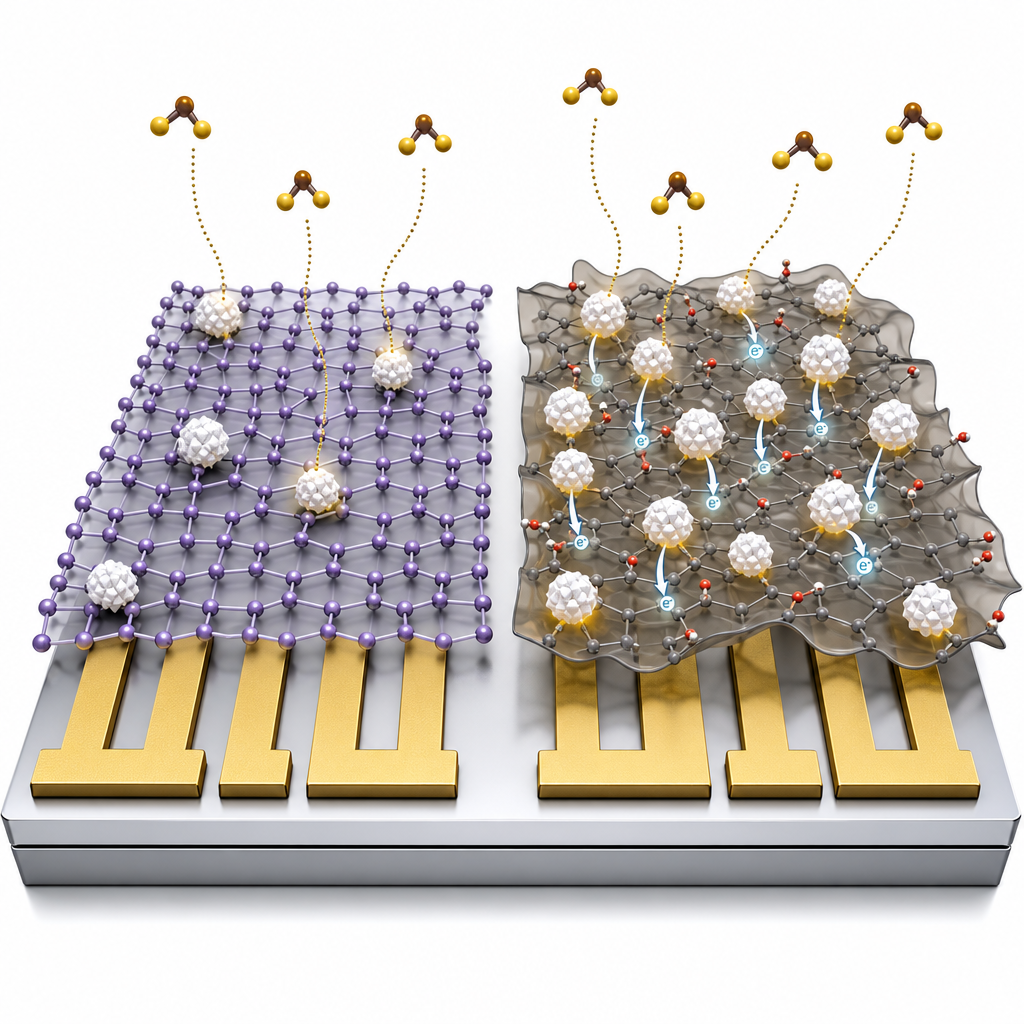 The ACS Material graphene oxide was used to construct the rGO/SnO2 benchmark device that the new MoS2/SnO2 hybrid had to outperform. According to the Experimental section: "5 mg of GO (ACS Materials) was dispersed in 30 mL of water and sonicated for 10 min. Then, 1 mL of SnCl4 (0.01 M) was added into the GO suspension under magnetic stirring. The precipitate was retrieved, and the rGO/SnO2 nanohybrids were obtained by annealing the precipitate at 300 °C for 2 h in an argon flow." The same SnCl4 hydrolysis-and-anneal protocol was applied to lithium-exfoliated 2H-MoS2 nanosheets to give the MoS2/SnO2 hybrid, so the only difference between the comparison samples was the 2D substrate. HRTEM imaging showed SnO2 NC surface coverage of approximately 3 NCs per 100 nm² on MoS2 and 7 NCs per 100 nm² on rGO, meaning the ACS Material-based rGO control actually carried more than twice the density of active adsorption sites.
The key sensing results were obtained in a dry air environment at room temperature with NO2 balanced in dry air. The MoS2/SnO2 sensor exhibited a clear ohmic I-V response and a p-type transfer curve, in contrast to the n-type behavior of pristine 2H-MoS2. The lower detection limit reached 0.5 ppm NO2 with a sensitivity ΔG/G0 of approximately 0.6%, well below the OSHA 5 ppm and NIOSH 1 ppm limits and comparable to or better than chemically modified graphene (1 ppm), rGO-Cu2O mesocrystals (0.4 ppm), and Pt-MoS2 (0.5 ppm). At 10 ppm NO2, the sensitivity reached 28% with a response time of about 6.8 min and recovery time of 2.7 min, with full recovery achieved simply by flushing with dry air, without thermal annealing or UV assistance. Three successive sensing cycles confirmed excellent repeatability, log10(ΔG/G0) varied linearly with concentration from 0.5 to 10 ppm, and the device retained near-original performance after 11 months of ambient storage. Selectivity tests against H2, CO, H2S, and NH3 at 10 ppm showed essentially negligible responses to interferents. Crucially, when MoS2/SnO2 and rGO/SnO2 (built from the ACS Material GO) were tested side by side at 10 ppm NO2, MoS2/SnO2 delivered higher sensitivity, faster recovery, and lower noise despite the lower SnO2 loading, confirming that MoS2 is the superior FET conductance channel.
The demonstrated MoS2/SnO2 platform points to practical, low-power room-temperature NO2 monitors for environmental, industrial-hygiene, and automotive emissions applications, where conventional SnO2 sensors must run above 200 °C. The same metal-oxide-decoration strategy should extend to selective sensing of other oxidizing gases, to photocatalysis, and to electrocatalytic energy-storage electrodes where stabilizing 2D semiconductors against ambient oxidation matters. The authors note that detection limit and response speed can be pushed further by using single-layer MoS2 channels, increasing SnO2 coverage, or doping the SnO2 NCs, and that gate-tunable FET operation may add another sensitivity lever.
For researchers working on graphene-oxide-based sensors, supercapacitor electrodes, photocatalysts, or 2D heterostructures, the graphene oxide grade used here as the rGO/SnO2 control is available from ACS Material in single-layer flake, powder, and dispersion forms. The paper does not claim superiority for the GO product itself - it is used as a fair benchmark - but the fact that rGO/SnO2 still gave clean, quantitative NO2 responses at room temperature underlines that ACS Material GO is a reliable starting point for nanohybrid sensor research.How ACS Material products were used
- Graphene Oxide (GO) (Graphene Series) — “To prepare the rGO/SnO2 nanohybrids as control samples, 5 mg of GO (ACS Materials) was dispersed in 30 mL of water and sonicated for 10 min.”
Product Performance in this StudyACS Material-supplied graphene oxide was reduced and decorated with SnO2 nanocrystals to form rGO/SnO2 control samples. The benchmark demonstrated that MoS2/SnO2 outperformed rGO/SnO2 for NO2 detection, with higher sensitivity, faster recovery, and lower signal noise despite lower SnO2 NC coverage.
Related product categories
Frequently asked questionsWhy use graphene oxide as a control material for evaluating MoS2-based gas sensors?
Graphene oxide can be reduced and decorated with metal-oxide nanocrystals using the same wet-chemistry protocol applied to MoS2, isolating the 2D channel as the only variable. In this study, ACS Material GO was converted to rGO/SnO2 under identical SnCl4 hydrolysis and 300 °C argon annealing conditions, allowing the researchers to directly compare MoS2 and rGO as FET conductance channels for room-temperature NO2 detection.
How does SnO2 nanocrystal decoration improve MoS2 stability in air?
SnO2 has a higher work function (5.7 eV) than MoS2 (5.2 eV), so electrons transfer from MoS2 into SnO2 nanocrystals, creating depletion zones and a passivation layer at the interface. This electron transfer raises the MoS2 work function and reduces its electron-donating capacity toward adsorbed oxygen, suppressing oxygen-induced degradation and enabling stable NO2 sensing in dry air rather than only in inert atmospheres.
What is the lower detection limit of the MoS2/SnO2 nanohybrid NO2 sensor?
The MoS2/SnO2 nanohybrid sensor detected NO2 down to 0.5 ppm at room temperature in dry air, with a signal-to-noise ratio greater than 3 and a sensitivity of about 0.6%. This detection limit is well below the 5 ppm OSHA permissible exposure limit and 1 ppm NIOSH recommended exposure limit, and is comparable to or better than other state-of-the-art graphene-, rGO-, and Pt-MoS2-based NO2 sensors.