-
Graphene Oxide for rGO FET Sensors - University of Chicago, 2024
Jun 10, 2026 | ACS MATERIAL LLCZhuang, W. et al. (2024). Enhancing Electrochemical Sensing through Molecular Engineering of Reduced Graphene Oxide–Solution Interfaces and Remote Floating-Gate FET Analysis. *ACS Applied Materials & Interfaces*. https://doi.org/10.1021/acsami.4c03999
University of Chicago · ACS Applied Materials & Interfaces · 2024
University of Chicago researchers used ACS Material graphene oxide to build rGO remote floating-gate FET sensors, boosting lead-ion sensitivity by 32%.
About this research
Researchers at the University of Chicago, working with graphene oxide supplied by ACS Material, developed a remote floating-gate field-effect transistor (RFGFET) analytical platform that directly measures the surface charge density of reduced graphene oxide (rGO)–solution interfaces and used it to raise lead-ion sensing sensitivity by 32%. The team showed that the adhesion layer between SiO2 and rGO—either (3-aminopropyl)trimethoxysilane (APTMS) or hexamethyldisilazane (HMDS)—governs the oxygen functional-group content of the deposited rGO, its pH response, and the packing density of pyrenebutyric acid N-hydroxysuccinimide ester (PBASE) linkers. This work links interfacial molecular engineering directly to measurable FET sensor performance, providing a route to more reproducible 2D-material sensors.
Reduced graphene oxide is one of the most widely studied channel materials for FET-based chemical and biological sensors because of its high surface-to-volume ratio, electrical responsiveness, and low-cost, scalable synthesis. Yet a persistent obstacle to commercialization is the variability of rGO electrical and electrochemical properties, which depend on reduction method, residual oxygen groups, substrate surface energy, and the choice of probe-anchoring linker. Conventional tools such as XPS, Raman, and UV–vis cannot directly probe the electrochemical solution interface under operating conditions. By addressing this gap, the paper speaks to long-standing questions in biosensing, water-quality monitoring, and electrochemical sensing about how to control rGO interfaces for consistent device-to-device performance—a prerequisite for field-deployable heavy-metal and biomarker detectors.
The ACS Material graphene oxide was the central starting material for the rGO sensing layer. Following the Experimental section, GO solutions of 0.24 mg/mL were prepared by dispersing GO (ACS Material, 7782-42-5) in deionized water with 20 minutes of ultrasonication. A 4-inch silicon wafer carrying 300 nm of SiO2 was oxygen-plasma treated, then functionalized with either 5% APTMS or HMDS in ethanol to form self-assembled monolayers. Sixteen milliliters of the GO dispersion was drop-cast over the wafer and baked at 120 °C, producing multilayer GO on the APTMS- or HMDS-treated SiO2. The films were post-annealed in a horizontal furnace at 200 °C under argon for 10 minutes to yield rGO. The resulting rGO nanoflake networks were approximately 4 nm thick (confirmed by cross-sectional SEM and AFM) and covered the entire substrate. These rGO/adhesion-layer/SiO2 stacks were diced into 1 × 2 cm² remote floating-gate modules and capacitively coupled to a commercial n-type MOSFET (CD4007UB) transducer, with transfer curves recorded on a Keithley 4200A analyzer. The quality and oxygen content of the GO precursor were thus directly responsible for the interfacial behavior under study.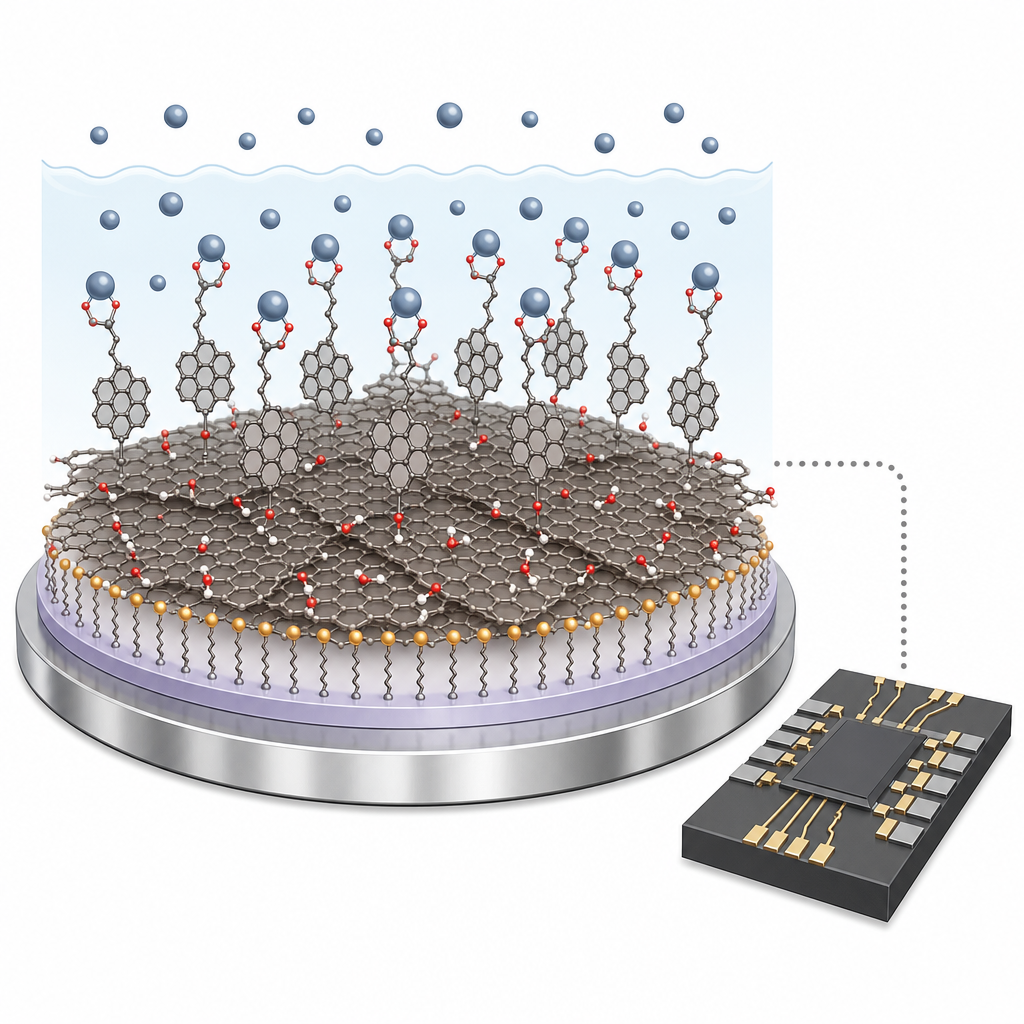
The study produced detailed quantitative results. rGO/APTMS/SiO2 showed a near-Nernstian pH sensitivity of 56.8 mV/pH, while rGO/HMDS/SiO2 was limited to 34.8 mV/pH, reflecting selective attachment of oxygen-rich rGO on the hydrophilic APTMS surface. XPS of the C 1s region gave 52.3 atom % C=C for rGO/APTMS/SiO2 versus 64.2 atom % C=C for rGO/HMDS/SiO2, confirming the more graphitic, carbon-rich HMDS surface. Surface treatments produced hysteresis of 82 mV (APTMS) and 98 mV (HMDS). PBASE functionalization shifted the threshold voltage from 1.37 to 1.31 V and saturated after 90 minutes, yielding a calculated surface charge density of about 0.088 C/m² and a PBASE density of 2.20 molecules/nm² by RFGFET, in close agreement with 2.82 molecules/nm² measured by quartz crystal microbalance. The carbon-rich HMDS surface supported a higher PBASE density of 2.65 molecules/nm², a 20.5% increase over APTMS. In the proof-of-concept lead-ion assay using glutathione (GSH) probes over a 1 nM–10 µM range, rGO/HMDS/SiO2 reached 8.8 mV/decade versus 6.1 mV/decade for rGO/APTMS/SiO2—a 32% sensitivity gain—while nonfunctionalized rGO showed negligible response.
These findings enable more rational design of rGO FET sensors for heavy-metal monitoring, water-quality analysis, and biosensing of analytes such as viral proteins, where the same RFGFET platform has previously detected SARS-CoV-2. By demonstrating that adhesion-layer chemistry controls oxygen content, linker density, and ultimately analyte sensitivity, the work offers a reproducible manufacturing lever for 2D-material electronics. The authors point toward broader application of the RFGFET as a non-destructive analytical tool for characterizing intrinsic electrochemical properties of other 2D nanomaterial–solution interfaces, supporting commercial translation of field-deployable, label-free sensors with digital readouts.
For researchers pursuing similar 2D-material sensors, the controllable, oxygen-rich graphene oxide used here as the rGO precursor is the kind of material available from ACS Material's graphene series. Because the device's pH and lead-ion performance trace directly back to the oxygen functional-group content and uniformity of the starting GO, the choice of a consistent graphene oxide supply is a meaningful experimental variable. This paper provides a concrete, quantitative reference for groups optimizing rGO interfaces, linker chemistry, and FET biosensing or electrochemical sensing platforms.How ACS Material products were used
- Graphene Oxide (GO) (Graphene Series) — “GO solutions of 0.24 mg/mL were prepared by dispersing GO (ACS Material, 7782-42-5) in deionized water aided by ultrasonication for 20 min.”
Product Performance in this StudyACS Material graphene oxide was the precursor for the reduced graphene oxide (rGO) sensing layer in every RFGFET device. Drop-cast and post-annealed GO formed the dense, continuous rGO nanoflake film whose interfacial chemistry drives the reported pH and lead-ion sensitivities.
Related product categories
Frequently asked questionsHow does graphene oxide improve rGO FET sensor performance?
Graphene oxide serves as the precursor for the reduced graphene oxide sensing layer. Its oxygen functional groups determine pH sensitivity and the binding sites available for PBASE linkers. In this study, dispersing GO in water and reducing it on APTMS- or HMDS-treated SiO2 controlled the oxygen content, directly setting the device's pH response and ultimately its lead-ion sensitivity.
Why does the adhesion layer matter for reduced graphene oxide sensors?
The adhesion layer between SiO2 and rGO controls surface energy and therefore which rGO flakes attach. Hydrophilic APTMS attracts oxygen-rich rGO, giving 56.8 mV/pH sensitivity, while hydrophobic HMDS favors graphitic carbon-rich rGO with 34.8 mV/pH. The carbon-rich HMDS surface allowed denser PBASE linker packing, raising lead-ion sensitivity by 32%.
What is graphene oxide used for in lead ion detection?
Graphene oxide is reduced to rGO and used as the sensing layer in field-effect transistor devices. PBASE linkers anchor glutathione probes that selectively bind lead ions. In this work the rGO/HMDS/SiO2 sensor achieved 8.8 mV/decade over a 1 nM to 10 µM lead concentration range, while nonfunctionalized rGO showed negligible response.