-
Graphene Oxide for SARS-CoV-2 Biosensor — University of Chicago, 2023
Jun 10, 2026 | ACS MATERIAL LLCJang, H. et al. (2023). Rapid, sensitive, label-free electrical detection of SARS-CoV-2 in nasal swab samples. *ACS Applied Materials & Interfaces*. https://doi.org/10.1021/acsami.3c00331
University of Chicago · ACS Applied Materials & Interfaces · 2023
University of Chicago researchers used ACS Material graphene oxide to build an rGO field-effect transistor that detects SARS-CoV-2 in nasal swabs label-free.
About this research
Researchers at the University of Chicago, working with Argonne National Laboratory, used graphene oxide supplied by ACS Material (CAS 7782-42-5) to build a remote floating-gate field-effect transistor (RFGFET) that performs rapid, label-free electrical detection of SARS-CoV-2 in nasal swab samples. The team, led by Prof. Junhong Chen at the Pritzker School of Molecular Engineering, demonstrated detection limits in the femtogram-per-milliliter range for the viral spike protein (SP) and successfully discriminated positive from negative clinical nasopharyngeal swabs in approximately five minutes per measurement. The work, published in ACS Applied Materials & Interfaces in 2023, presents one of the most sensitive antibody-functionalized rGO transistor platforms reported for respiratory virus diagnostics and addresses a clear gap between PCR sensitivity and rapid antigen-test speed.
The broader research context is the persistent need for diagnostic tools that combine the analytical sensitivity of RT-PCR with the turnaround time of lateral-flow antigen tests. Standard PCR requires nucleic acid extraction and thermal cycling, which limits its use at the point of care, while commercial antigen tests trade sensitivity for speed and often miss early or low-viral-load infections. Field-effect transistor (FET) biosensors based on two-dimensional carbon materials have long been proposed as a bridge between these regimes because their conductance responds to charged biomolecules binding within the Debye length of the channel. However, direct integration of fragile graphene-based channels with measurement electronics has historically limited robustness and reproducibility, motivating the remote floating-gate architecture explored in this paper.
In the device workflow, ACS Material graphene oxide was dispersed in deionized water at 0.24 mg/mL with 20 minutes of ultrasonication, then drop-cast (16 mL) over a four-inch silicon wafer carrying a 300-nm thermal SiO2 layer that had been oxygen-plasma activated and functionalized with APTMS to anchor the GO sheets through electrostatic interactions. After baking at 120 °C for one hour, the multilayer GO film was diced into 1 × 2 cm2 chips and post-annealed in a horizontal tube furnace at 400 °C under argon for five minutes to convert it to reduced graphene oxide (rGO). The rGO surface was then linked with 1-pyrenebutyric acid N-hydroxysuccinimide ester (PBASE) and conjugated with SARS-CoV-2 neutralizing antibody (NAb) or ACE-2 probes, with bovine serum albumin used to block non-specific binding. The functionalized chip forms the remote floating-gate (RFG) module, which is capacitively coupled to a commercial CD4007UB MOSFET transducer and biased through an Ag/AgCl reference electrode. The choice of ACS Material GO was central: the dispersion quality and uniform multilayer coverage directly determined the channel conductance, the threshold voltage stability, and the signal-to-noise floor of the resulting RFGFET.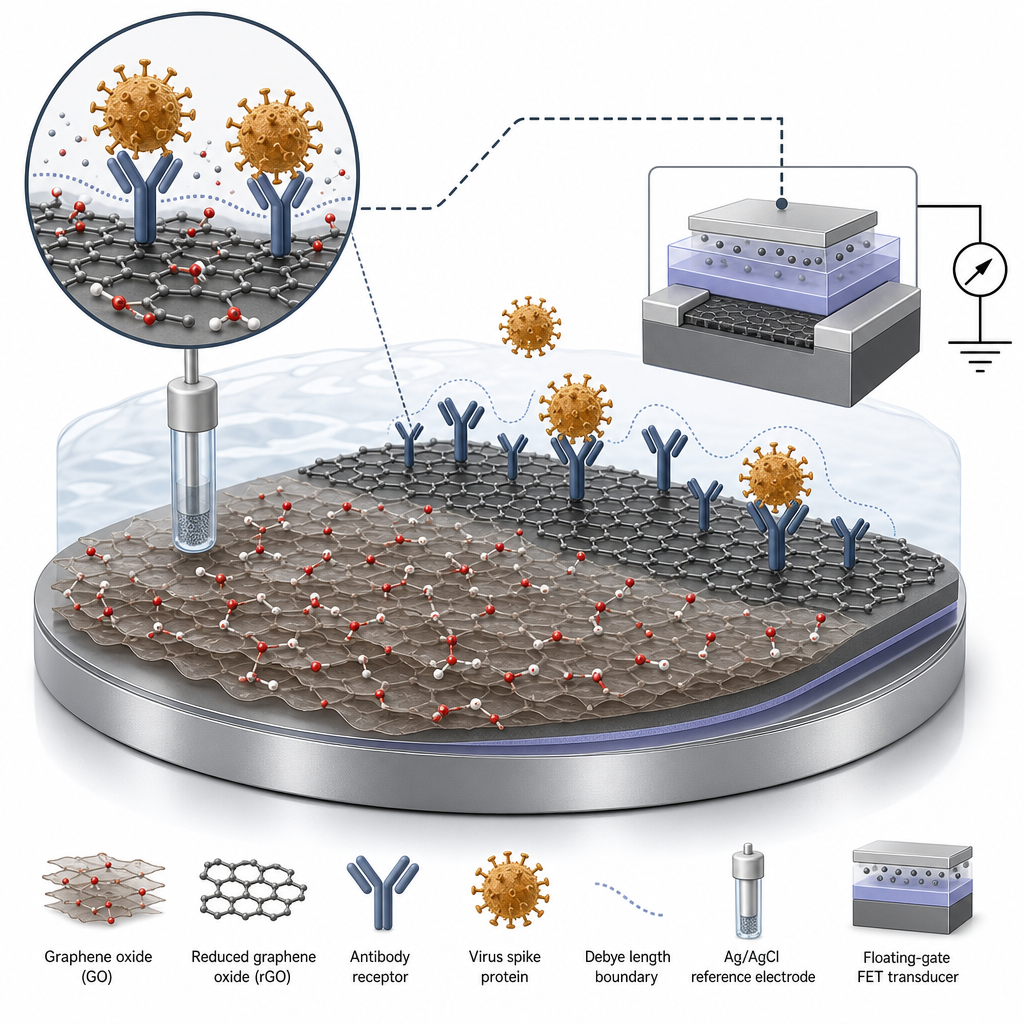
The key results demonstrate strong analytical performance. Transfer curves were measured with a Keithley 4200A at a 50 mV drain bias and a 0–5 V gate sweep, with the threshold-voltage shift (ΔVth) tracked over 20 cycles per analyte concentration. For purified spike protein in 0.05× PBS, NAb-functionalized rGO sensors produced concentration-dependent ΔVth from 34 fg/mL up to 3.4 µg/mL, and ACE-2-functionalized devices showed a comparable dynamic range with low coefficient-of-variation values. ELISA assays run on identical rGO substrates required substantially higher concentrations to register signal, illustrating the sensitivity advantage of the transistor read-out. Pseudo SARS-CoV-2 particles were detected over five log units (5 × 10⁻⁴ to 5 × 10³ TU/mL). The sensor was further challenged in a 20:1 mixture of 0.05× PBS and artificial saliva to mimic real specimen chemistry, and it retained linear response down to the 500 fg/mL range. Finally, twelve de-identified nasopharyngeal swab samples from UChicago Medicine (six RT-PCR positive, six negative) were tested, and the RFGFET correctly distinguished positives from negatives within roughly five minutes of incubation per chip.
The applications and outlook are broad. The same antibody-on-rGO platform can be retargeted to influenza, RSV, or future emerging pathogens simply by swapping the bioreceptor, making it attractive for point-of-care respiratory panels and biothreat surveillance. Because the rGO chip is the disposable element while the MOSFET transducer is reusable, the architecture is well aligned with low-cost cartridge-based diagnostics, and its electrical read-out is compatible with handheld semiconductor analyzers and smartphone-coupled interfaces. The authors point toward integration with microfluidic sample preparation, multiplexed antibody arrays, and on-chip drift compensation as natural extensions.
For researchers building similar biosensors, the study underscores how much performance depends on the starting graphene oxide. The ACS Material Graphene Oxide used here (available within the Graphene Series catalog) provides the dispersion uniformity and reproducibility needed for wafer-scale drop-casting and subsequent thermal reduction. Groups working on rGO field-effect biosensors, electrochemical immunoassays, or functionalized 2D-material electrodes can source equivalent graphene oxide and related rGO, carboxylated, and aminated graphene grades through ACS Material to reproduce or extend this platform.How ACS Material products were used
- Graphene Oxide (CAS 7782-42-5) (Graphene Series) — “GO solutions of 0.24 mg/ml were prepared by dispersing GO (ACS Material, 7782-42-5) in deionized water aided by ultrasonication for 20 min.”
Product Performance in this StudyThe GO from ACS Material was drop-cast onto APTMS-treated SiO2 wafers and thermally annealed to form a multilayer reduced graphene oxide (rGO) sensing layer. This rGO film served as the active channel of the remote floating-gate field-effect transistor (RFGFET) biosensor, enabling label-free electrical detection of SARS-CoV-2 spike protein and pseudovirus with femtogram-per-milliliter sensitivity.
Related product categories
Frequently asked questionsHow is graphene oxide converted to rGO for FET biosensor channels?
In this study, graphene oxide was dispersed in deionized water at 0.24 mg/mL with ultrasonication, drop-cast onto an APTMS-functionalized SiO2 wafer, and baked at 120 °C. The multilayer GO film was then thermally reduced in a horizontal tube furnace at 400 °C under argon for five minutes. This produced a conductive reduced graphene oxide layer suitable for antibody functionalization and field-effect transistor operation.
What detection limit can an rGO field-effect transistor reach for SARS-CoV-2 spike protein?
The remote floating-gate rGO transistor described here detected SARS-CoV-2 spike protein in 0.05× PBS at concentrations as low as 34 fg/mL using neutralizing-antibody probes, with a dynamic range extending to 3.4 µg/mL. In a simulated saliva matrix, the sensor still resolved spike protein down to roughly 500 fg/mL, several orders of magnitude more sensitive than ELISA performed on the same rGO substrates.
Why use a remote floating-gate architecture instead of a standard graphene FET?
A remote floating-gate FET separates the disposable rGO sensing chip from the silicon MOSFET transducer. This protects the transistor electronics from biological liquids, allows the rGO module to be replaced between assays, and standardizes the read-out across devices. It also improves reproducibility and lowers per-test cost, since the same commercial MOSFET can be reused while only the functionalized rGO chip is consumed.