-
Graphene Oxide for V2O5 Supercapacitor Hybrids — Kansas State University, 2020
Jun 19, 2026 | ACS MATERIAL LLCChen, Y. et al. (2020). Microwave-assisted high-yield exfoliation of vanadium pentoxide nanoribbons for supercapacitor applications. *Electrochimica Acta*. https://doi.org/10.1016/j.electacta.2019.135200
Electrochimica Acta · 2020
Kansas State researchers used ACS Material graphene oxide to build V2O5 nanoribbon/rGO hybrid electrodes for high-performance symmetric supercapacitors.
About this research
Researchers led by Jun Li at Kansas State University used graphene oxide (GO) supplied by ACS Material to build V2O5 nanoribbon/reduced graphene oxide (V2O5/rGO) hybrid electrodes for symmetric supercapacitors, reporting a microwave-assisted exfoliation route that yields large quantities of crystalline V2O5 nanoribbons in a single 40-minute step. The work, published in Electrochimica Acta in 2020, pairs a new top-down exfoliation method for layered V2O5 with a graphene oxide self-assembly step, producing a binder-compatible hybrid that performs well in aqueous Na2SO4 electrolyte. The combination addresses two long-standing problems in vanadium-oxide electrochemistry: poor electronic conductivity and mechanical instability of nanostructured V2O5 during repeated charge/discharge.
Vanadium pentoxide is one of the most studied pseudocapacitive oxides because of its layered structure, multiple accessible oxidation states (V5+/V4+/V3+) and high theoretical capacity. However, bulk α-V2O5 is a poor electronic conductor and its nanostructures tend to aggregate or dissolve in aqueous electrolytes, limiting cycle life. The community has explored hydrothermal synthesis, chemical exfoliation with strong oxidants, and template methods, but these routes are slow, low-yield, or generate hazardous waste. A scalable, gentle exfoliation that produces high-aspect-ratio nanoribbons compatible with graphene self-assembly would benefit both supercapacitor and battery research, as well as adjacent fields such as electrochromics and gas sensing where high-surface-area V2O5 is also valuable.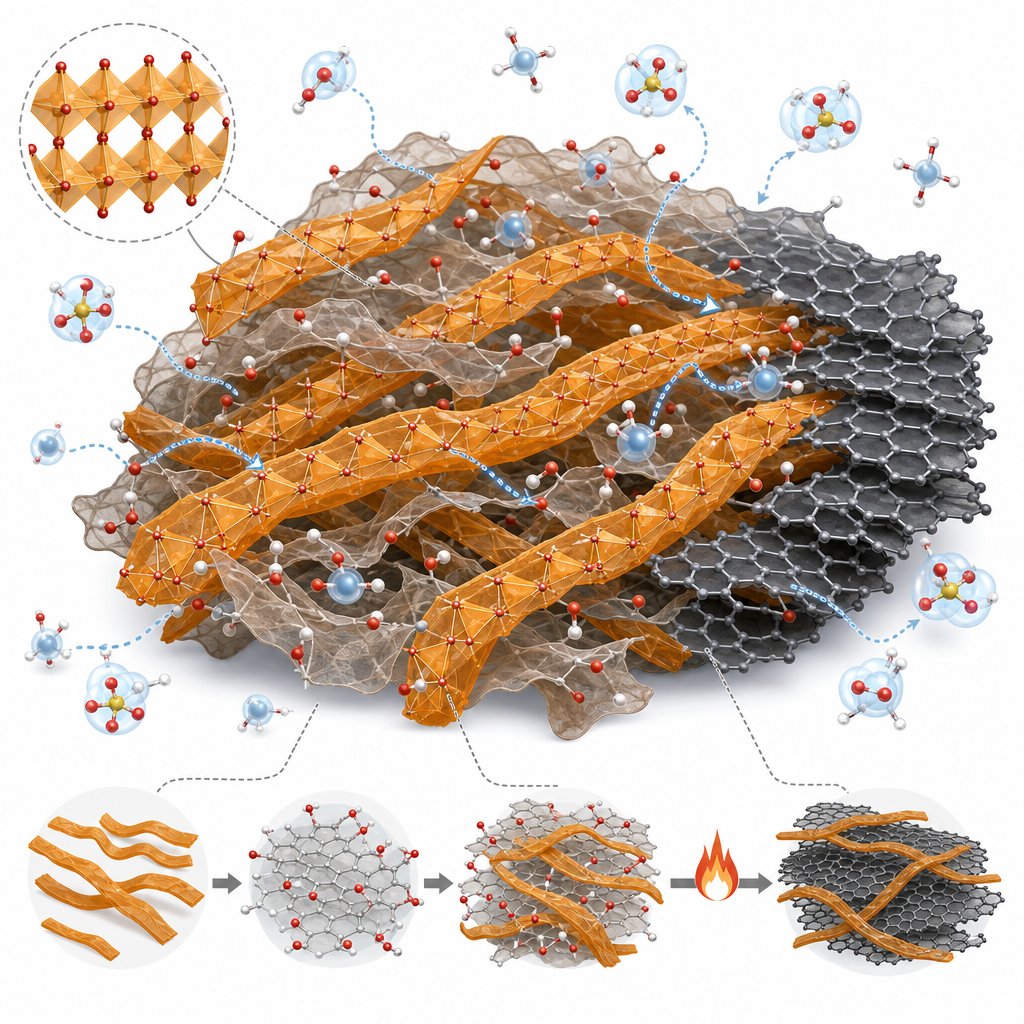
In the methodology, 350 mg of bulk α-V2O5 powder was soaked in deionized water for 4 hours so that water molecules could intercalate between the VO5 layers, then dispersed in tetrahydrofuran (THF). The dispersion was heated in a CEM microwave system at 300 W, 150 °C and 15 bar for 40 minutes; THF was chosen because its low loss tangent (tan δ ≈ 0.042) concentrates microwave energy into the V2O5 particles and the intercalated water, selectively rupturing interlayer interactions and breaking the zigzag double chains of square VO5 pyramids into ribbons. After centrifugation and 15 minutes of sonication in water, V2O5 nanoribbons 10–50 nm wide and several micrometres long were obtained at a yield of roughly 20%, with a supernatant concentration of 4.9 mg mL⁻¹. The nanoribbon supernatant was then mixed with graphene oxide from ACS Material at a V2O5:GO weight ratio of 8:2 and sonicated to ensure uniform dispersion. Adding 0.1 M Na2SO4 neutralized the surface charges, triggering self-assembly of the V2O5 nanoribbons with the GO nanosheets into a gel. Drying at 80 °C followed by annealing at 280 °C in nitrogen for 3 hours reduced the GO to rGO and produced the V2O5/rGO hybrid that was integrated with Super P and PVDF binder on nickel foam electrodes.
Key results confirmed the structural and electrochemical advantages of the hybrid. TEM imaging showed wrinkled nanoribbons with widths of 10–50 nm and lengths of thousands of nanometres, while HRTEM and fast Fourier transform analysis verified retention of the orthorhombic α-V2O5 crystal structure after microwave treatment. XRD, XPS, FTIR and Raman characterizations supported the preservation of V5+ oxidation states and successful reduction of GO to rGO at 280 °C, while BET surface area measurements showed enhanced porosity in the hybrid relative to bulk V2O5. Electrochemical testing in a three-electrode cell with 1.0 M Na2SO4 used a cyclic voltammetry window of −0.95 to 0.1 V, while the symmetric coin cell was operated from −1.0 to 1.0 V at scan rates between 10 and 150 mV s⁻¹. The V2O5/rGO electrodes achieved high specific capacitance values calculated from galvanostatic charge–discharge curves, delivered competitive energy and power densities for an aqueous symmetric device, and retained capacity over extended cycling. EIS measurements over 10⁻² to 10⁵ Hz showed low equivalent series resistance, consistent with the conductive rGO percolation network provided by the ACS Material graphene oxide precursor.
The approach has clear practical relevance. Aqueous, neutral-pH symmetric supercapacitors are attractive for grid storage, hybrid electric vehicle peak-power buffering, and wearable electronics because they avoid flammable organic electrolytes and toxic precursors. The microwave-assisted method described here is fast, uses inexpensive solvents, and scales naturally with commercial microwave reactors, while the GO self-assembly step can be readily transferred to other layered-oxide systems such as MoO3, MnO2, or Nb2O5. The authors point to further opportunities in optimizing the V2O5:GO ratio, exploring asymmetric device configurations with carbon counter electrodes, and applying the same exfoliation strategy to other vanadate phases for lithium- and sodium-ion battery cathodes.
For researchers pursuing similar hybrid electrode chemistries, the relevant precursor — graphene oxide — is part of ACS Material's graphene series and is available in multiple grades, including single-layer flake and dispersion forms suitable for self-assembly with metal-oxide nanostructures. The Kansas State team's results show that a straightforward charge-screening protocol can deliver well-integrated 2D-oxide/graphene hybrids without harsh chemical reduction, providing a useful reference protocol for groups working on pseudocapacitive composites, flexible energy-storage devices, and graphene-supported electrocatalysts.How ACS Material products were used
- Graphene Oxide (GO) (Graphene Series) — “The obtained V2O5 nanoribbon supernatant (14 mL) was mixed with graphene oxide (GO, ACS Material) to form a suspension with a V2O5-to-GO weight ratio of 8:2.”
Product Performance in this StudyThe ACS Material graphene oxide served as the carbon scaffold that self-assembled with exfoliated V2O5 nanoribbons and was thermally reduced to rGO, producing a V2O5/rGO hybrid that achieved high specific capacitance and stable cycling performance in symmetric supercapacitors.
Related product categories
Frequently asked questionsWhy use graphene oxide instead of reduced graphene oxide for V2O5 composite electrodes?
Graphene oxide carries oxygen functional groups and a negative surface charge that allows electrostatic self-assembly with V2O5 nanoribbons in solution. This produces an intimate, uniform mixing that is difficult to achieve with already-reduced graphene. After assembly, mild thermal annealing converts the GO to rGO in situ, restoring electrical conductivity while preserving the V2O5/graphene interface needed for fast pseudocapacitive charge transfer.
How does microwave-assisted exfoliation of V2O5 compare with hydrothermal synthesis?
Microwave-assisted exfoliation completes the nanoribbon production step in about 40 minutes, compared with several hours to days for typical hydrothermal V2O5 synthesis. It also preserves the crystalline α-V2O5 phase because it operates as a top-down disruption of interlayer bonds rather than dissolution and recrystallization. The reported 20% yield of high-aspect-ratio nanoribbons is competitive with chemical exfoliation while avoiding strong oxidizers.
What V2O5 to graphene oxide ratio works best for supercapacitor hybrids?
In this study, a V2O5-to-GO weight ratio of 8:2 was used and gave good electrochemical performance in symmetric Na2SO4 supercapacitors. This composition keeps V2O5 as the dominant pseudocapacitive component while providing enough rGO after annealing to form a continuous conductive network. Lower graphene loading reduces conductivity, while higher loading dilutes the active V2O5 mass and lowers volumetric capacitance.