-
Graphene Oxide H2 Storage Study - Umeå University, 2015
Jul 01, 2026 | ACS MATERIAL LLCKlechikov, A. G. et al. (2015). Hydrogen storage in bulk graphene-Related materials. *Microporous and Mesoporous Materials*. https://doi.org/10.1016/j.micromeso.2015.02.017
Microporous and Mesoporous Materials · 2015
Umeå University researchers used ACS Material graphite oxide to benchmark hydrogen storage in bulk graphene, reaching 5 wt% at 77 K and 2300 m²/g.
About this research
Researchers at Umeå University, working with collaborators at Grupo Antolin (GRAnPH), used Hummers graphite oxide purchased from ACS Material as one of several precursors to systematically benchmark hydrogen storage in bulk graphene-related materials, demonstrating that even high-surface-area reduced graphene oxide does not exceed 1 wt% H2 uptake at 293 K and 120 bar. The study, published in Microporous and Mesoporous Materials in 2015, tackles a contentious question in the hydrogen energy community: do graphene materials truly outperform other nanostructured carbons for H2 physisorption, as several earlier reports had claimed? By preparing dozens of samples spanning 200-2300 m²/g, the authors deliver one of the most thorough surface-area-versus-uptake datasets available for this material class.
Hydrogen storage is the bottleneck for practical hydrogen-fuel deployment. Nanostructured carbons - activated carbons, single- and multi-walled carbon nanotubes, carbide-derived carbons, and graphite nanofibers - have been studied for two decades as physisorbents because they offer high surface area, chemical stability, and scalable production. Historically, the field has been plagued by overestimated uptake values, most notoriously for early carbon nanotube reports that were later revised downward. When papers began claiming H2 uptakes as high as 3.1 wt% at 100 bar and room temperature for graphene samples with only 925 m²/g, the discrepancy with established trends for other carbons (~0.3 wt% per 1000 m²/g at ambient) demanded independent verification. This paper provides that verification using carefully controlled gravimetric and volumetric measurements.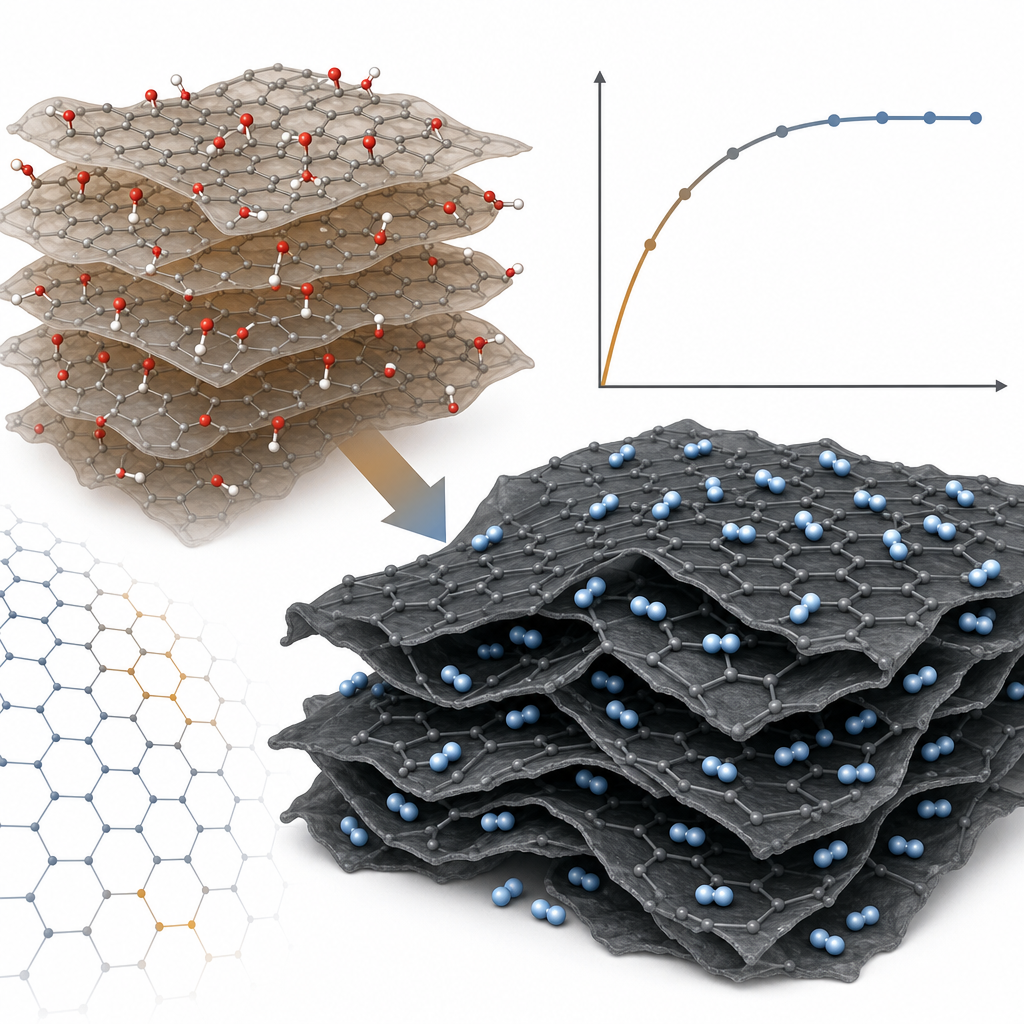
The ACS Material Hummers graphite oxide (HGO) was used as a starting material for graphene synthesis. According to the experimental section, the authors note: "HGO purchased from ACS Materials (see detailed characterization in [31],[32]), C/O=2.47." This sample was one of multiple HGO and Brodie graphite oxide (BGO) precursors thermally exfoliated by rapid insertion into a hot furnace at 250-450 °C, producing reduced graphene oxide powders. The ACS Material HGO was characterized in detail in prior work by the same group, providing a well-known reference point for C/O ratio and structural features. Some r-GO samples were further subjected to KOH activation - either by grinding KOH with the powder and annealing in argon at 800 °C, or by KOH solution impregnation - to push surface areas from the ~450-500 m²/g typical of thermally exfoliated HGO up to 2300 m²/g. Hydrogen sorption isotherms were then recorded using a Rubotherm gravimetric system up to 120 bar and a Hiden IMI volumetric system at 77 K, with uptake precision of ±0.02 wt%.
The headline results overturn several optimistic earlier claims. At 293 K and 120 bar, H2 uptake scaled linearly with BET surface area below 1000 m²/g and saturated near 0.8-0.9 wt% at the highest accessible surface areas (~3000 m²/g extrapolated). Best Brodie GO exfoliation produced ~850 m²/g; HGO-derived r-GO topped out at 450-500 m²/g; the GRAnPH HGO yielded up to 311 m²/g. KOH activation expanded the range to 1000-2300 m²/g. At 77 K, uptake increased linearly with surface area to a maximum of ~5 wt% for the 2300 m²/g sample. Crucially, samples spanning very different synthesis routes, defect densities, and flake sizes all collapsed onto a single uptake-versus-surface-area curve - and that curve also captured benchmark MOF-5 and Pt-on-carbon samples measured on the same instrument. Additional H2 annealing at 350 °C and 50 bar for 12 hours improved uptake only marginally (0.20 to 0.22 wt%), confirming that residual functional groups are not the limiting factor. The data demonstrate that bulk graphene materials follow exactly the same physisorption trends as activated carbons and CNTs, with no anomalous enhancement.
The findings have important implications for hydrogen-storage research and for any application relying on graphene surface area, including supercapacitors, adsorptive separations, and catalyst supports. Researchers can now use this dataset as a reliable calibration baseline when evaluating new porous carbons. At cryogenic temperatures, graphene remains among the best physisorbents and could find use in liquid-nitrogen-cooled hydrogen storage tanks, on-board reformer pre-storage units, and laboratory H2 buffering systems. The paper also strengthens the case for combining graphene with chemical hydrogen carriers or for engineering interlayer spacing to break the single-layer surface-area ceiling.
For researchers pursuing graphene-based gas adsorption, electrochemistry, or composite synthesis, the Hummers-method graphite oxide and reduced graphene oxide grades available from ACS Material provide well-characterized, batch-consistent starting points - the same kind of material on which this benchmarking study was built. Reproducibility in this field hinges on knowing the C/O ratio, flake size, and defect state of the precursor, all of which ACS Material specifies for its graphene-series products.How ACS Material products were used
- Hummers Graphite Oxide (HGO) (Graphene Series) — “HGO purchased from ACS Materials (see detailed characterization in [31],[32]), C/O=2.47”
Product Performance in this StudyThe ACS Material Hummers graphite oxide was one of several GO precursors thermally exfoliated to produce reduced graphene oxide samples for hydrogen storage testing. Exfoliation of this HGO yielded r-GO with surface areas up to ~450-500 m2/g, contributing to the broader 200-2300 m2/g dataset used to establish the H2 uptake vs surface area trend.
Related product categories
Frequently asked questionsHow much hydrogen can bulk graphene actually store at room temperature?
Carefully controlled gravimetric measurements across reduced graphene oxide samples with BET surface areas from 200 to 2300 m²/g show that hydrogen uptake at 293 K and 120 bar does not exceed 1 wt%. The uptake scales linearly with surface area below 1000 m²/g and saturates near 0.8-0.9 wt% at higher surface areas, matching the trend established for activated carbons and carbon nanotubes.
Why is BET surface area important for hydrogen physisorption in graphene materials?
Hydrogen physisorption on carbon materials is governed by available surface area and micropore volume because H2 molecules bind weakly through van der Waals forces. The 2015 study showed that despite differences in defect density, C/O ratio, and flake size, all graphene samples collapse onto a single uptake-versus-surface-area curve. Reaching higher uptakes therefore requires increasing accessible surface area, typically via KOH activation.
What role does graphite oxide play in producing high-surface-area graphene?
Graphite oxide is the most common precursor for bulk graphene synthesis. Rapid thermal exfoliation releases oxygen and hydroxyl groups as gas, generating internal pressure that separates the layers. Hummers-method graphite oxide, including material from ACS Material with C/O around 2.5, yields reduced graphene oxide with surface areas of 450-500 m²/g, which can be increased to 2300 m²/g by post-exfoliation KOH activation.