-
Graphene Oxide Membrane Swelling in Alcohols - Umeå University, 2019
Jun 04, 2026 | ACS MATERIAL LLCIakunkov, A. et al. (2019). Swelling of graphene oxide membranes in alcohols: effects of molecule size and air ageing. *Journal of Materials Chemistry A*. https://doi.org/10.1039/c9ta01902b
Department of Physics · Journal of Materials Chemistry A · 2019
Umeå University researchers used ACS Material graphite oxide to show how GO membrane swelling in alcohols changes with molecule size and air ageing.
About this research
Researchers from the Department of Physics at Umeå University used commercial ACS Material Hummers graphite oxide (HGO1) to systematically investigate how graphene oxide (GO) membranes swell in a homologous series of nine liquid alcohols and how this behavior degrades with air ageing. The team found that freshly prepared HGO membranes expand their interlayer spacing from about 7 Å in the dry state up to roughly 26 Å in 1-nonanol, but after only months to years of storage in ambient air the same membranes lose the ability to intercalate larger alcohols entirely. The work, published in Journal of Materials Chemistry A, identifies sample ageing as a previously underappreciated variable that may explain the orders-of-magnitude scatter in GO membrane permeation data reported in the literature.
GO laminate membranes have been heavily promoted for gas separation, nanofiltration, solvent separation, and water desalination, with their performance governed by the size of solvent-filled permeation channels between stacked GO sheets. Yet reported permeation rates and selectivities vary by up to two orders of magnitude between groups. Standardization efforts have so far focused on oxidation degree, flake size, and defect density, but the role of post-synthesis ageing has received almost no attention. Because GO interlayer expansion in polar solvents directly determines pore dimensions, any time-dependent change in swelling translates immediately into changes in flux and selectivity. Understanding ageing is therefore essential for translating GO membrane research into reproducible industrial separation technology.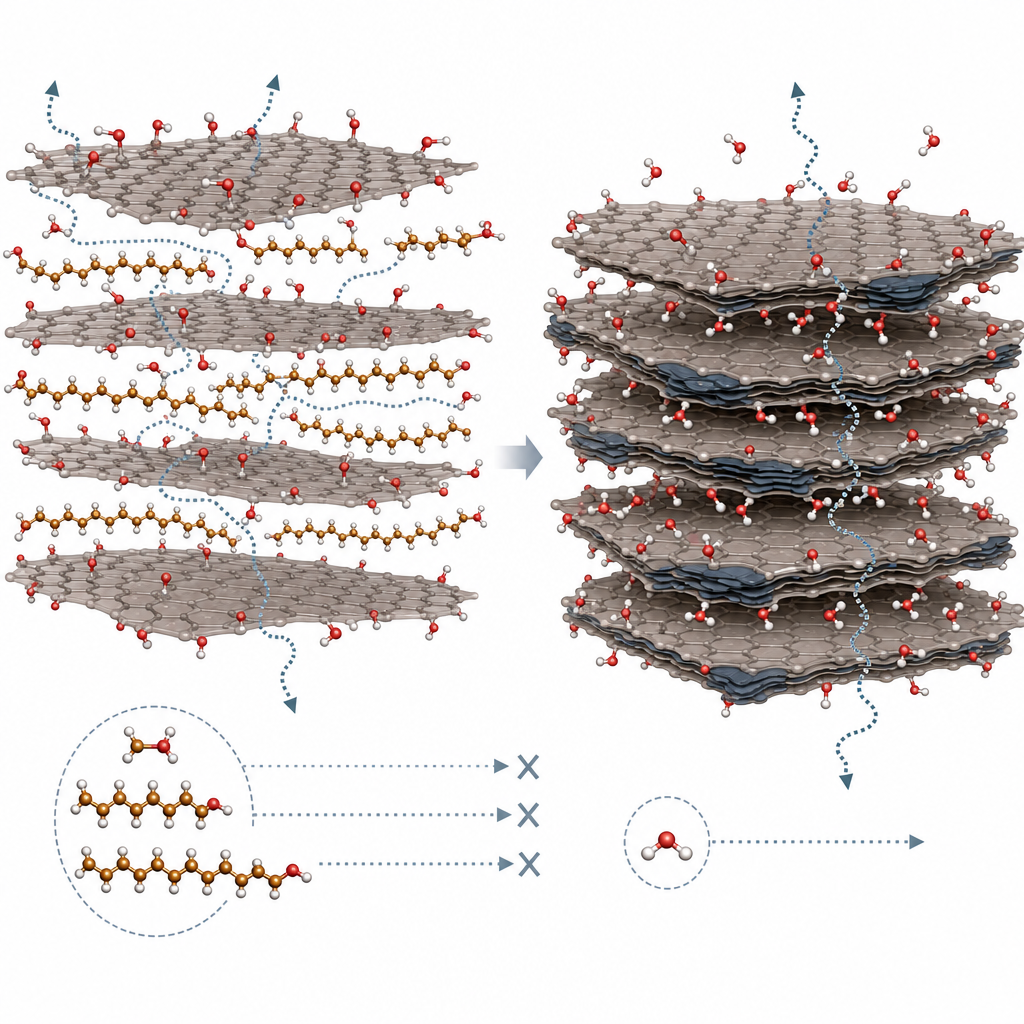
The ACS Material HGO1 precursor powder was used both as a reference swelling material and as the feedstock for vacuum-filtered free-standing membranes typically 5–50 µm thick. Aqueous dispersions of the commercial graphite oxide were prepared, filtered, and dried into laminates, with several batches set aside for ageing studies extending from one week to five years under typical laboratory humidity (15–40%) and room temperature. Synchrotron XRD at beamline ID11 of the ESRF (λ = 0.30996 Å) and an in-house PANalytical X'pert with Cu Kα radiation were used to track the (001) reflection of samples immersed in excess liquid methanol through 1-nonanol. Complementary characterization included Neutron Reflectivity at SuperADAM (ILL Grenoble) on spin-coated HGO1 films in saturated d6-ethanol vapor, plus XPS, FTIR, and AFM to track chemical and flake-size evolution. Importantly, the same lot of ACS Material HGO1 powder purchased in 2013 was re-evaluated in 2018 to test for precursor ageing.
Freshly prepared HGO membranes and the precursor HGO powder swelled essentially identically in all nine alcohols, with d(001) scaling with carbon-chain length up to 26 Å in 1-nonanol, consistent with multilayer alcohol intercalation. The picture changed dramatically with air storage. A five-year-old HGO1 membrane retained its dry-state spacing of 7.8 Å but expanded to only 8.1 Å in ethanol, versus 15 Å for the freshly prepared analogue. Membranes aged 0.6–2.5 years showed three signatures: (i) complete suppression of swelling in 1-hexanol, 1-heptanol, 1-octanol, and 1-nonanol; (ii) anomalously reduced ethanol swelling to 9.5–10.5 Å; and (iii) preserved swelling in 1-propanol, 1-butanol, and 1-pentanol. Crucially, water uptake remained substantial even in the five-year-old sample (d(001) = 10.6 Å). Neutron reflectivity confirmed d6-ethanol sorption fell from 0.30 to 0.07 mol per formula unit over four years. In stark contrast, the ACS Material HGO1 precursor powder showed essentially unchanged swelling in all alcohols even after four years of storage, with only minor XPS changes (C/O ratio shifting from 2.47 to 2.38). XPS depth analysis revealed ageing initiates at the membrane surface and propagates inward over months.
The authors propose a two-step swelling mechanism in which solvent must diffuse along zigzag pathways past overlapping flake edges ("junctions") within the laminate. Ageing appears to crosslink or stiffen these junction regions, progressively closing off paths for larger molecules while leaving water transport intact. This insight reframes ageing as a tunable parameter rather than purely a degradation pathway: controlled air exposure could be exploited to engineer molecular-sieving selectivity for water/alcohol separations, solvent dehydration, and selective sorption. The work also calls for standardized reporting of storage time, humidity, and temperature in all GO membrane studies, which should improve reproducibility across the nanofiltration, pervaporation, and gas-separation communities.
For researchers working on GO laminates, 2D-material membranes, or carbon-based separation media, this study underlines the importance of starting from a well-characterized, reproducible precursor. The Hummers graphite oxide and related graphene oxide products in the ACS Material Graphene Series catalog are available to groups pursuing similar swelling, intercalation, and membrane-permeation work, and the present paper provides quantitative benchmarks against which new batches and storage protocols can be compared.How ACS Material products were used
- Hummers Graphite Oxide (HGO) powder (Graphene Series) — “The powder samples of commercial ACS Material graphite oxide (HGO1) and several batches of graphite oxides synthesized in our laboratory (HGO2, HGO3, and HGO4) were used to prepare membranes by vacuum filtration of aqueous dispersions.”
Product Performance in this Study
The commercial ACS Material Hummers graphite oxide (HGO1) served as the reference precursor and was used to fabricate vacuum-filtered GO membranes. It exhibited reproducible swelling behavior in alcohols from methanol to 1-nonanol, with interlayer spacing increasing from 7 Å to 26 Å, and notably retained its swelling capability even after 4 years of air storage.
Related product categories
Frequently asked questions
How does air ageing affect graphene oxide membrane swelling in alcohols?
Air ageing progressively reduces alcohol uptake in graphene oxide membranes. Within 0.6–2.5 years, swelling in 1-hexanol and larger alcohols disappears entirely, and ethanol-induced interlayer spacing drops from about 15 Å to 9.5–10.5 Å. After five years, ethanol swelling is nearly absent, though water swelling is partially preserved. The effect originates at the membrane surface and propagates inward through restricted edge-overlap junctions.
Why do graphite oxide powders resist ageing while GO membranes degrade?
In graphite oxide powders, every interlayer is directly accessible to the bulk liquid through the open edges of the original graphite grains, so swelling proceeds in one step. In vacuum-filtered membranes, solvent must navigate zigzag pathways past overlapping flake edges. These junction regions appear to stiffen or crosslink over time via humidity-mediated reactions, blocking larger molecules while leaving the bulk flake chemistry essentially unchanged.
What is the maximum interlayer spacing of GO membranes in long-chain alcohols?
Freshly prepared Hummers graphene oxide membranes reach interlayer spacings of approximately 26 Å when immersed in 1-nonanol, with the d(001) value scaling roughly linearly with alcohol carbon-chain length. This corresponds to multilayer intercalation of alcohol molecules between GO sheets, consistent with behavior previously documented in Brodie graphite oxides and useful for designing tunable molecular-sieving channels.