-
Graphene Oxide Membranes for Air Dehumidification — Lomonosov Moscow State University, 2021
Jun 02, 2026 | ACS MATERIAL LLCChernova, E. et al. (2021). The role of oxidation level in mass-transport properties and dehumidification performance of graphene oxide membranes. *Carbon*. https://doi.org/10.1016/j.carbon.2021.07.011
Carbon · 2021
Researchers at Lomonosov Moscow State University benchmark GO membranes against ACS Material graphene oxide, achieving water vapor permeance over 60 m³(STP)·m⁻²·bar⁻¹·h⁻¹.
About this research
Researchers at Lomonosov Moscow State University investigated how the oxidation degree of graphene oxide (GO) governs mass-transport in ultra-thin GO membranes for air dehumidification, using ACS Material commercial graphene oxide as a published reference for interlayer-spacing behavior. By varying the graphite:KMnO₄ ratio in an improved Hummers' synthesis and applying mild thermal reduction, the team produced GO membranes spanning a C:O range of 1.81 to 2.60. They demonstrated that strongly oxidized GO delivers water vapor permeance exceeding 60 m³(STP)·m⁻²·bar⁻¹·h⁻¹ while retaining strong selectivity against permanent gases — a combination directly relevant to next-generation dehumidification membrane technology.
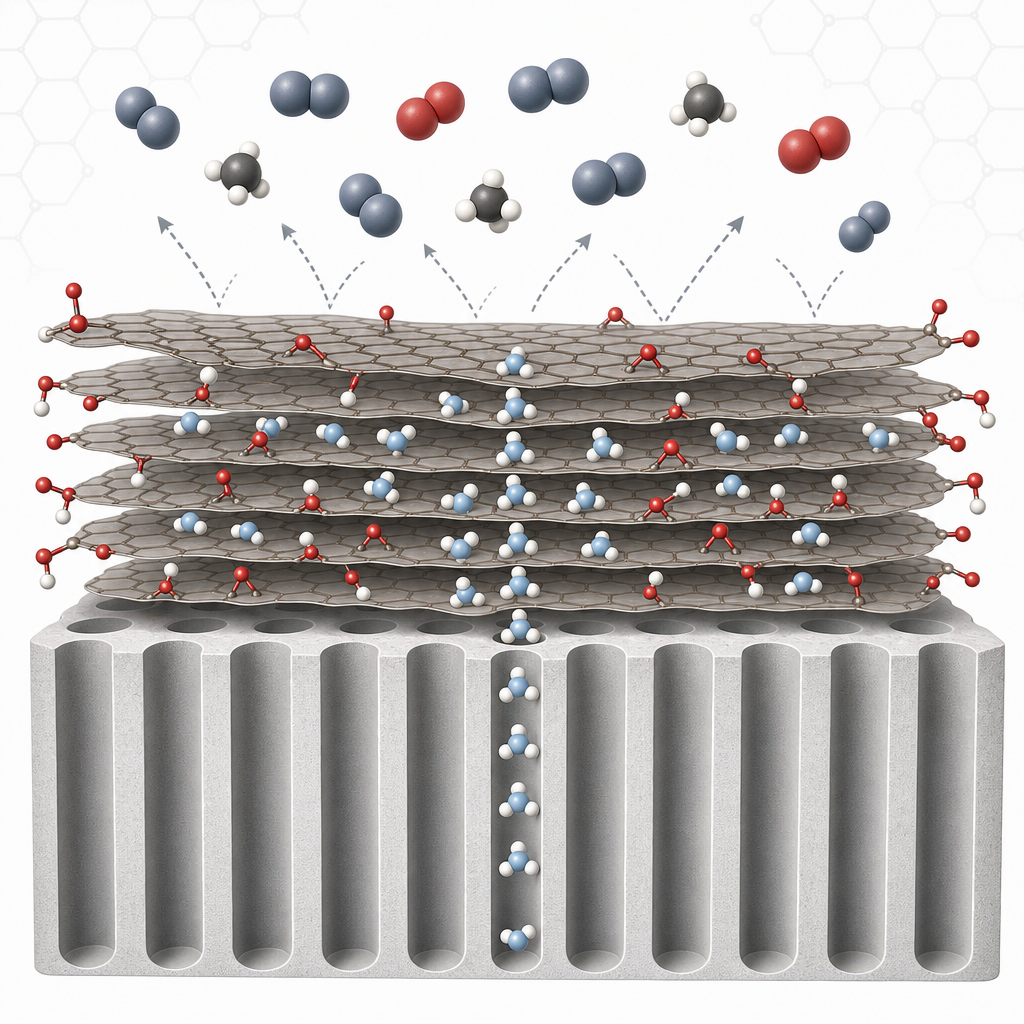
Air dehumidification is increasingly important for HVAC efficiency, pharmaceutical processing, fuel cell humidity management, and compressed-gas drying. Conventional polymeric dehumidification membranes based on sulfonated polyether ether ketone or polyethersulfone are limited in their H₂O/N₂ selectivity and permeance trade-off. Two-dimensional graphene oxide membranes have emerged as a leading alternative because their interlayer galleries provide selective water diffusion channels. However, GO is chemically diverse: oxygen functional group composition shifts strongly with synthesis route, and prior reports on the role of oxidation degree have remained controversial. This work systematically isolates oxidation-degree effects while holding nanosheet lateral size (~750–900 nm) constant, providing the field with quantitative correlations between C:O ratio, interlayer spacing, and water transport activation barriers.
Graphene oxide was synthesized in-house by the improved Hummers' method with graphite:KMnO₄ mass ratios ranging from 2:1 to 1:20, yielding nanosheets with C:O ratios from 2.11 to 1.81. To extend the C:O range to 2.60, one membrane was thermally reduced at 200 °C. Selective GO layers were spin-coated under vacuum suction onto porous anodic aluminum oxide (AAO) supports with ~80 nm pores. The ACS Material commercial graphene oxide entered the study as a published structural benchmark: the authors cited its reported interlayer distance of 7.18 Å in the dry state and 12.41 Å in the wet state (C:O = 2.47) to validate their grazing-incidence wide-angle X-ray scattering (GIWAXS) measurements at the P03 beamline of PETRA III. This cross-reference confirmed that the in-house GO membranes' measured d-spacing values (8.3–13.3 Å across the humidity range) followed the same structural trends as established commercial GO products.
XPS analysis revealed that increasing oxidizer activity shifted C–O functional group content from 35 at.% to 50 at.%, while C–C content fell from 54 at.% to 38 at.%. The C=O fraction remained nearly constant at 9–11 at.%, indicating that the improved Hummers' method does not produce significant through-defects in the basal plane. Water contact angles decreased from 32° (MFGO-1:1) to 4.5° (MFGO-1:20), confirming progressive hydrophilization. GIWAXS measurements showed dry-state interlayer distances rising from 8.31 Å (MFGO-1:1) to 8.54 Å (MFGO-1:20), expanding to 12.2–13.3 Å under humid conditions. Water vapor permeance grew dramatically with oxidation degree, exceeding 60 m³(STP)·m⁻²·bar⁻¹·h⁻¹ for the most oxidized samples, while permanent gas (CH₄, N₂, O₂, CO₂, C₄H₁₀) permeance dropped slightly. Crucially, water sorption capacity stayed nearly independent of C:O ratio (0.65–0.70 g H₂O per g GO at saturation), revealing that diffusivity — not sorption — is the rate-limiting factor. Semi-empirical PM7 modeling in MOPAC2016 confirmed that H₂O hopping activation barriers drop by up to an order of magnitude over 0–100% RH for strongly oxidized GO.
These findings have direct implications for industrial air dehumidification, fuel cell humidity management, natural gas drying, and pervaporation membranes. By identifying that water-vapor diffusivity (not sorption uptake) is the key bottleneck, the work guides membrane designers to prioritize maximum oxidation degree and optimized interlayer chemistry. The semi-empirical activation-barrier model also offers a transferable predictive tool for designing GO and graphene-oxide-derivative membranes targeting low partial-pressure water removal. Follow-up work suggested by the authors includes deeper exploration of azimuthal corrugation effects, hybrid GO membranes with tunable functional groups, and operational testing under varied temperature and pressure regimes relevant to compressed-air drying systems.
For researchers developing 2D membrane technologies, this paper underscores the importance of using well-characterized graphene oxide as a starting material. ACS Material's graphene oxide series — including modified Hummers' method GO, large-size GO, low-defect GO, and reduced graphene oxide — provides researchers with reproducible 2D building blocks suitable for membrane separation, dehumidification, and ion-rejection research. Comparable interlayer-spacing behavior between commercial and in-house GO, as documented in this study, makes commercial GO a reliable foundation for systematic transport investigations.How ACS Material products were used
- Graphene Oxide (modified Hummers' method, C:O ratio 2.47) (Graphene Series) — “results, published for membranes based on commercial GO prepared by modified Hummers' method (ACS Material) with C:O ratio of 2.47, (the interlayer distance is 7.18 Å in dry state and 12.41 Å for wet GO)”
Product Performance in this Study
ACS Material's commercial graphene oxide served as a literature benchmark for interlayer distance measurements. The authors' in-house synthesized GO membranes showed d-spacing values (8.3–13.3 Å) consistent with previously published data on ACS Material GO, validating their structural characterization.
Related product categories
Frequently asked questions
How does graphene oxide oxidation degree affect water vapor permeance in membranes?
Increasing the oxidation degree of graphene oxide (lowering the C:O ratio from 2.60 to 1.81) raises water vapor permeance to over 60 m³(STP)·m⁻²·bar⁻¹·h⁻¹ while only slightly reducing permanent gas permeance. The improvement is driven primarily by lower water diffusion activation barriers, not by increased sorption capacity, which remains roughly constant across oxidation levels at around 0.65–0.70 g H₂O per g GO.
What is the typical interlayer spacing of graphene oxide membranes in dry and wet states?
Graphene oxide membranes typically show interlayer spacing of 7.2–8.5 Å in the dry state and 12.2–13.3 Å under wet or high-humidity conditions. The exact values depend on oxidation degree and humidity. Commercial graphene oxide from ACS Material is reported at 7.18 Å (dry) and 12.41 Å (wet), serving as a useful benchmark for laboratory-synthesized GO.
Why is diffusivity more important than sorption for water transport in GO membranes?
Although graphene oxide absorbs significant water across all oxidation degrees, the rate of transmembrane transport depends on how easily water molecules hop between interlayer sites. The semi-empirical modeling in this study showed that activation barriers drop by up to an order of magnitude with higher oxidation degree, while sorption capacity stays nearly constant — making diffusivity the controlling factor for dehumidification performance.