-
Graphene Oxide rGO FET Biosensor for SARS-CoV-2 - University of Chicago, 2022
Jun 10, 2026 | ACS MATERIAL LLCJang, H. et al. (2022). Remote floating-gate field-effect transistor with 2-dimensional reduced graphene oxide sensing layer for reliable detection of SARS-CoV-2 spike proteins. *ACS Applied Materials & Interfaces*. https://doi.org/10.1021/acsami.2c04969
University of Chicago · ACS Applied Materials & Interfaces · 2022
University of Chicago researchers built a remote floating-gate rGO FET biosensor using ACS Material graphene oxide to detect SARS-CoV-2 spike proteins at pg/mL levels.
About this research
Researchers at the University of Chicago report a remote floating-gate field-effect transistor (RFGFET) built with a two-dimensional reduced graphene oxide (rGO) sensing layer derived from ACS Material graphene oxide, achieving label-free detection of SARS-CoV-2 spike proteins from 500 fg/mL to 5 µg/mL in saliva-relevant media with a coefficient of variation under 3%. Published in ACS Applied Materials & Interfaces (2022), the work tackles the long-standing reliability problem of 2D-material FET biosensors by capacitively decoupling the rGO sensing surface from the transistor channel. The platform delivers near-Nernstian pH sensitivity (54 mV/pH), a 90% device yield, and a drift rate of only 2%, positioning the architecture as a credible candidate for clinical point-of-care COVID-19 diagnostics.
Despite years of demonstrations, low-dimensional FET biosensors have struggled to leave the laboratory. Variations in grain boundaries, defects, oxygen functional groups, and solution-interface redox reactions translate into device-to-device drift and hysteresis that disqualify these sensors from regulated diagnostic use. RT-PCR remains the gold standard for SARS-CoV-2 but requires hours of laboratory turnaround, while lateral flow immunoassays sacrifice sensitivity. A reliable FET-based platform would close that gap by combining rapid electrical readout with sensitivity in the pg/mL regime. The University of Chicago team addresses this by isolating the 2D sensing surface from current-carrying paths and systematically dissecting how rGO thickness, coverage, and reduction temperature govern interfacial stability.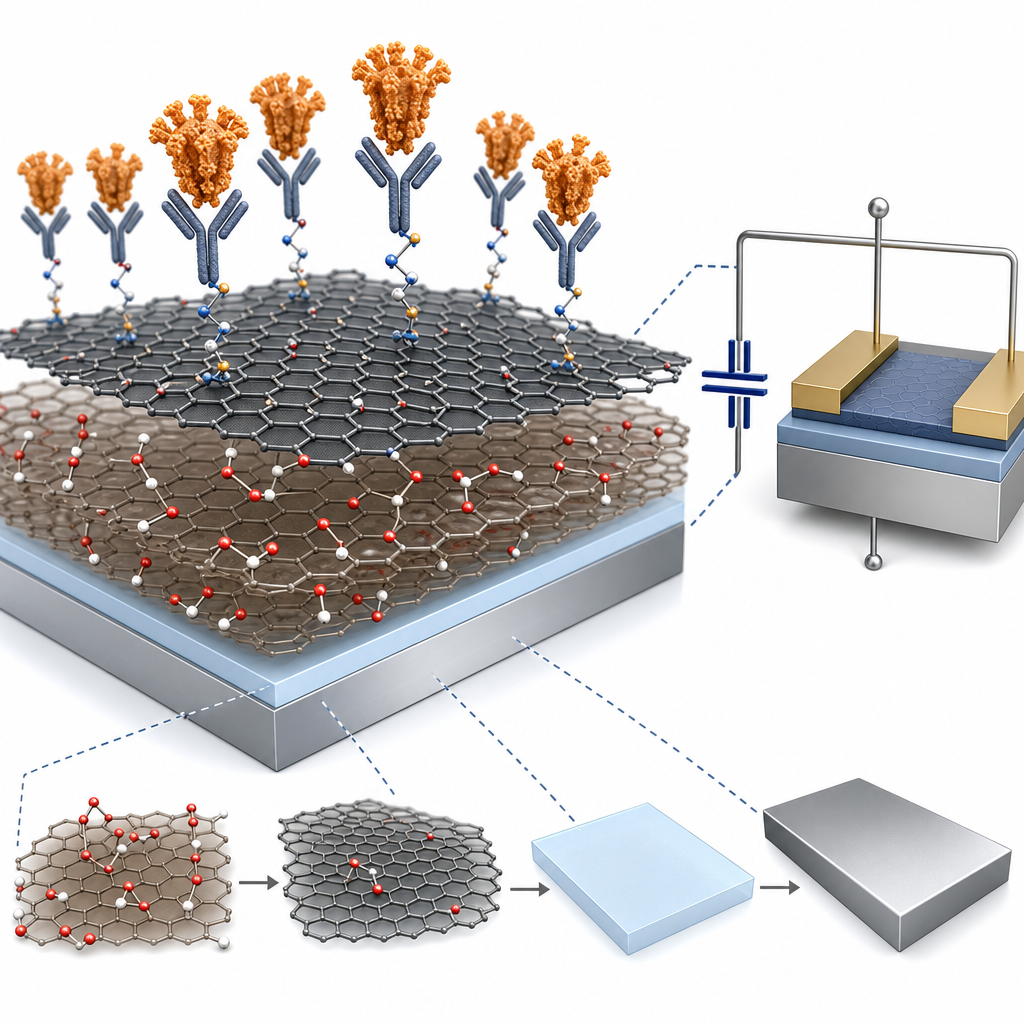
The graphene oxide was sourced from ACS Material (CAS 7782-42-5) and dispersed in deionized water by ultrasonication to produce GO solutions ranging from 0.12 to 0.59 mg/mL. Two deposition routes were compared on (3-aminopropyl)trimethoxysilane (APTMS)-treated SiO2/Si floating-gate substrates: spin-coating at 1,600 rpm for 1 min, and a heat-assisted drop-casting method in which 16 mL of 0.12 mg/mL GO solution was cast over a 4-inch wafer and baked at 120 °C for 1 h. The drop-casting route produced essentially continuous, approximately 4-nm-thick multilayer GO films verified by AFM and SEM, in contrast to the discontinuous networks generated by spin-coating. The GO films were thermally reduced at 200, 300, or 400 °C under argon. Raman spectra (D band at 1,350 cm⁻¹, G band at 1,583 cm⁻¹) and XPS confirmed retained oxygen functional groups critical for pH and protein sensing. The rGO sensing layer was then capacitively coupled to a commercial CD4007 FET transducer.
The optimized multilayer rGO, reduced at 200 °C, delivered a Nernstian pH response of 54 mV/pH from pH 2 to pH 11 with R² of 0.998 and CV below 3%, a 90% yield across ten devices, and a drift rate of 2% — a 50-fold improvement over comparable rGO-channel FETs. For SARS-CoV-2 spike protein detection, rGO surfaces were functionalized with 1-pyrenebutyric acid N-hydroxysuccinimide ester (PBASE), conjugated with 20 or 250 µg/mL neutralizing antibody (Sino Biological 40592-MM57), and blocked with BSA. In 0.05× PBS the sensor achieved a sensitivity of 6.3 mV/dec over 3.4 pg/mL to 34 ng/mL with R² = 0.986. In a 1:20 artificial-saliva/PBS mixture buffered at pH 7.4, the device gave 5.1 mV/dec from 500 fg/mL to 5 µg/mL, with R² = 0.984 and CV < 3% across five devices. The guaranteed limit of detection was a few pg/mL, well below clinically relevant viral loads. Specificity was confirmed by inverse signal trends on bare rGO with BSA and by complementary ELISA on antibody-conjugated rGO substrates.
The results have direct implications for rapid, scalable COVID-19 testing and, more broadly, for any FET biosensor that needs to operate reproducibly outside controlled lab conditions. By electrically isolating the 2D sensing layer with an insulator and treating it as a remote floating gate, the architecture can in principle be adapted to other targets — viral antigens, cytokines, nucleic acids, neurodegenerative biomarkers — while preserving device uniformity demanded by FDA-grade diagnostics. The authors note that the trade-off between conductivity and pH sensitivity, governed by reduction temperature and GO network density, is a general design lever for graphene-based bioelectronics. Future work pointed to by the paper includes extending the platform to multiplexed panels and integrating it with microfluidic saliva sampling.
For researchers working on graphene-oxide-based biosensors, electrochemical pH sensors, or 2D-material FETs, the graphene oxide grade used in this study is available from ACS Material, along with related reduced graphene oxide products and CVD graphene substrates. The reproducibility and yield reported here illustrate why starting material quality matters as much as device architecture when building clinically translatable bioelectronics.How ACS Material products were used
- Graphene Oxide (GO) (Graphene Series) — “GO solutions of 0.12, 0.24, 0.48, and 0.59 mg/ml were prepared by dispersing GO (ACS Material, 7782-42-5) in deionized water aided by ultrasonication for 20 min.”
Product Performance in this StudyThe ACS Material graphene oxide was used to fabricate the reduced graphene oxide (rGO) sensing layer at the heart of the RFGFET. Optimized multilayer rGO achieved a near-Nernstian pH response of 54 mV/pH (R² = 0.998), 90% device yield, drift rate of 2%, CV < 3%, and enabled reliable SARS-CoV-2 spike protein detection down to a few pg/mL.
Related product categories
Frequently asked questionsHow does reduced graphene oxide improve FET biosensor reliability for SARS-CoV-2 detection?
In this study, reduced graphene oxide acted as a remote floating-gate sensing layer that is electrically isolated from the transistor channel by a SiO2 insulator. This configuration blocks current flow into the rGO and eliminates degradation from interface traps, defects, and redox reactions. The result is a 50-fold lower drift rate, a 90% device yield, CV below 3%, and reproducible detection of SARS-CoV-2 spike proteins down to a few pg/mL.
Why does the reduction temperature of graphene oxide matter for biosensor performance?
Reduction temperature controls the trade-off between conductivity and pH or protein sensitivity. Higher temperatures (300–400 °C) remove more oxygen functional groups, increasing conductivity but also hydrophobicity and reducing surface response to analytes. The University of Chicago team found that 200 °C reduction preserves enough oxygen functionalities for a 54 mV/pH Nernstian response while still providing sufficient conductivity to suppress hysteresis and drift at the solution interface.
What is the detection limit of the rGO RFGFET for SARS-CoV-2 spike proteins in saliva?
In a 1:20 artificial saliva to 0.05× PBS mixture buffered at pH 7.4, the antibody-functionalized rGO RFGFET responded linearly from 500 fg/mL to 5 µg/mL of SARS-CoV-2 spike protein with a sensitivity of 5.1 mV/dec, R² of 0.984, and CV below 3% across five devices. Considering the maximum baseline fluctuation of about 10 mV, the guaranteed practical limit of detection is a few pg/mL.