-
Graphene Oxide Transport in Aquifer Sediments — Flinders University, 2021
Jun 23, 2026 | ACS MATERIAL LLCEsfahani, A. R. et al. (2021). Transport and retention of graphene oxide nanoparticles in sandy and carbonaceous aquifer sediments: Effect of physicochemical factors and natural biofilm. *Journal of Environmental Management*. https://doi.org/10.1016/j.jenvman.2020.111419
Journal of Environmental Management · 2021
Flinders University researchers used ACS Material single-layer graphene oxide to study GONP transport, retention, and biofilm effects in sandy and limestone aquifer sediments.
About this research
Researchers at Flinders University (Adelaide, Australia), in collaboration with the National Centre for Groundwater Research and Training, used single-layer graphene oxide nanoparticles purchased from ACS Material to investigate the transport and retention behavior of graphene oxide nanoparticles (GONPs) in sandy and carbonaceous aquifer sediments. Published in the Journal of Environmental Management in 2021, the study reports that ionic strength, cation valence, temperature, sediment mineralogy, and natural biofilms all significantly modulate GONP mobility in porous media. The work provides one of the first systematic datasets on GONP behavior in limestone-bearing aquifer materials and biofilm-conditioned sediments relevant to real groundwater systems.
Graphene oxide is produced and used at growing industrial scale, and its hydrophilicity and colloidal stability raise concerns about migration into groundwater. Most prior column studies have used clean silica sand or generic soils, which poorly represent the mineralogical and biological complexity of actual aquifers. As GO is reported to cause cytotoxic effects on aquatic organisms and bacterial cells, accurate prediction of subsurface transport is needed for environmental risk assessment, regulatory limits, and the design of remediation barriers. The authors specifically targeted three open questions: (1) how carbonaceous (limestone) collectors compare to siliceous (quartz, sand) collectors, (2) how temperature gradients typical of shallow versus deeper aquifers affect retention, and (3) how naturally developed biofilms alter GONP attachment in flow-through systems.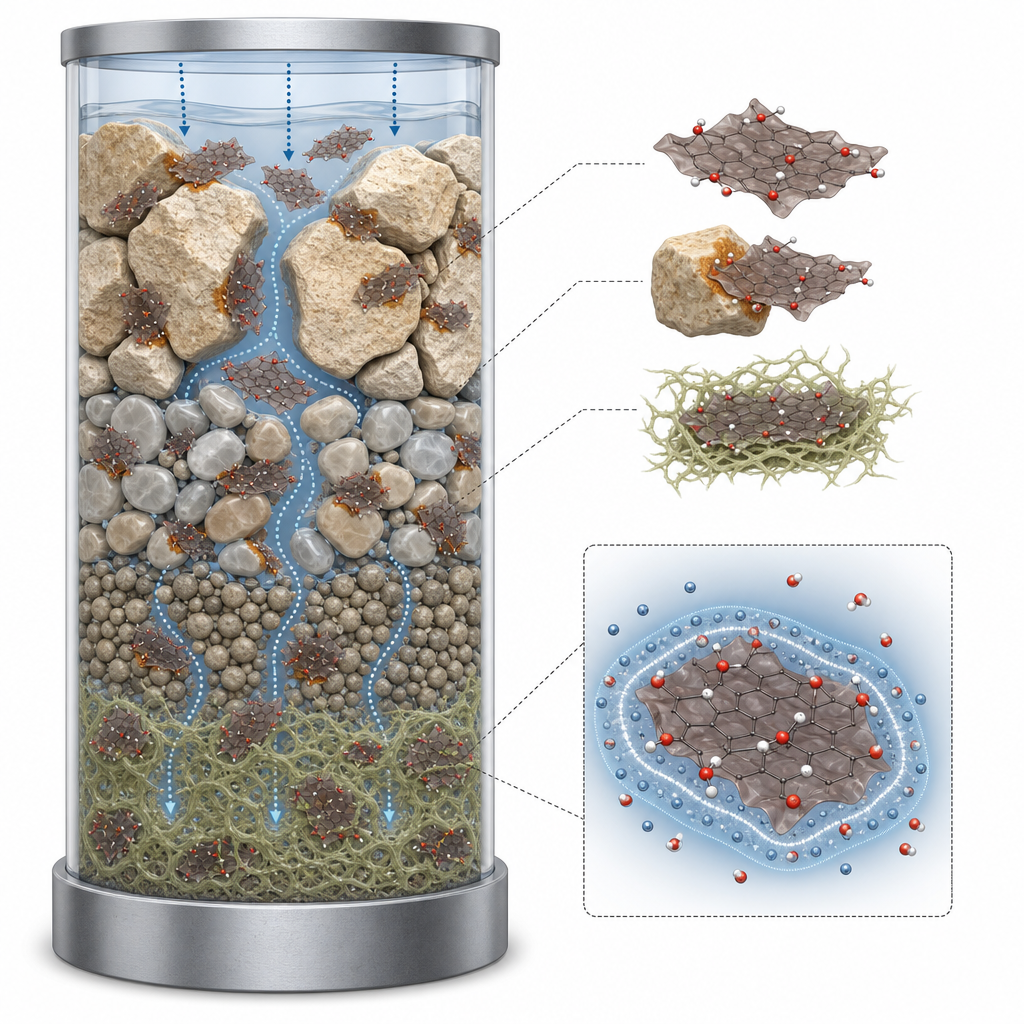
The ACS Material single-layer graphene oxide nanoparticles, prepared by Hummers' method with a reported thickness of 0.8–1.2 nm, served as the model nanoparticle throughout. A stock suspension was prepared by dispersing 100 mg of the GO powder in 1000 mL of RO water followed by 2 hours of ultrasonic bath sonication. The stock was diluted to a working concentration of 25 mg GONP/L and adjusted to ionic strengths of 10 mM NaCl, 50 mM NaCl, or 1 mM CaCl2 at pH 7.5. Zeta potential of the GO suspension was characterized at 4 °C and 22 °C using a Malvern Zetasizer Nano-ZS. The same suspension was used in (i) batch sorption experiments with sand, quartz, and limestone grains in PyrexTM tubes on a rotary shaker, and (ii) column experiments in 9 cm × 2.5 cm Plexiglass columns wet-packed with each porous medium, with effluent concentrations quantified by UV–vis absorption at 226 nm against calibration curves (R² = 0.99).
Retention of GONPs increased with rising ionic strength, consistent with compressed electrical double layers and reduced electrostatic repulsion between GONPs and collector grains. Divalent Ca²⁺ at 1 mM produced retention behavior comparable to much higher Na⁺ concentrations, reflecting cation-bridging effects. Retention profiles changed shape from linear at low ionic strength to hyper-exponential at high ionic strength, with the size distribution of retained GONPs decreasing with distance from the column inlet at high ionic strength but remaining uniform at low ionic strength—indicative of straining of larger aggregates near the inlet. Temperature also played a measurable role: retention at 22 °C exceeded retention at 4 °C, attributed to enhanced Brownian motion and collision frequency. Mineralogically heterogeneous limestone and quartz sediments retained more GONPs than clean acid-washed sand, which the authors linked to metal-oxide patch heterogeneities providing favorable attachment sites identified by XRF and EDS analysis. Strikingly, the establishment of natural biofilms (grown by feeding treated wastewater from the Mount Barker Treatment Plant upward through columns for ~10 days) further increased GONP retention at 22 °C compared to the biofilm-free controls, demonstrating that extracellular polymeric substances act as effective sinks for GO.
These findings are directly relevant to groundwater protection, managed aquifer recharge, and the design of permeable reactive barriers. They suggest that risk assessments based solely on clean-sand column data will underestimate GONP retention in real carbonate or biofilm-rich aquifers, and conversely that natural attenuation may be more effective than previously assumed in geochemically heterogeneous settings. The work also provides quantitative inputs (zeta potentials, retention rate constants, breakthrough profiles across ionic strength regimes) that can be incorporated into colloid filtration theory and reactive transport models. Follow-up directions noted include longer-term column experiments, the role of dissolved organic matter, and the fate of GO breakdown products under varying redox conditions.
For researchers working on nanoparticle environmental fate, colloid transport, or aquifer remediation, the ACS Material single-layer graphene oxide product offers a reproducible, well-characterized GO source suitable for column and batch studies of this kind. The broader Graphene Series catalog from ACS Material also includes industrial-grade and low-defect graphene oxide variants for studies that require different functional-group densities or particle sizes.How ACS Material products were used
- Single Layer Graphene Oxide (Hummers' method, 0.8–1.2 nm thickness) (Graphene Series) — “Single layer graphene oxide nanoparticles with thickness 0.8–1.2 nm prepared by Hummer's method (according to the manufacturer) were purchased from ACS Material, Medford, MA.”
Product Performance in this StudyThe single-layer graphene oxide nanoparticles supplied by ACS Material served as the central nanoparticle system whose transport, retention, and biofilm interactions were investigated. Their well-defined 0.8–1.2 nm single-layer thickness enabled reproducible breakthrough-curve measurements and consistent UV–vis quantification at 226 nm across all column experiments.
Related product categories
Frequently asked questionsHow does ionic strength affect graphene oxide transport in groundwater aquifers?
Higher ionic strength compresses the electrical double layer around graphene oxide nanoparticles and aquifer grains, reducing electrostatic repulsion and increasing attachment. In this Flinders University study, retention profiles shifted from linear at 10 mM NaCl to hyper-exponential at 50 mM NaCl, with larger aggregates retained near the column inlet. Divalent Ca²⁺ at just 1 mM produced retention comparable to much higher Na⁺ concentrations due to cation bridging.
Why does natural biofilm increase graphene oxide retention in porous media?
Biofilms produce extracellular polymeric substances (EPS) that coat aquifer grains with sticky, charged, and hydrophobic functional groups. These provide additional favorable attachment sites for graphene oxide nanoparticles beyond what mineral surfaces alone offer. In biofilm-conditioned columns grown with treated wastewater, GONP retention increased significantly compared to biofilm-free controls, suggesting natural microbial communities can enhance subsurface attenuation of nanoparticle contaminants.
What grade of graphene oxide is best for nanoparticle transport column studies?
Single-layer graphene oxide prepared by Hummers' method with well-defined thickness (such as 0.8–1.2 nm) is preferred because it provides reproducible dispersions, predictable zeta potential behavior, and consistent UV–vis absorbance for breakthrough-curve quantification. The Flinders study quantified GONPs at 226 nm with R² = 0.99 calibration. Material from a single reproducible supplier minimizes batch-to-batch variability in functional group density, which strongly affects colloidal stability.