-
Graphene Oxide Transport in Porous Media — Hohai University, 2018
Jun 16, 2026 | ACS MATERIAL LLCWang, M. et al. (2018). Concurrent aggregation and transport of graphene oxide in saturated porous media: Roles of temperature, cation type, and electrolyte concentration. *Environmental Pollution*.
Environmental Pollution · 2018
Hohai University and University of Florida researchers used ACS Material graphene oxide to study concurrent aggregation and transport in saturated porous media.
About this research
Researchers from Hohai University, in collaboration with the University of Florida, used graphene oxide (GO) nanosheets supplied by ACS Material to systematically map how temperature, cation type, and electrolyte concentration jointly govern the concurrent aggregation and transport of GO in saturated porous media. Published in Environmental Pollution (2018), the study found that raising temperature from 6 °C to 24 °C in 0.05 mM Al³⁺ electrolyte reduced GO column recovery from 27.11% to zero, demonstrating that environmentally realistic shifts in subsurface conditions can dramatically alter the mobility of graphene oxide. The work pairs column breakthrough experiments with an advection–dispersion–reaction model to quantify deposition mechanisms.
Understanding the environmental fate of graphene oxide has become a pressing question as the global production of graphene-based materials accelerates. GO is widely used as a precursor for reduced graphene oxide and as a sorbent, coating, and composite filler, meaning that release into soils and groundwater is increasingly likely. Because GO's oxygen-containing functional groups make it both hydrophilic and reactive toward metal cations, its mobility in subsurface systems is strongly coupled to local water chemistry. Previous transport studies often assumed GO remains colloidally stable, but field-relevant porewater contains Na⁺, Ca²⁺, Mg²⁺, and Al³⁺ at concentrations that can trigger rapid aggregation. The authors address this gap by deliberately combining aggregation and column transport in a single experimental framework, providing data directly relevant to risk assessment for groundwater and shallow soil systems.
The ACS Material graphene oxide nanosheets formed the central material system for the study. As described in the Materials and Methods section, "GO nanosheets (ACS Material, Medford, MA) with 1–5 μm lateral diameter and 0.8–1.2 nm thickness were used as received from the manufacturer in all experiments." The well-defined lateral dimensions and near-monolayer thickness — corresponding to an average cross-sectional area of 338,724 nm² verified by AFM — provided a reproducible starting material across the full experimental matrix. A stock dispersion was prepared by suspending 100 mg of GO in 1000 mL of deionized water and ultrasonicating for 2 h with a Misonix S3000 ultrasonicator. Working suspensions at 20 mg L⁻¹ were then prepared in NaCl, CaCl₂, MgCl₂, or AlCl₃ electrolyte solutions and stored at 6 °C. The dispersions were pumped through saturated sand columns held at controlled temperatures from 6 °C to 24 °C, with influent and effluent GO concentrations quantified to construct breakthrough curves.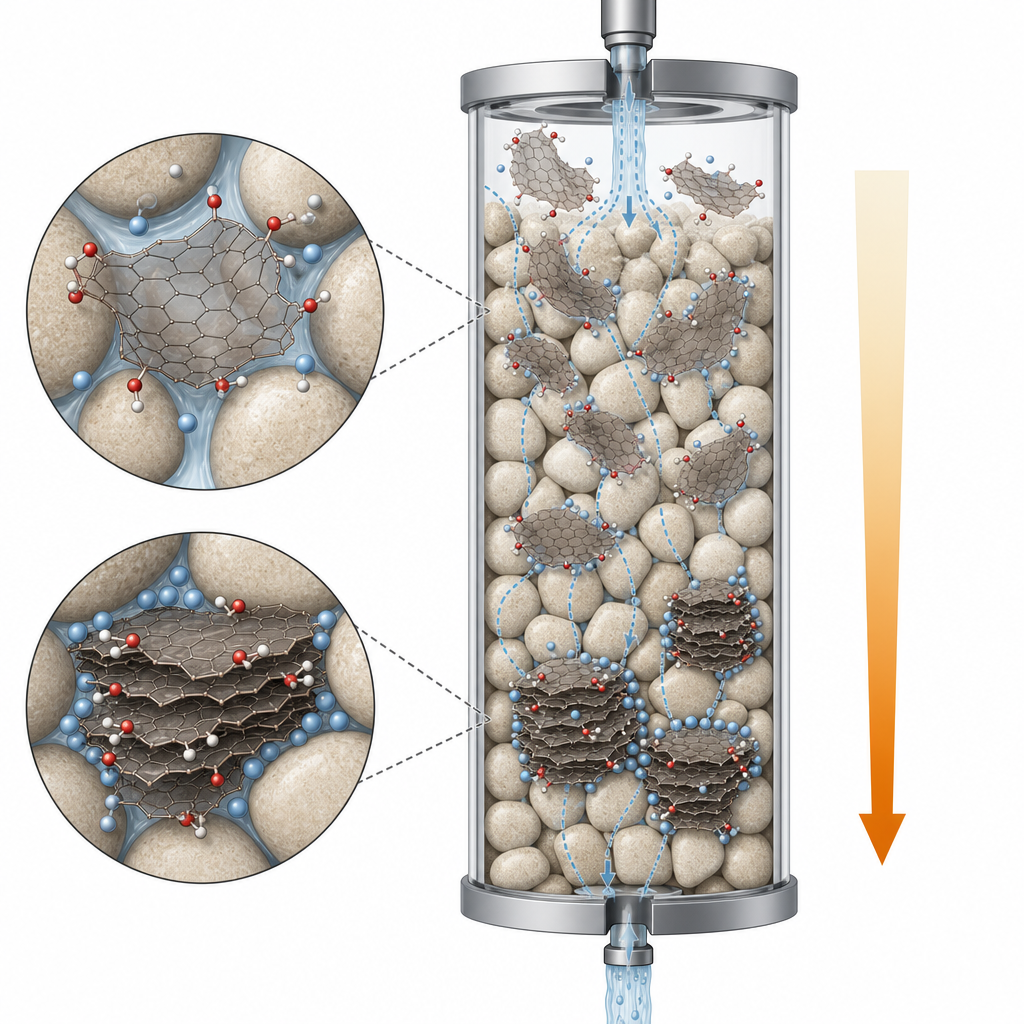
The quantitative results reveal a strong, monotonic suppression of GO mobility with rising temperature, cation valence, and ionic strength. At a fixed high electrolyte concentration of 50 mM Na⁺, 1 mM Ca²⁺, 1.75 mM Mg²⁺, or 0.03–0.05 mM Al³⁺, warming the column from 6 °C to 24 °C consistently increased GO retention. The most striking case occurred for 0.03 mM Al³⁺, where recovery dropped from 31.08% to 6.53%, while at 0.05 mM Al³⁺ GO recovery fell from 27.11% to 0% — complete retention within the column. At any fixed temperature, increasing the cation valence from Na⁺ to Ca²⁺/Mg²⁺ to Al³⁺ or raising electrolyte concentration also promoted retention. Mechanistic analysis showed that deposition pathways depend on cation type: for 50 mM Na⁺, surface deposition via secondary energy minima dominated, while for multivalent cations rapid GO aggregation introduced physical straining and gravitational sedimentation as additional retention modes. Effluent GO particles consistently displayed lower initial aggregation rates than the influent, indicating selective filtration of less stable, lower-surface-charge sheets. An advection–dispersion–reaction model successfully reproduced all breakthrough curves, supporting the proposed coupled aggregation–deposition framework.
These findings have direct implications for predicting the environmental behavior of graphene oxide in soils, aquifers, and engineered filtration systems. The strong temperature dependence is particularly important because shallow subsurface temperatures vary widely on diurnal and seasonal timescales, meaning that GO transport models built on room-temperature data may significantly overestimate mobility under summer conditions. The cation-valence trends also suggest that GO released near agricultural fields receiving lime or aluminum-based amendments will be far less mobile than GO released into low-ionic-strength surface waters. Beyond risk assessment, the results inform the design of GO-based groundwater remediation strategies, where controlled retention is desirable, and adjacent applications such as nanoparticle-amended permeable reactive barriers, soil column experiments, and colloid-facilitated contaminant transport studies.
For researchers working on environmental nanotechnology, colloid science, or graphene-based water treatment, the consistent performance of ACS Material's graphene oxide nanosheets across this demanding experimental matrix illustrates the value of starting from a well-characterized 2D nanomaterial. The same product line — including single-layer graphene oxide dispersions, powders, and large-size GO sheets — is available through ACS Material for laboratories investigating nanoparticle fate, transport modeling, sorption of heavy metals and organics, or composite membrane development.How ACS Material products were used
- Graphene Oxide (GO) Nanosheets (Graphene Series) — “GO nanosheets (ACS Material, Medford, MA) with 1–5 μm lateral diameter and 0.8–1.2 nm thickness were used as received from the manufacturer in all experiments.”
Product Performance in this StudyThe ACS Material graphene oxide nanosheets served as the model nanomaterial whose aggregation, retention, and transport in saturated porous media were systematically quantified. Their well-defined 1–5 μm lateral size and 0.8–1.2 nm thickness enabled reproducible column experiments across temperatures, cation types, and electrolyte concentrations.
Related product categories
Frequently asked questionsHow does temperature affect graphene oxide transport in saturated porous media?
Higher temperatures consistently increase graphene oxide retention in saturated porous media because warming enhances Brownian motion and inter-particle collisions, accelerating aggregation. In this study, raising the column temperature from 6 °C to 24 °C reduced GO recovery from 31.08% to 6.53% in 0.03 mM Al³⁺, and from 27.11% to zero in 0.05 mM Al³⁺. The effect was reproducible across Na⁺, Ca²⁺, Mg²⁺, and Al³⁺ electrolytes.
Why do multivalent cations like Ca²⁺ and Al³⁺ enhance graphene oxide deposition?
Multivalent cations compress the electric double layer around graphene oxide sheets and bridge negatively charged oxygen functional groups, lowering colloidal stability. This triggers rapid aggregation in porewater, which in turn enables physical straining and gravitational sedimentation in addition to secondary-minimum surface deposition. The result is a sharp drop in GO mobility compared with monovalent Na⁺ systems, where surface deposition via secondary minima remains the dominant mechanism.
What size and thickness of graphene oxide were used in this transport study?
The authors used graphene oxide nanosheets from ACS Material with 1–5 μm lateral diameter and 0.8–1.2 nm thickness, approximating single-layer GO. The average cross-sectional area was 338,724 nm² as measured by AFM. A 20 mg L⁻¹ working suspension was prepared by ultrasonicating 100 mg of GO in 1000 mL deionized water for 2 h before mixing with NaCl, CaCl₂, MgCl₂, or AlCl₃ electrolyte solutions.