-
Graphene Oxide Transport in Porous Media - Jinan University, 2022
Jun 08, 2026 | ACS MATERIAL LLCWu, M. et al. (2022). Effects of polyamide microplastic on the transport of graphene oxide in porous media. *Science of The Total Environment*. https://doi.org/10.1016/j.scitotenv.2022.157042
Science of The Total Environment · 2022
Jinan University used ACS Material graphene oxide to study how polyamide microplastics inhibit GO transport in saturated porous media via XDLVO modeling.
About this research
Researchers at Jinan University used graphene oxide (GO) powder supplied by ACS Material to quantify how polyamide (PA) microplastics influence the transport of GO through saturated porous media, finding that PA, elevated ionic strength, and divalent cations all markedly suppress GO mobility. The team combined one-dimensional column experiments, advection-dispersion transport modeling, and a novel two-dimensional Extended Derjaguin-Landau-Verwey-Overbeek (XDLVO) interaction-energy surface to link colloidal interaction energies directly to measurable transport kinetics. The result is a predictive framework that connects the secondary minimum trap of the XDLVO energy surface to the deposition rate coefficient, maximum deposition, and mass recovery rate of GO.
This research matters because graphene oxide and microplastics are both rapidly accumulating environmental contaminants. GO is an engineered nanoparticle widely used in medicine, composites, catalysis, water treatment, and environmental remediation, and accidental spillage or runoff inevitably releases it into soil-groundwater systems. GO can also adsorb heavy metals and organic pollutants, acting as a carrier that amplifies contamination risk. Polyamide is among the most abundant microplastics detected in soil. Until now, the influence of co-existing microplastics on nanoparticle transport in porous media has been poorly understood. Understanding these interactions is essential for predicting the fate, mobility, and ecological risk of nanomaterials in subsurface environments, and for designing effective contamination remediation strategies in aquifers and engineered filtration systems.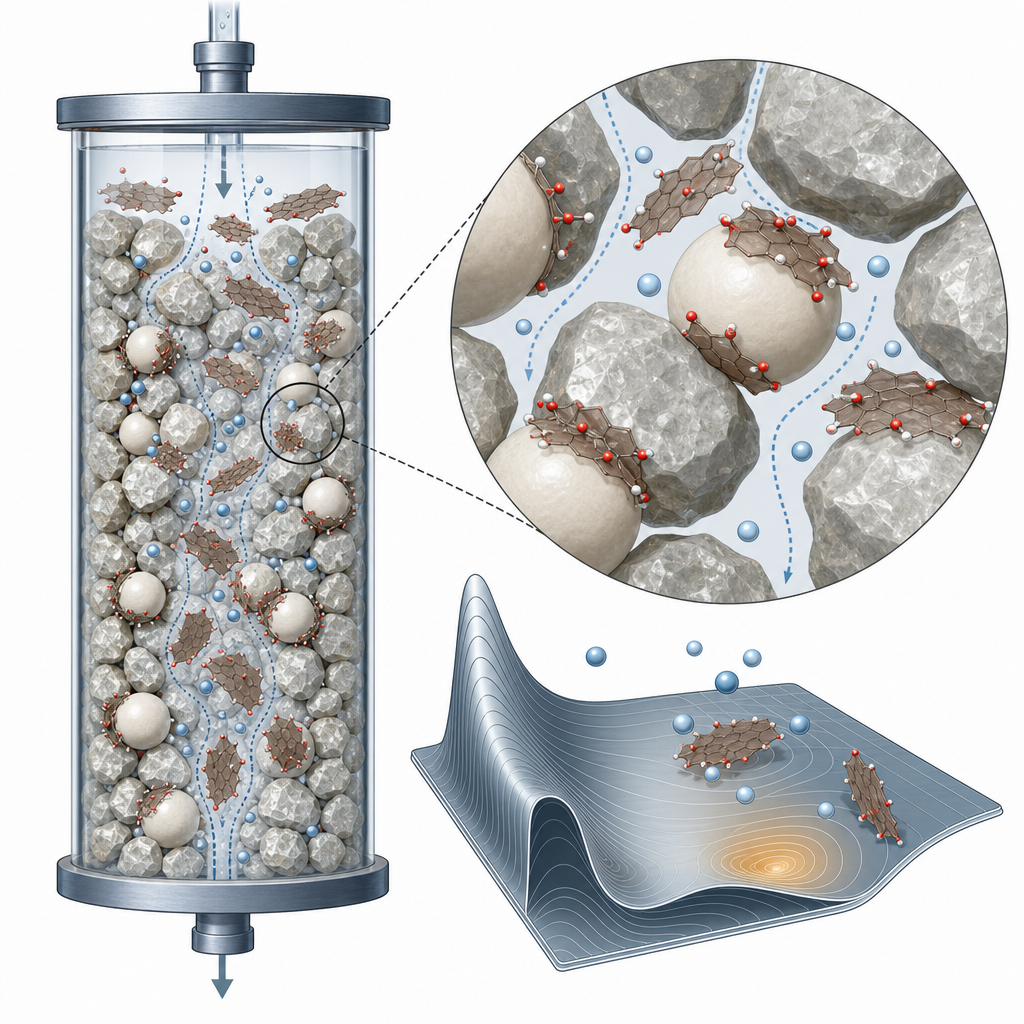
The ACS Material graphene oxide powder was the central sample under study. To prepare the stock solution, 100 mg of GO powder was added to ultrapure water in a 500 mL volumetric flask, ultrasonicated for 2 hours, and stored at 4 °C. This dispersion was diluted to initial concentrations of 5, 10, and 20 mg/L for the column injections. The quartz sand (QS, grain size 0.6-0.85 mm) was cleaned, acid-washed, and dried, then wet-packed with PA (25 μm particle size) at porosity 0.4 into a 2.5 cm diameter, 20 cm long column. Background electrolytes were prepared from NaCl, CaCl2, and BaCl2 to vary ionic type and strength. GO effluent concentrations were measured by UV-visible spectrophotometer at 230 nm. Zeta potentials of GO, PA, and QS were measured with a Malvern Zetasizer Nano ZS90, and FTIR confirmed GO adsorption onto PA through a new C=O peak at 1723 cm-1. Hydrus-1D solved the one-site kinetic transport model to extract the deposition rate coefficient k and maximum deposition Smax.
The key results were quantitative and consistent across methods. Increasing the PA mass fraction from 0 to 6% reduced the GO breakthrough peak C/C0 from baseline to 0.27 and cut the GO mass recovery from 98.9% to 27.2%; correspondingly k rose from 3.21x10⁻⁵ to 4.13x10⁻² min-1 and Smax from 0.646 to 3.45 mg/g. Higher flow velocity enhanced GO mobility: raising velocity from 0.1 to 0.82 cm/min decreased k and Smax and increased recovery. Higher initial GO concentration also increased recovery (42.4% at 5 mg/L to 67.0% at 20 mg/L) due to blocking effects. Ionic strength strongly inhibited transport: increasing NaCl from 1 to 10 mM dropped recovery from 28.2% to 13.6%. Divalent cations were far more inhibitory than monovalent. The XDLVO model predicted critical ionic strengths of GO-PA at 56.7 mM (Na+), 19.4 mM (Ca2+), and 28.5 mM (Ba2+). The secondary minimum trap of XDLVO interaction energy correlated linearly with k, Smax, and recovery rate, with R2 values exceeding 0.73 for k and recovery, demonstrating the energy surface can quantitatively predict GO transport kinetics.
This work enables more accurate prediction of engineered-nanoparticle fate in contaminated soil and groundwater, especially where microplastics co-exist. The XDLVO energy-surface approach offers a transferable tool for environmental risk assessment, filtration design, and aquifer remediation planning. It is directly relevant to researchers in environmental engineering, hydrogeology, colloid science, and water treatment who need to forecast colloid mobility under variable salinity and cation chemistry. The framework could be extended to other nanomaterials (carbon nanotubes, metal oxide nanoparticles) and other microplastic types (polystyrene, polyethylene, PET) to build a broader understanding of co-contaminant transport. The demonstrated link between interaction energy and kinetic parameters suggests a route toward physics-based, less empirical transport models.
For researchers pursuing similar nanoparticle-transport, colloid-stability, or environmental-fate studies, reproducible and well-characterized graphene oxide is essential, since GO's surface chemistry and dispersion quality directly determine zeta potential, agglomeration, and deposition behavior. The graphene oxide used here is available through ACS Material's Graphene Series, which offers GO in several grades and forms suitable for transport, adsorption, and environmental-interaction experiments. The consistent, quantifiable behavior observed in this study reflects the value of starting from a defined GO source when building predictive transport models.How ACS Material products were used
- Graphene Oxide (GO) powder (Graphene Series) — “Add 100 mg GO (ACS Material) powder into ultrapure water and transfer to a 500 mL volumetric flask.”
Product Performance in this StudyThe ACS Material graphene oxide powder served as the model engineered nanoparticle whose transport behavior through porous media was quantified. Its colloidal and surface properties (zeta potential, agglomeration tendency) governed all measured transport metrics.
Related product categories
Frequently asked questionsHow do microplastics affect graphene oxide transport in porous media?
In this study, polyamide microplastics strongly inhibited graphene oxide mobility. Increasing polyamide mass fraction from 0 to 6% lowered the GO breakthrough peak and cut mass recovery from 98.9% to 27.2%. Polyamide increases the surface roughness of the porous media and lowers the XDLVO energy barrier between GO and the medium, favoring GO deposition and reducing migration distance.
Why do divalent cations inhibit graphene oxide mobility more than monovalent cations?
Divalent cations such as Ca2+ and Ba2+ compress the electrical double layer around graphene oxide more effectively than monovalent Na+, reducing electrostatic repulsion and promoting agglomeration and deposition. The study found lower critical ionic strengths for divalent systems (19.4 mM for Ca2+, 28.5 mM for Ba2+) versus 56.7 mM for Na+, confirming the stronger inhibitory effect of divalent cations on GO transport.
What is the XDLVO energy surface used for in nanoparticle transport studies?
The two-dimensional XDLVO energy surface quantifies the interaction energy between particles and surfaces, accounting for van der Waals attraction, electrical double-layer repulsion, and Lewis acid-base interactions. In this work it was used to predict graphene oxide mobility by linking the secondary minimum trap of the energy surface to deposition kinetics, achieving linear correlations with R2 above 0.73 for deposition rate and recovery.