-
Graphene Oxide–Iron Oxide–Gold Hybrid for Doxorubicin Delivery — University at Albany, SUNY, 2013
Jun 30, 2026 | ACS MATERIAL LLCBalcioglu, M., Rana, M., & Yigit, M. (2013). Doxorubicin loading on graphene oxide, iron oxide and gold nanoparticle hybrid. *Journal of Materials Chemistry B*.
Journal of Materials Chemistry B · 2013
Researchers at University at Albany, SUNY built a graphene oxide/iron oxide/gold nanoparticle hybrid using ACS Material carboxyl graphene to load doxorubicin.
About this research
Researchers at the University at Albany, SUNY (Yigit and co-workers) used carboxyl graphene water dispersion supplied by ACS Material to construct a three-component [GO-MNcy5.5-AuNP] nanohybrid that loads the anticancer drug doxorubicin (DOX). The carboxylated graphene served as a two-dimensional platform that simultaneously quenched fluorescent dye on dextran-coated superparamagnetic iron oxide nanoparticles, organized 13 nm gold nanoparticles through electrostatic interactions, and provided abundant binding sites for DOX through π–π stacking and hydrogen bonding. The combined system unites optical, magnetic, and plasmonic functionalities in a single nanocarrier intended for image-guided chemotherapy.
Multifunctional nanocarriers that integrate imaging contrast, targeting, and drug payloads are a long-standing goal in cancer nanomedicine. Iron oxide nanoparticles supply T2-weighted MRI contrast, gold nanoparticles introduce plasmonic and computed-tomography-relevant features, and graphene oxide offers a high-surface-area sheet that strongly adsorbs aromatic drugs such as doxorubicin. The challenge is bringing these dissimilar building blocks together in a stable, reproducible architecture without sacrificing the function of each component. Carboxyl-functionalized graphene oxide is particularly attractive here because the surface –COOH groups improve aqueous colloidal stability and provide handles for electrostatic or covalent coupling with other nanoparticles. This paper addresses how a well-defined carboxyl graphene dispersion can serve as the unifying scaffold for an iron-oxide–gold hybrid loaded with a clinically relevant chemotherapeutic.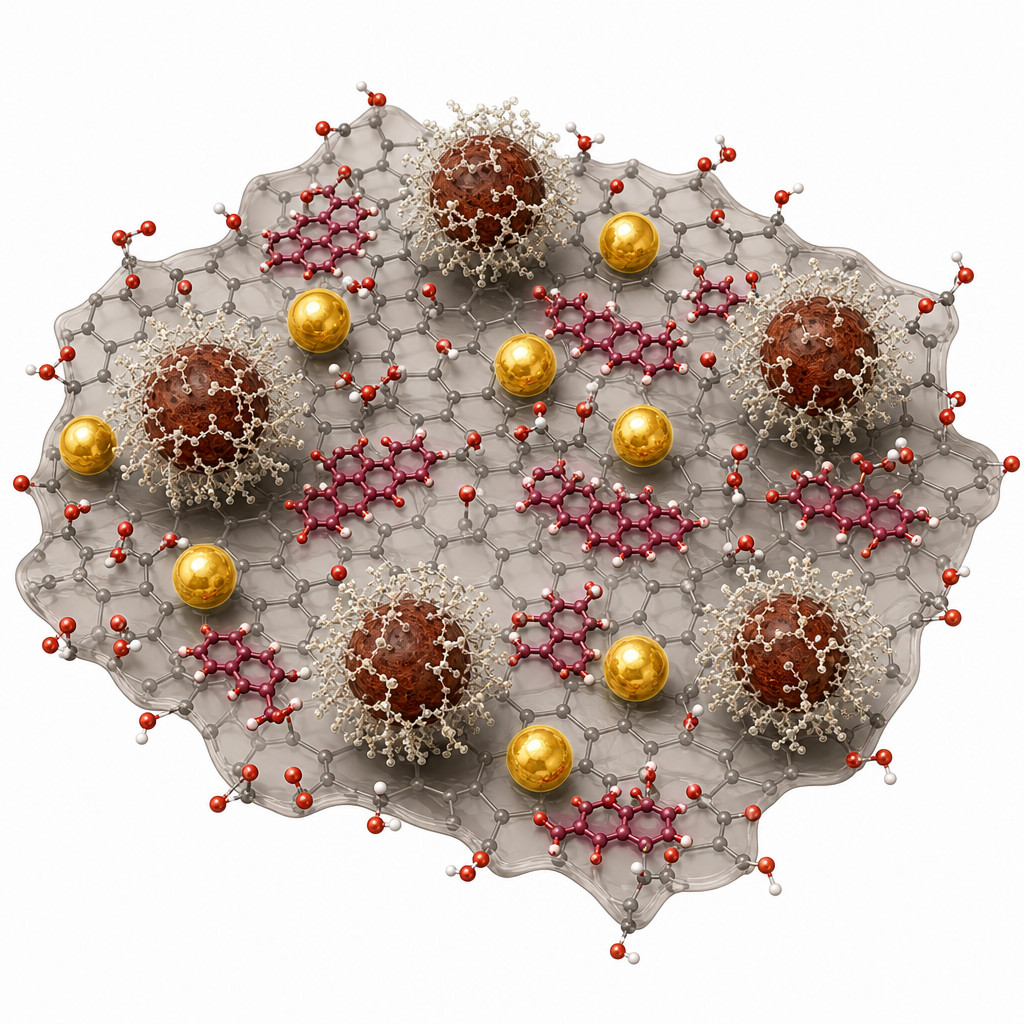
The authors used ACS Material carboxyl graphene water dispersion directly as the GO component, without further modification. Throughout the methods section, the carboxyl graphene is referred to simply as "GO" and was diluted to working concentrations of 25–500 µg/mL in double-distilled water. Visual assembly experiments mixed 50 µL of 500 µg/mL GO with cy5.5-labeled magnetic nanoparticles (MNcy5.5) and observed rapid agglomeration that responded to an external magnet, confirming a stable GO–nanoparticle interaction. Fluorescence quenching titrations were carried out at a much lower MNcy5.5 concentration (~13 nM) by adding 5 µL aliquots of 100 µg/mL GO and recording the emission with a Fluorolog-3 spectrofluorometer; the carboxyl graphene quenched the cy5.5 emission progressively as more GO was added. NMR T2 measurements on a Bruker Minispec mq20 demonstrated that GO addition also altered the magnetic relaxivity of the iron oxide component. For the full [GO-MNcy5.5-AuNP] hybrid, final concentrations of 40 µg/mL GO, 10 nM iron oxide, and 3.9 nM gold nanoparticles were combined and characterized by TEM (JEOL JEM-2010) and zeta-potential measurements (Malvern Zetasizer Nano ZS).
Key results center on assembly fidelity and DOX loading. The carboxyl graphene from ACS Material induced visible aggregation with both MNcy5.5 (after a gentle shake) and with positively charged amine-modified gold nanoparticles, while citrate-stabilized (negatively charged) AuNPs also assembled with GO under the studied conditions, indicating that both electrostatic and non-electrostatic interactions contribute. Absorbance titrations of 1 nM gold nanoparticles with 0–40 µg/mL GO produced systematic plasmon peak changes consistent with surface organization. For doxorubicin loading, 40 µL of 1 mg/mL DOX was mixed with the assembled [GO-MNcy5.5-AuNP] hybrid (final DOX 80 µg/mL) and incubated for 24 hours; unbound drug was separated by centrifugation or magnetic pull-down, and quantification used the DOX absorbance at 480 nm with ε = 10,500 M⁻¹·cm⁻¹. Loading efficiency and loading capacity were computed from the standard mass-balance equations. The hybrid retained both magnetic responsiveness and the optical signature of the gold component after DOX loading, indicating that drug uptake did not disrupt the assembly. Re-dispersion of the precipitate confirmed that DOX was bound directly to the GO–nanoparticle hybrid rather than only co-precipitated, supporting a stable nanocarrier-payload structure.
Applications and outlook for this work span theranostic oncology, MRI-guided drug delivery, and triggered release systems. Because the hybrid combines a T2 MRI contrast agent (iron oxide), a near-infrared fluorescent reporter (cy5.5), a plasmonic component for photothermal or CT signal (gold), and a high-capacity 2D adsorbent (GO), it is well aligned with current research on multimodal nanocarriers for solid tumors. The paper itself suggests that the platform can be adapted to other aromatic chemotherapeutics that interact with graphene through π–π stacking, and that the magnetic component allows facile in vitro separation, washing, and potentially in vivo magnetic targeting. Researchers interested in stimuli-responsive release, biosensing of intracellular drug cargo, or hybrid nanostructures for photothermally enhanced chemotherapy can use this assembly route as a starting point.
For researchers building related drug-delivery hybrids, the study illustrates that a well-dispersed, carboxyl-functionalized graphene oxide is a practical, ready-to-use starting material — no in-house Hummers' synthesis or extensive purification required. The carboxyl graphene water dispersion used here is available from ACS Material and is suitable for groups working on doxorubicin delivery, multimodal imaging probes, magnetic-graphene composites, and other aqueous nanocarrier formulations. As with any pre-dispersed 2D material, end users should verify flake size, oxidation degree, and zeta potential for their specific application before scale-up.How ACS Material products were used
- Carboxyl Graphene Water Dispersion (Graphene Series) — “Carboxyl graphene water dispersion was purchased from ACS Material, Medford, MA 02155, USA.”
Product Performance in this StudyThe carboxyl graphene (used as the graphene oxide component, GO) served as the central scaffold for assembling the hybrid nanocarrier and loading doxorubicin. It enabled fluorescence quenching of cy5.5-labeled iron oxide nanoparticles, electrostatic assembly with gold nanoparticles, and π–π/electrostatic binding of DOX, yielding high drug loading efficiency.
Related product categories
Frequently asked questionsWhy use carboxyl graphene oxide instead of pristine graphene oxide for doxorubicin delivery?
Carboxyl-functionalized graphene oxide carries a high density of –COOH groups, giving it excellent water dispersibility and a strongly negative surface charge. These features stabilize the 2D flakes in aqueous physiological-like media, promote electrostatic assembly with positively charged nanoparticles and dyes, and create binding sites for aromatic chemotherapeutics like doxorubicin through combined π–π stacking, hydrogen bonding, and electrostatic interactions, enabling reproducible drug loading.
How does graphene oxide quench cy5.5 fluorescence on iron oxide nanoparticles?
When cy5.5-labeled dextran-coated iron oxide nanoparticles adsorb onto graphene oxide sheets, the dye is brought into very close proximity to the GO surface. Graphene oxide acts as a broad-spectrum energy acceptor, quenching the cy5.5 emission at 695 nm through nonradiative energy transfer. In this work the quenching was monitored on a Fluorolog-3 spectrofluorometer as 100 µg/mL GO was titrated into 13 nM MNcy5.5.
What advantages does a GO–iron oxide–gold hybrid offer over single-component nanocarriers?
Combining graphene oxide, superparamagnetic iron oxide, and gold nanoparticles unites three functional modes in one carrier: GO provides high-capacity aromatic drug loading, iron oxide enables magnetic separation and T2 MRI contrast, and gold nanoparticles add plasmonic optical response useful for photothermal or CT-based readouts. The result is a multifunctional platform suited to image-guided, magnetically targeted chemotherapy that single-component carriers cannot easily match.