-
Graphene Quantum Dots for WORM Memory - Hanyang University, 2018
Jul 07, 2026 | ACS MATERIAL LLCSung, S. et al. (2018). Highly-stable write-once-read-many-times switching behaviors of 1D–1R memristive devices based on graphene quantum dot nanocomposites. *Scientific Reports*. https://doi.org/10.1038/s41598-018-30538-y
Scientific Reports · 2018
Hanyang University built 1D-1R WORM memristive devices using ACS Material graphene quantum dots in PMSSQ, achieving a 10^4 ON/OFF ratio.
About this research
Researchers at Hanyang University demonstrated stable write-once-read-many-times (WORM) memristive devices built around graphene quantum dots (GQDs) supplied by ACS Material, achieving an ON/OFF current ratio of up to 10^4 and retention times exceeding 10^4 seconds. The devices combine a poly(methylsilsesquioxane) (PMSSQ):GQD hybrid nanocomposite as the resistive switching layer with a p-Si/Al Schottky diode in a one-diode-one-resistor (1D-1R) configuration. By integrating the diode and memory functions in a single vertical stack (Al/PMSSQ:GQDs/Al/p-Si/Al), the team eliminated cross-talk and produced a non-volatile memory element suitable for archival-style data storage.
Non-volatile organic memory has been pursued for years because it promises low cost, mechanical flexibility, simple solution processing, and low power consumption compared to conventional silicon flash. However, most prior hybrid memories rely on metallic Au, Ag, Al, or Cu nanoparticles as charge-trapping centers. These metallic fillers are expensive and degrade at elevated temperatures, limiting practical deployment. A second persistent problem is cross-talk in passive crossbar arrays: leakage currents through unselected neighboring cells corrupt the readout of the addressed cell. Combining a rectifying diode with each resistive element (1D-1R) is the most direct way to suppress this sneak-path current. The authors therefore needed both a thermally robust, inexpensive charge-trapping nanomaterial and a clean integration scheme with a silicon-based diode - the motivation for choosing GQDs and a Schottky-diode back end.
The ACS Material graphene quantum dots were supplied as a solution and incorporated directly into the PMSSQ precursor. The PMSSQ matrix was first prepared by mixing de-ionized water, n-butanol, and trimethoxymethylsilane [CH3Si(OCH3)3] in a 1:10:4 weight ratio and ultrasonicating the mixture for 24 hours at 60 °C. The GQD solution was then added at 0, 10, or 20 wt% relative to the polymer and ultrasonicated for a further 2 hours at room temperature. The resulting PMSSQ:GQD dispersion was spin-coated onto Al-coated p-Si substrates using a multi-step recipe (500/1000/3000/1000/500 rpm) and annealed at 140 °C for 1 hour. Thermal evaporation of 70 nm middle Al, 180 nm top Al (1 mm diameter), and 200 nm bottom Al electrodes completed the 1D-1R stack. In this architecture the GQDs act as discrete charge-trapping centers dispersed in the low-dielectric, thermally stable PMSSQ host; their large work function and edge-induced quantum confinement make them efficient at storing injected charge.
Current-voltage measurements at 300 K using a Keithley 2400 source-meter revealed clear WORM behavior. The pristine devices began in a high-resistance OFF state, switched abruptly to a low-resistance ON state at a programming voltage, and could not be erased back - the signature of true write-once memory desirable for permanent archival storage. The ON/OFF ratio reached 10^4, providing a wide read margin that minimizes misreading even with modest sense circuitry. Retention testing under ambient conditions showed that both the ON and OFF states remained stable for more than 10^4 seconds with negligible drift. The integrated Schottky diode rectified the I-V response, so the 1D-1R device displays both memory and diode behavior simultaneously: forward bias allows reading or programming of the addressed cell, while reverse bias blocks current through unselected cells in a hypothetical crossbar. Control samples with 0% GQDs showed no switching, confirming that the GQDs themselves are responsible for charge trapping. The authors rationalize the mechanism with an energy band diagram in which holes from the p-Si are injected into and trapped at the GQDs, raising the conductivity of the PMSSQ layer permanently after the SET event.
Devices of this type are attractive for one-time programmable (OTP) memory, secure data storage, archival applications, RFID tags, and printed flexible electronics where information must be written once and remain readable for years. The 1D-1R configuration is directly compatible with passive crossbar architectures, which is the most area-efficient way to scale resistive memory. Because PMSSQ is solution processable and tolerant of moderate temperatures, the approach is in principle extendable to flexible plastic substrates, and the GQDs can be further functionalized to tune trap depth. The authors point toward optimization of the GQD loading and matrix chemistry as the next step for improving switching uniformity and endurance.
For researchers working on organic resistive memory, charge-trap floating-gate devices, or 2D-material-based electronics, this study illustrates a practical pathway from a commercial graphene-quantum-dot dispersion to a working 1D-1R memory cell. ACS Material supplies graphene quantum dots in several functionalized forms (aminated, carboxylated, hydroxylated) and in both solution and powder formats, supporting reproducible incorporation into polymer hosts of the kind used here.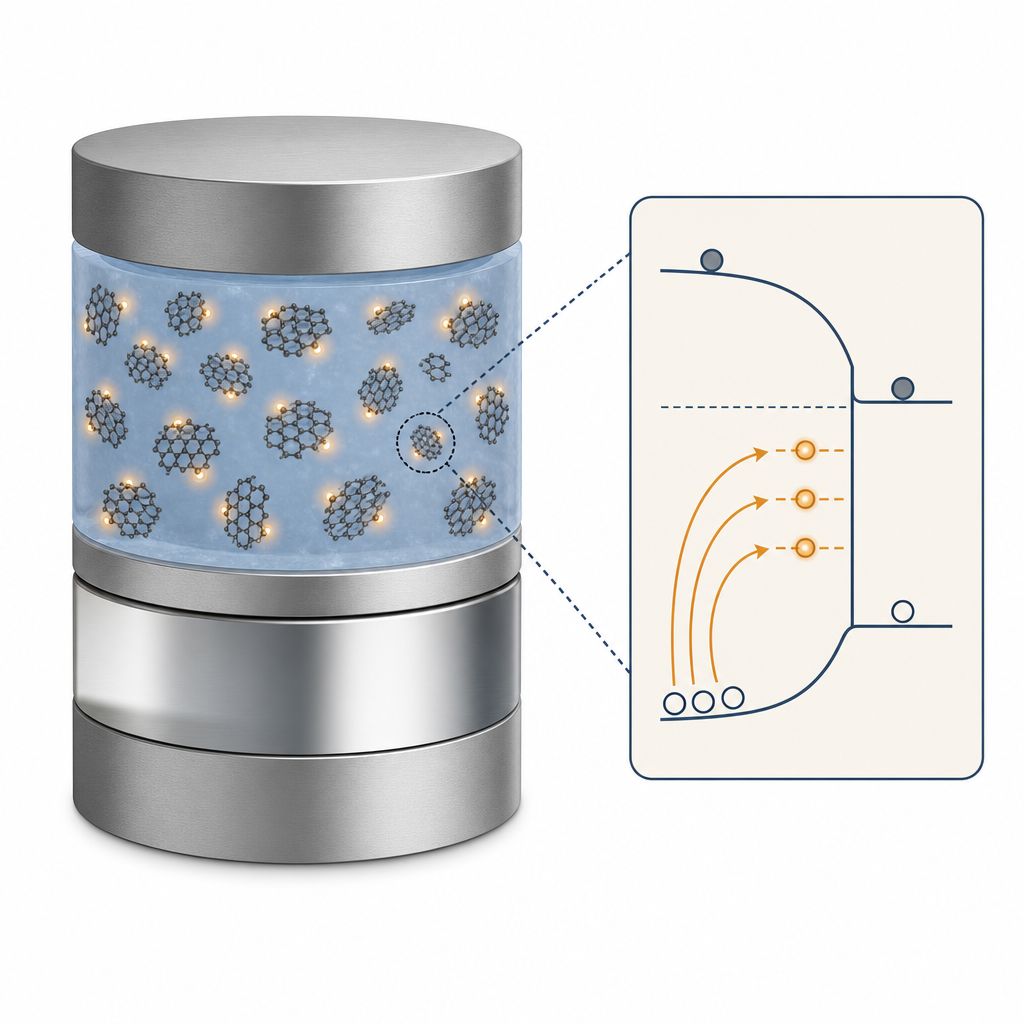
How ACS Material products were used
- Graphene Quantum Dots (GQD solution) (Quantum Dots & Upconverting Nanoparticles) — “Then, the GQD solution (ACS MATERIAL) was added to the PMSSQ solution in a weight ratio of 0, 10, or 20%”
Product Performance in this Study
The ACS Material graphene quantum dots served as the charge-trapping centers embedded in the PMSSQ matrix, enabling write-once-read-many-times memory behavior with an ON/OFF ratio as large as 10^4 and retention exceeding 10^4 s.
Related product categories
Frequently asked questions
How do graphene quantum dots enable WORM memory behavior?
Graphene quantum dots embedded in a PMSSQ polymer matrix act as discrete charge-trapping centers. When a programming voltage is applied, holes from the p-Si substrate inject into and become trapped at the GQDs, permanently raising the conductivity of the active layer. Because the trapped charge cannot be efficiently de-trapped by reverse bias, the device transitions from the OFF state to the ON state irreversibly, producing the write-once-read-many-times characteristic with an ON/OFF ratio of 10^4.
Why is a 1D-1R architecture used in resistive memory arrays?
In passive crossbar arrays, leakage currents through unselected cells (sneak paths) can corrupt the readout of an addressed cell. Integrating a rectifying diode in series with each resistive element forces current to flow only under forward bias, suppressing sneak paths. In this paper, the p-Si/Al Schottky diode stacked beneath the PMSSQ:GQD layer provides this rectification while the GQD nanocomposite stores the memory state, enabling reliable read operations.
Why are graphene quantum dots preferred over metallic nanoparticles for memory devices?
Metallic Au, Ag, Al, and Cu nanoparticles are widely used as charge-trapping centers, but they are expensive and thermally unstable, which complicates device fabrication and limits long-term reliability. Graphene quantum dots offer chemical inertness, low toxicity, a large work function, and strong edge-induced quantum confinement, making them efficient and stable charge traps. They are also solution-compatible, which simplifies integration into spin-coated polymer hosts like PMSSQ.