-
Graphite Flakes for Anodized Al Alloy Tribology - Universiti Teknologi Malaysia, 2020
Jun 29, 2026 | ACS MATERIAL LLCMohamad, S., Liza, S., & Yaakob, Y. (2020). Strengthening of the mechanical and tribological properties of composite oxide film formed on aluminum alloy with the addition of graphite. *Surface and Coatings Technology*.
Surface and Coatings Technology · 2020
Researchers at Universiti Teknologi Malaysia used ACS Material graphite flakes to create self-lubricating composite anodic oxide films on AA2017-T4 aluminum.
About this research
Researchers at Universiti Teknologi Malaysia, working with collaborators at Universiti Putra Malaysia, used 300-mesh graphite flakes purchased from ACS Material LLC to fabricate self-lubricating composite anodic oxide films on AA2017-T4 aluminum alloy, achieving substantially improved hardness, friction, and wear performance compared with conventional anodized films. The study, published in Surface and Coatings Technology (2020), systematically maps how anodizing time and graphite loading control the film growth mechanism and the resulting mechanical-tribological behavior. By co-depositing graphite into the porous alumina matrix during sulfuric-acid anodization, the authors deliver a single-step surface treatment that addresses both the hardness deficit and the unstable friction that normally limit AA2017 in sliding applications.
The broader context is that 2XXX-series aluminum alloys are widely used in aircraft and automotive structures because of their strength-to-weight ratio, but their soft surface, low wear resistance, and high friction coefficient restrict their use in moving-contact components. Conventional sulfuric-acid anodizing forms an oxide film that improves hardness and corrosion resistance, yet copper-rich intermetallic phases (Al2Cu, Al2CuMg, Al7Cu2Fe) dissolve preferentially during anodizing, producing soft, porous coatings prone to cracking. Composite anodic films incorporating ceramic or carbon-based reinforcements have therefore become an active research direction. Within this landscape, graphite is attractive because its lamellar structure provides intrinsic solid lubrication, and it is electrically conductive, which can also modify the anodizing process itself.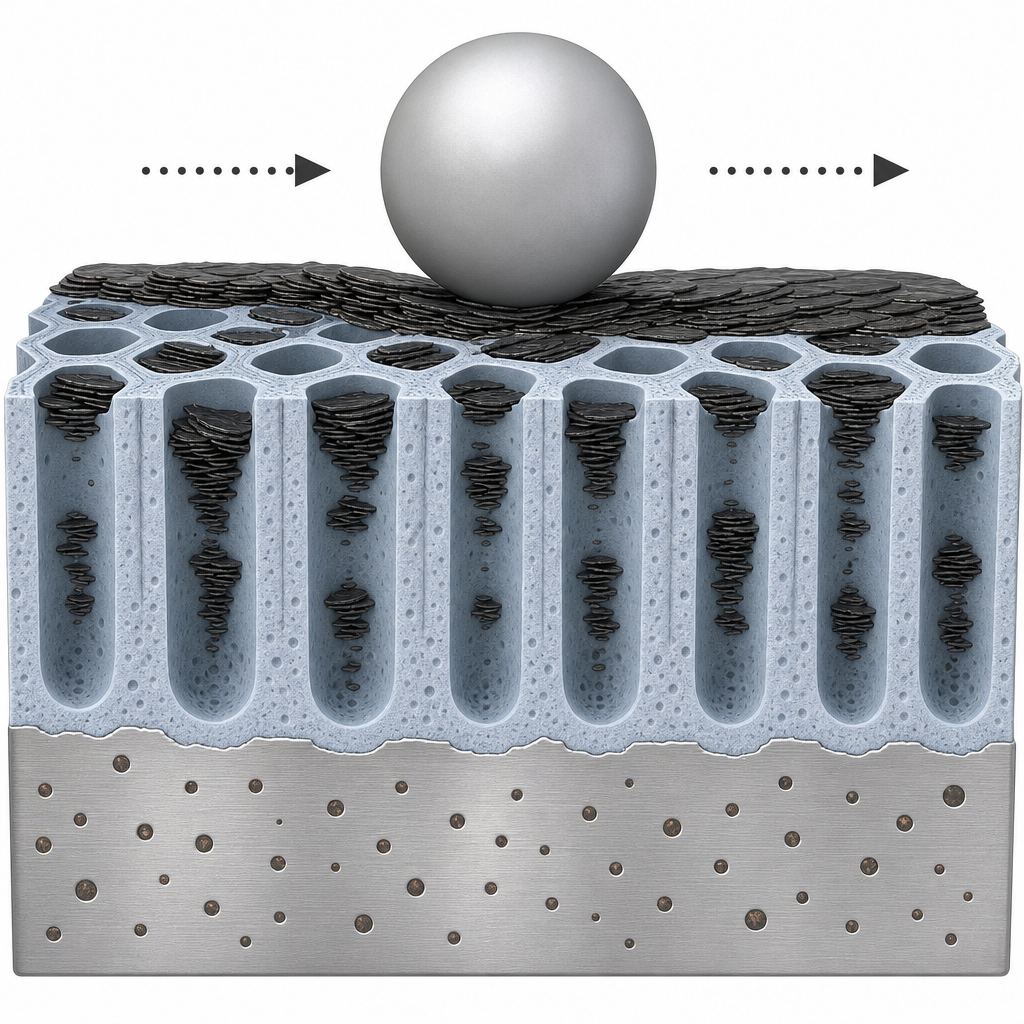
The ACS Material graphite flakes were specified as 300 mesh with an average flake size of approximately 48 μm and 99.60% purity, and their as-received surface morphology was first verified by SEM. For the anodization, graphite flakes were dispersed in 20 wt% diluted sulfuric acid with 20 mL/L ethanol and magnetically stirred for 20 min to wet and suspend the particles. Anodization was carried out at a constant current density of 15 A/dm² on AA2017-T4 disks (polished to Ra ≤ 0.08 μm) against a copper cathode. Two experimental series were performed: a time series at 5, 10, 20, 30, and 60 min with 1 g/L graphite to map the film growth mechanism, and a loading series at 0, 0.2, 0.5, and 1 g/L graphite for 60 min to evaluate mechanical and tribological response. The flakes were continuously stirred during anodizing to maintain uniform ion concentration and limit local heating, and the dispersion of graphite increased electrolyte conductivity, lowering the operating voltage from 15 V to about 9.8 V over the 60 min run.
The results document a clear film-growth sequence. A non-porous barrier oxide layer forms between 5–10 min; pores begin to develop at 20 min, breaking through the barrier; and a fully developed porous composite oxide film is obtained by 60 min, with pore width 23.74 ± 8.91 μm and depth 27.9 ± 9.09 μm. The thickness of the 1 g/L composite oxide film reached 32.45 ± 4.92 μm. Critically, increasing graphite loading reduced the surface porosity of the films, because graphite particles filled or capped pore openings as they were co-deposited. This porosity reduction translated into significantly higher Vickers microhardness at the surface and across the cross-section, and the embedded graphite produced a sliding self-lubricating layer that lowered and stabilized the friction coefficient during dry ball-on-disk sliding against a Si3N4 counterbody. The wear rate, calculated by the Archard equation from cross-sectional wear-track area, decreased markedly with graphite content, and Raman spectroscopy of the worn surfaces confirmed retained graphitic carbon in the tribolayer, supporting the proposed lubrication mechanism. The service life of the composite films was governed jointly by hardness and by the persistence of the graphite-lubricated layer.
These findings are directly relevant to aerospace fasteners, automotive pistons, bushings, and other Al-alloy sliding components where weight, hardness, and friction must all be optimized. The single-bath co-anodization approach is attractive industrially because it requires no additional vapor- or vacuum-based deposition step. The work also points toward follow-up directions, including optimizing graphite particle size and dispersion stability, exploring hybrid reinforcements that combine graphite with hard ceramic phases, and extending the strategy to other heat-treatable aluminum series such as 6XXX and 7XXX alloys used in transport structures.
For researchers exploring self-lubricating coatings, metal-matrix surface composites, or modified anodizing chemistries, the graphite flakes used in this study are available from ACS Material as a standard graphite flake product, supporting reproducible particle size and purity comparable to that reported by the authors. The paper does not claim performance beyond the dry sliding regime tested, but the documented reductions in surface porosity and friction make graphite-reinforced anodic films a credible candidate for further evaluation under lubricated and high-load conditions.How ACS Material products were used
- Graphite Flake (Graphene Series) — “Graphite flakes 300 mesh used in the experiment were purchased from Advanced Chemicals Supplier (ACS) – Material LLC, USA. The average size of graphite flake was approximate ~48 μm with 99.60% purity.”
Product Performance in this StudyThe 300-mesh graphite flakes (≈48 µm, 99.60% purity) served as the lubricating reinforcement co-deposited into anodic oxide films on AA2017-T4. Their incorporation reduced surface porosity, raised microhardness, and formed a self-lubricating tribolayer that lowered and stabilized the friction coefficient and reduced wear.
Related product categories
Frequently asked questionsHow does graphite improve the tribological properties of anodized aluminum alloy?
Graphite flakes co-deposited into the porous anodic oxide film fill surface pores and form a lamellar solid-lubricating layer at the sliding interface. During dry ball-on-disk testing, this graphite-rich tribolayer lowers and stabilizes the friction coefficient and reduces the wear rate calculated from the Archard equation. Raman spectroscopy of worn surfaces confirms graphitic carbon is retained, supporting the self-lubrication mechanism on AA2017-T4 aluminum.
Why is graphite content kept below 1 g/L during anodization?
Graphite is intrinsically brittle, so excessive loading can promote crack initiation and propagation at the oxide/metal interface and weaken the composite film. The authors therefore limited graphite content to 1 g/L or less in the sulfuric-acid electrolyte. Within this range, surface porosity is reduced and microhardness and wear resistance improve, while the risk of brittle failure beneath the oxide layer remains acceptable.
What anodizing conditions produce a fully developed composite oxide film on AA2017-T4?
Using 20 wt% diluted sulfuric acid with 1 g/L graphite at a constant current density of 15 A/dm², a complete porous composite oxide film develops in 60 min. A non-porous barrier layer forms in the first 5–10 min, pores nucleate at 20 min, and after 60 min the film reaches a thickness of about 32.45 ± 4.92 μm with pore width and depth near 24 and 28 μm respectively.