-
Graphite Oxide for Li–S Battery Aerogels — AIST, 2018
Jun 04, 2026 | ACS MATERIAL LLCHe, Y. et al. (2018). Porous hybrid aerogels with ultrahigh sulfur loading for lithium–sulfur batteries. *Journal of Materials Chemistry A*. https://doi.org/10.1039/c8ta01750f
Energy Technology Research Institute · Journal of Materials Chemistry A · 2018
AIST researchers built RGA@S aerogels from ACS Material graphite oxide, delivering 22.2 mg cm⁻² sulfur loading and 0.013% per-cycle fade over 2000 cycles.
About this research
Researchers at the National Institute of Advanced Industrial Science and Technology (AIST), in collaboration with the University of Tsukuba and Nanjing University, used graphite oxide purchased from ACS Material to fabricate porous reduced graphene oxide/sulfur (RGA@S) hybrid aerogel cathodes that achieve sulfur loadings up to 22.2 mg cm⁻² while delivering a mass specific capacity of 1386 mA h g⁻¹ and an areal capacity of 25.86 mA h cm⁻² for lithium–sulfur (Li–S) batteries. The work, published in Journal of Materials Chemistry A in 2018, demonstrates that a one-step in situ assembly of GO with sulfur generated from Na₂S₂O₃/HCl can produce a 3D interconnected porous framework that simultaneously hosts active sulfur, accommodates volume expansion, and traps soluble polysulfide intermediates.
Lithium–sulfur batteries are widely viewed as a leading candidate for next-generation energy storage because of their theoretical energy density of 2600 W h kg⁻¹ and the low cost of elemental sulfur. However, three persistent obstacles continue to hold back commercialization: the electrical insulating nature of sulfur and Li₂S, the ~80% volumetric expansion during lithiation, and the polysulfide "shuttle effect" that consumes active material and degrades the lithium metal anode. Most laboratory demonstrations report respectable cycling but at impractically low sulfur loadings (typically 1–2 mg cm⁻²). Pushing areal sulfur loading well above 4 mg cm⁻² without losing rate capability or cycle life is a major engineering challenge, and porous carbon hosts based on graphene have emerged as one of the most promising architectures.
Graphite oxide from ACS Material was the central starting material for building the aerogel host. The authors dispersed graphite oxide in water at 3 mg mL⁻¹ and combined the dispersion with sodium thiosulfate (Na₂S₂O₃), followed by addition of 5 M HCl. The acid-driven reaction between thiosulfate and protons generated elemental sulfur and dissolved SO₂ in situ within the GO suspension, producing a GO/S intermediate. Sealed heating at 95 °C for 4 hours triggered hydrogel formation through partial reduction and self-assembly of the GO sheets around the newly formed sulfur. After dialysis to remove ionic byproducts, immersion in 20% aqueous ethanol, and freeze-drying for 10 hours, the team obtained a 3D RGA@S monolith 7 mm in diameter and 1.2 mm tall. By tuning the Na₂S₂O₃ and HCl quantities (39.5 to 221.2 mg of Na₂S₂O₃), they programmed sulfur loadings of 4.2, 8.9, 13.3, and 22.2 mg cm⁻². The aerogel disks were pressed directly onto carbon paper as binder-free, additive-free cathodes.
The electrochemical performance highlights the value of using a high-quality graphite oxide precursor. Cells assembled with the RGA@S aerogels delivered a mass specific capacity of 1386 mA h g⁻¹, approaching the theoretical limit of sulfur, and an areal capacity of 25.86 mA h cm⁻² at the highest sulfur loading of 22.2 mg cm⁻² — a value that meets and exceeds the practical loading benchmarks for commercial-class Li–S cells. The interconnected porous network provided continuous electron transport pathways through the partially reduced graphene scaffold and short Li⁺ diffusion lengths, improving redox kinetics evident from cyclic voltammetry and electrochemical impedance spectroscopy. Importantly, the abundant free volume in the aerogel accommodated sulfur's volumetric expansion during lithiation and adsorbed soluble Li₂Sₓ (4 ≤ x ≤ 8) intermediates, suppressing the polysulfide shuttle. The cells achieved exceptional long-term cycle stability with a capacity decay of only 0.013% per cycle over 2000 cycles. Comparison samples prepared by the conventional melt-diffusion route (RGO–S, 70 wt% sulfur) underperformed both in capacity utilization and in cycling stability, confirming that the in situ aerogel architecture, rather than simply the sulfur content, was responsible for the improvements. Characterization by FE-SEM, TEM, XRD, and TGA verified the uniform sulfur distribution and 3D porous morphology.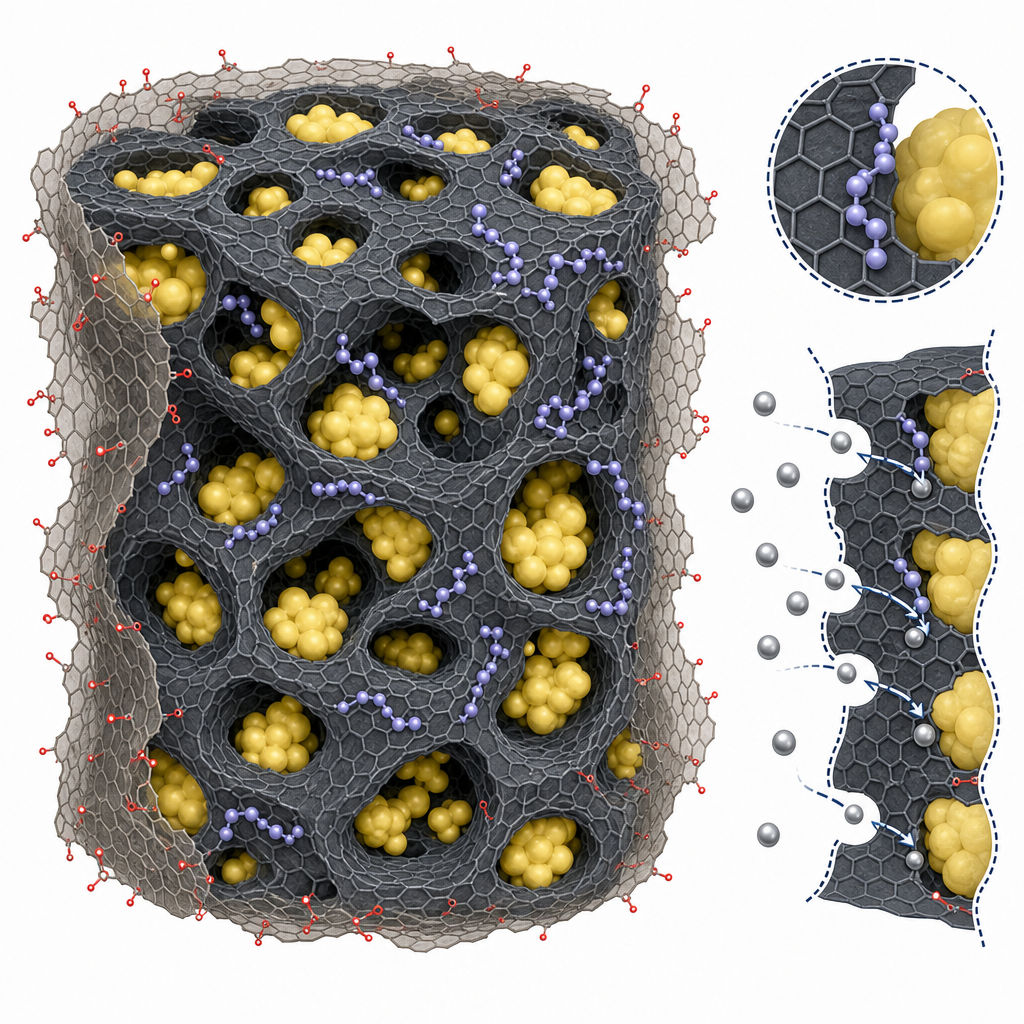
The demonstrated ability to achieve >20 mg cm⁻² sulfur loading with stable cycling has direct implications for high-energy-density Li–S pouch cells, electric vehicle batteries, and grid-scale energy storage where areal capacity, not just gravimetric capacity, determines pack-level energy density. The simple aqueous self-assembly route is scalable and avoids high-temperature melt infiltration, polymer binders, and toxic solvents, making it attractive for industrial translation. The strategy can also be adapted to other conversion-type cathode chemistries (selenium, tellurium) and to anode hosts requiring volume buffering (silicon, sodium). Future work suggested by the authors includes pairing RGA@S cathodes with protected lithium anodes and exploring sparse-electrolyte conditions, which are essential for translating high areal capacity into cell-level energy density gains.
For researchers developing graphene-based hosts for Li–S, supercapacitors, or related electrochemical systems, this paper underscores the importance of starting from a well-defined graphite oxide. The graphite oxide product from ACS Material used here is part of the broader Graphene Series catalog, which is available to research groups working on similar self-assembled aerogel and hydrogel architectures.How ACS Material products were used
- Graphite Oxide (Graphene Series) — “Graphite oxide (GO) was purchased from ACS Material.”
Product Performance in this Study
The graphite oxide served as the primary precursor for the reduced graphene oxide aerogel framework. Its uniform dispersibility enabled the self-assembly into a 3D porous hybrid aerogel with sulfur, which underpinned the ultrahigh sulfur loading and stable cycling performance reported in the paper.
Related product categories
Frequently asked questions
How is graphite oxide used to make high-loading lithium–sulfur battery cathodes?
Graphite oxide is dispersed in water and mixed with sodium thiosulfate, then acidified with HCl to generate elemental sulfur in situ. Mild heating at 95 °C drives partial reduction and self-assembly of GO sheets around the sulfur, forming a 3D hybrid hydrogel. After dialysis and freeze-drying, the resulting porous reduced graphene oxide/sulfur aerogel can be pressed directly onto carbon paper as a binder-free cathode with sulfur loadings exceeding 20 mg cm⁻².
Why does a porous graphene aerogel suppress the polysulfide shuttle effect?
The interconnected pores of the reduced graphene oxide aerogel physically confine dissolved lithium polysulfide intermediates (Li₂Sₓ, 4 ≤ x ≤ 8) within the cathode, while the partially oxygenated graphene surface provides chemical adsorption sites. This dual confinement reduces migration of polysulfides toward the lithium anode, preserving active material and limiting capacity fade. In this study the strategy delivered only 0.013% capacity loss per cycle over 2000 cycles.
What sulfur loading is needed for practical lithium–sulfur batteries?
To match the volumetric and gravimetric energy density of commercial lithium-ion cells, lithium–sulfur cathodes generally need sulfur loadings above 4–5 mg cm⁻² with areal capacities exceeding 5 mA h cm⁻². This work pushed loading to 22.2 mg cm⁻² and demonstrated 25.86 mA h cm⁻² areal capacity, showing that aerogel-based architectures can meet practical thresholds while retaining cycle stability.