-
Graphite Oxide for ORR Electrocatalysts - UC Merced, 2019
Jul 10, 2026 | ACS MATERIAL LLCMusico, Y. L. F. et al. (2019). One-pot hydrothermal synthesis of heteroatom co-doped with fluorine on reduced graphene oxide for enhanced ORR activity and stability in alkaline media. *Materials Chemistry and Physics*. https://doi.org/10.1016/j.matchemphys.2019.121804
Materials Chemistry and Physics · 2019
UC Merced researchers used ACS Material graphite oxide to synthesize B/N and F co-doped rGO electrocatalysts with strong ORR activity and stability in alkaline media.
About this research
Researchers at the University of California, Merced report that graphite oxide purchased from ACS Material LLC can be transformed by a simple one-pot hydrothermal route into boron- or nitrogen-fluorine co-doped reduced graphene oxide (B-F-rGO and N-F-rGO) electrocatalysts that match or exceed commercial Pt/C in stability for the alkaline oxygen reduction reaction (ORR). The dual-doped catalysts achieved near 4-electron oxygen reduction pathways with hydrogen peroxide yields of only 20–30%, while showing negligible activity loss over 5,000 accelerated durability cycles, whereas Pt/C lost significant activity in the same test. The work demonstrates a low-cost, scalable, and environmentally friendly path to non-precious-metal ORR catalysts.
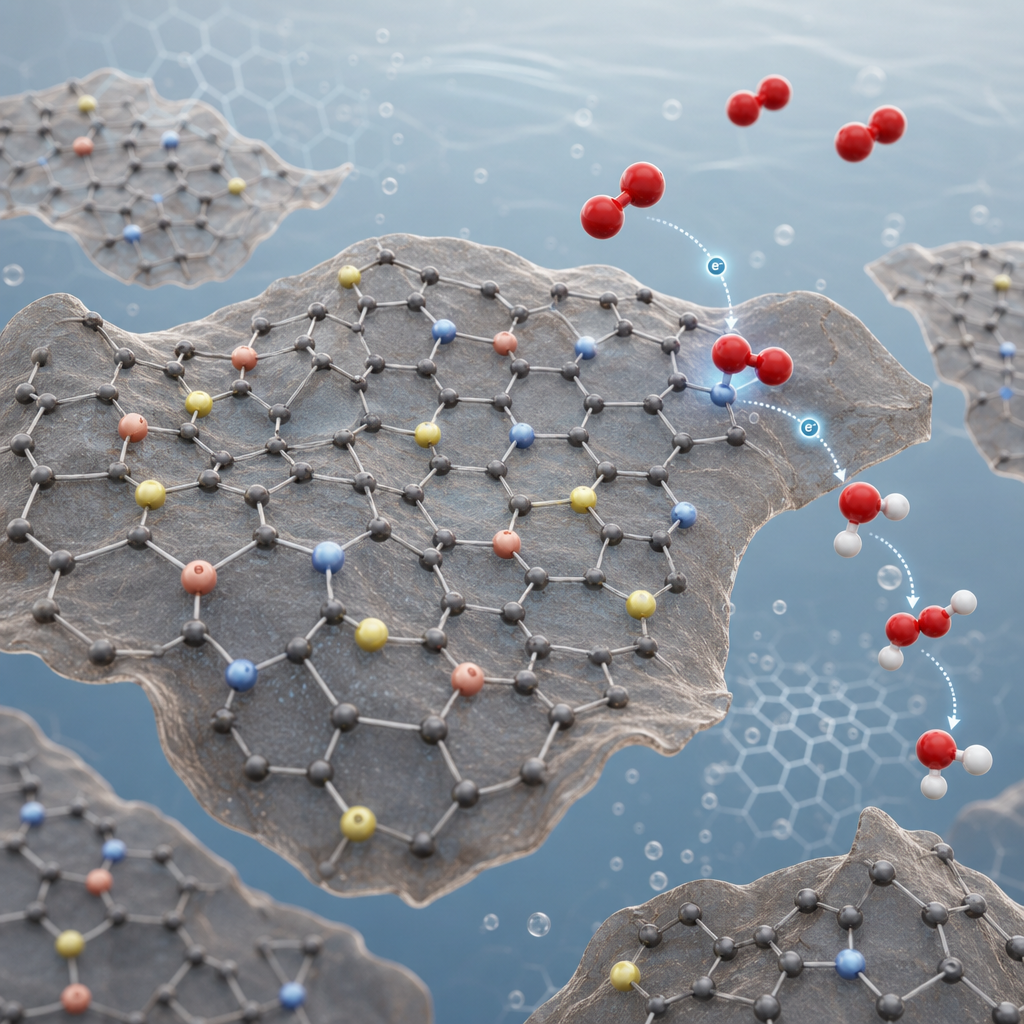
The ORR is the kinetically limiting step in fuel cells, metal-air batteries, and many electrolysis devices. Platinum and Pt-based catalysts remain the benchmark, but Pt scarcity and cost block mass deployment. Heteroatom-doped graphene has emerged as a leading non-platinum-group-metal alternative because doping with N, B, S, P, or halogens disturbs the electroneutrality of the sp² carbon network, creating active sites that adsorb O2 and lower the ORR overpotential. Co-doping two heteroatoms can produce synergistic electronic effects beyond either single dopant. Fluorine, the most electronegative element, is particularly promising because it polarizes neighboring carbons; however, simple, water-based routes to F co-doped graphene that avoid pyrolysis or gas-phase deposition have remained scarce.
The Merced team began with commercially available graphite oxide from ACS Material, dispersed it in water at 1 mg/mL, and combined it with citric acid as a mild reducing agent. To introduce nitrogen they added urea; for boron they used boric acid (H3BO3). Fluorine was introduced either through trifluoroacetic acid or ammonium fluoride (NH4F). The mixtures were sonicated, transferred into a 100 mL Teflon-lined autoclave, and treated at 180 °C for 24 h. After vacuum filtration and washing with water and ethanol, the resulting B-rGO, B-F-rGO, N-rGO, and N-F-rGO powders were dried and used directly as catalysts. SEM showed that ACS Material's graphite oxide started as thin, large-area flakes consistent with effective exfoliation during oxidation, and that the hydrothermal product retained an open, wrinkled morphology with edge planes exposed for heteroatom incorporation. XPS confirmed successful B-C, N-C (pyridinic, nitrile, quaternary), and ionic C-F bonding, and the resulting catalysts were drop-cast onto a glassy-carbon rotating disk electrode at 0.5 mg cm⁻² for testing.
The quantitative ORR results show clear synergy from F co-doping. BET surface areas rose from 42 m² g⁻¹ for B-rGO and 69 m² g⁻¹ for N-rGO to 74 m² g⁻¹ for B-F-rGO and 103 m² g⁻¹ for N-F-rGO. In O2-saturated 0.1 M KOH at 1600 rpm, B-F-rGO reached an onset potential of 0.79 V vs RHE with a limiting current density of −3.68 mA cm⁻², while N-F-rGO delivered an onset of 0.80 V vs RHE and −4.09 mA cm⁻², compared with −4.90 mA cm⁻² for 20 wt% Pt/C. Koutecky-Levich analysis and RRDE collection-efficiency measurements (N = 0.28) both yielded electron transfer numbers near 4 (3.41 for N-F-rGO and 3.54 for B-F-rGO), confirming the desired direct four-electron O2 → OH⁻ pathway. Peroxide yields stayed between 20% and 30% across 0.3–0.7 V vs RHE for the F co-doped samples, versus 30–40% for the singly doped controls. In a 5,000-cycle accelerated durability test between 0.6 and 1.15 V vs RHE, Pt/C suffered a large drop in half-wave potential and limiting current, whereas the heteroatom-doped rGOs showed only minor ΔE1/2 shifts—particularly N-F-rGO, which was the most stable.
These results position B-F-rGO and N-F-rGO as cost-effective candidates for alkaline fuel-cell cathodes, zinc-air and other metal-air batteries, and alkaline water-electrolysis devices that share ORR-type intermediates. Because the synthesis uses water as the solvent, runs at modest temperature, and avoids pyrolysis or CVD, scale-up to gram and multi-gram quantities is straightforward—well-suited to flow-battery and membrane-electrode-assembly research. The authors point to further optimization of the N:F and B:F ratios and the exploration of ternary doping (e.g., N, B, F) as natural next steps, alongside integration into gas-diffusion electrodes for full-cell testing.
For groups working on metal-free electrocatalysts, graphene composites, or low-cost energy materials, the relevant precursor used here—graphite oxide—is available from ACS Material in research and bulk quantities, alongside related reduced graphene oxide, graphene oxide, and CVD graphene products. The paper illustrates how a single well-characterized starting graphite oxide can be tuned by simple aqueous-phase chemistry into multiple application-ready catalyst formulations, making it a useful platform material for ORR, HER, supercapacitor, and battery-electrode research.How ACS Material products were used
- Graphite Oxide (Graphene Series) — “Graphite oxide (GO) is a commercially available product purchased from ACS Material, LLC.”
Product Performance in this Study
The commercially purchased graphite oxide from ACS Material served as the precursor for all reduced graphene oxide (rGO) catalysts. SEM confirmed it had a thin, exfoliated curtain-like morphology with large surface areas, providing an effective template for heteroatom (B, N, F) doping via hydrothermal treatment.
Related product categories
Frequently asked questions
Why is fluorine co-doping used with N or B doped graphene for the oxygen reduction reaction?
Fluorine has the highest electronegativity of any element, so when it is co-doped alongside nitrogen or boron on reduced graphene oxide it polarizes adjacent carbon atoms and creates additional ORR active sites. In this study, adding F raised BET surface area, shifted the onset potential more positive, increased the limiting current density, and pushed the electron-transfer number closer to four versus singly N- or B-doped rGO.
How does heteroatom-doped reduced graphene oxide compare to Pt/C for ORR stability in alkaline media?
In 5,000-cycle accelerated durability tests between 0.6 and 1.15 V vs RHE in O2-saturated 0.1 M KOH, commercial 20 wt% Pt/C showed a significant drop in half-wave potential and limiting current density. The B-F-rGO and N-F-rGO catalysts showed only minor ΔE1/2 shifts and negligible loss of surface active sites, indicating that heteroatom-doped rGO is more durable than Pt/C in alkaline conditions.
What is graphite oxide used for in graphene-based electrocatalyst synthesis?
Graphite oxide is the most common precursor for producing reduced graphene oxide (rGO) and doped graphene catalysts. After exfoliation in water, the oxygen functional groups on the graphite oxide surface enable reaction with dopant precursors such as urea, boric acid, ammonium fluoride, or trifluoroacetic acid. Hydrothermal treatment then simultaneously reduces the GO and incorporates heteroatoms into the carbon lattice, yielding active catalysts in a single step.