-
Hummers Graphite Oxide vs Brodie GO Membranes - Umeå University, 2017
Jun 03, 2026 | ACS MATERIAL LLCTalyzin, A. V. et al. (2017). Brodie vs Hummers graphite oxides for preparation of multi-Layered materials. *Carbon*. https://doi.org/10.1016/j.carbon.2016.12.097
Carbon · 2017
Umeå University researchers compare Brodie and Hummers graphite oxides (including ACS Material HGO) for multilayered GO membranes, revealing superior mechanical strength of BGO.
About this research
Researchers at Umeå University, working with collaborators at Humboldt-Universität zu Berlin, Karlstad University, and Nokia Technologies, used commercial Hummers graphite oxide purchased from ACS Material as a key reference sample to demonstrate that Brodie-method graphite oxide (BGO) produces multilayered membranes with Young's moduli more than two orders of magnitude higher than Hummers-method graphite oxide (HGO). Published in Carbon (2017), the study combined XPS, solid-state 13C NMR, FTIR, NEXAFS, TGA/DSC, and dynamic mechanical analysis to show that the synthetic route, not just the C/O ratio, controls the structural integrity and mechanical properties of GO papers and membranes.
The broader scientific context is that graphite oxide is the primary precursor for graphene oxide dispersions, GO papers, membranes for water purification and gas separation, and reduced graphene oxide used in composites and electrodes. Most published studies rely on Hummers-method GO and treat the results as general for "graphite oxide." However, GO synthesized by the older Brodie method exhibits markedly different swelling, exfoliation temperatures, and intercalation behavior. Understanding why these two materials differ has direct consequences for membrane engineering, selective permeation, mechanical reinforcement of polymer composites, and reproducibility across laboratories. With GO membranes increasingly proposed for molecular sieving and ion-selective transport, the choice of synthesis method becomes a critical experimental variable that researchers cannot ignore.
The ACS Material Hummers graphite oxide was used as HGO2, one of three Hummers samples (alongside two laboratory-synthesized batches, HGO1 and HGO3) benchmarked against one- and two-step Brodie graphite oxides (BGO1, BGO2). The authors note that "a second sample of Hummers graphite oxide was purchased from ACS Materials (HGO2)" and that "the same type of commercial HGO was characterized in several of our previous studies," giving the work a multi-year continuity. HGO2 was analyzed in powder form by XPS, NMR, FTIR, NEXAFS, and TGA, and was processed into free-standing multilayered membranes by vacuum filtration through Anodisc alumina filters. The resulting ~4–5 μm thick membranes were air-dried, equilibrated for at least three weeks, and tested in a TA Instruments DMA Q800 under ambient, vacuum-dried, and 80% humidity conditions inside a Voetch environmental chamber.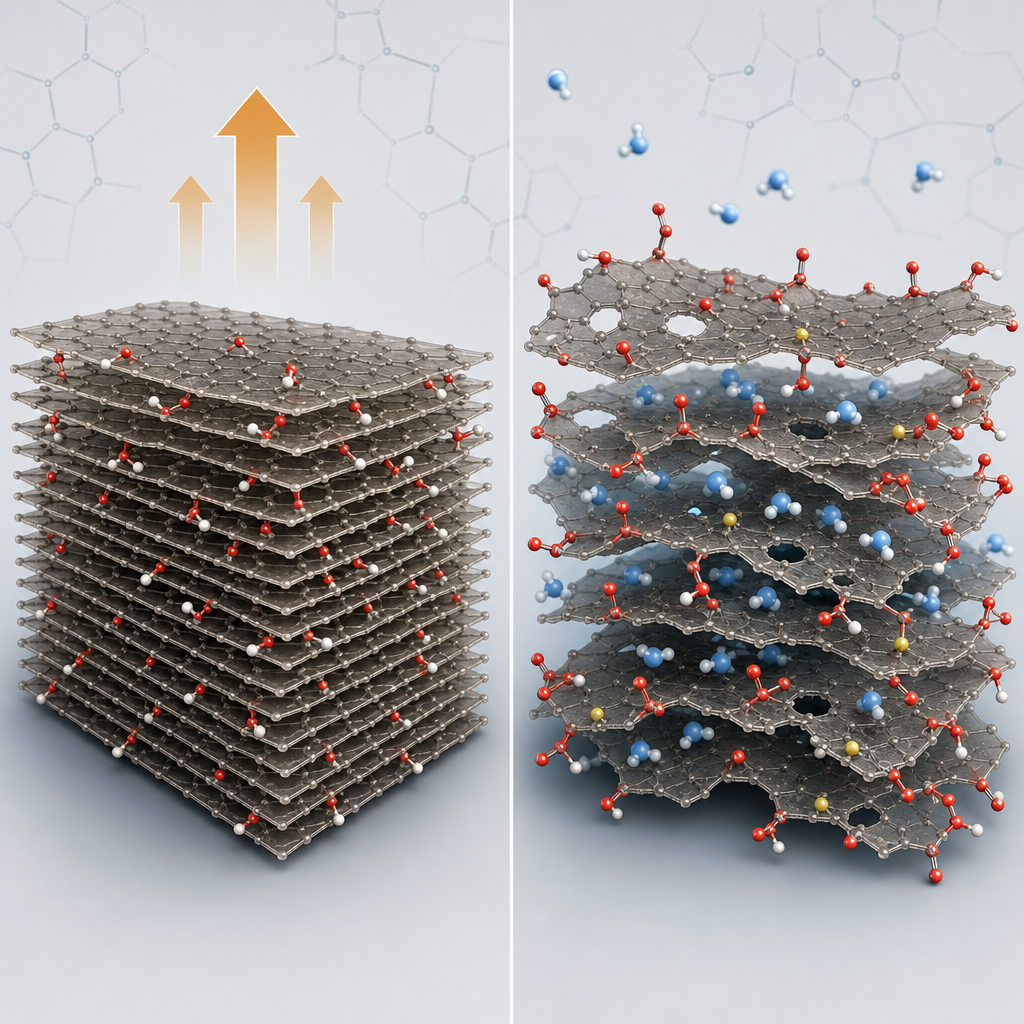
Key results spanned chemistry, structure, and mechanics. XPS gave C/O ratios of 2.31 for HGO1 and 2.5 for HGO2 (versus 2.7 for BGO2), with HGO containing 0.66–0.76% sulfur impurity from sulfuric acid used in synthesis. The carboxylic-group peak at 288.9 eV was approximately twice as intense in HGO as in BGO (6.1 at% vs 2.2 at% in membranes), consistent with more holes and edge defects in HGO sheets. TGA showed HGO absorbed ~15–20 wt% water at ambient humidity versus only ~5 wt% for BGO, and HGO exfoliated at 213–220 °C with a broad weight-loss step compared with 280–284 °C and a sharper step for BGO. The most striking contrast was mechanical: BGO membranes reached a Young's modulus of 24,229 MPa at ambient humidity, dropping to 20,019 MPa under vacuum drying and 14,448 MPa at 80% humidity. HGO2 membranes reached only 200.6 MPa at ambient, 2,684 MPa after vacuum drying, and 186.2 MPa at 80% humidity. NMR and FTIR consistently indicated higher hydroxyl and epoxy content in BGO versus higher carbonyl/carboxyl content in HGO, while NEXAFS revealed planar C=C orientation in both materials but stronger dichroism in HGO.
These findings have direct applications for membrane technology, where GO papers are candidates for water desalination, molecular sieving of hydrogen, and selective separation of water-alcohol mixtures. The work suggests that Brodie GO should be preferred when high mechanical strength and low humidity sensitivity are required, whereas Hummers GO remains attractive when easy aqueous dispersion is needed. The results also caution against generalizing literature findings between synthesis methods. Follow-up work referenced by the authors—including comparisons of individual GO sheet strength and detailed quantification of functional groups by selective chemical labeling—points toward designing tailored GO precursors for next-generation flexible electrodes, gas-barrier coatings, and structural nanocomposites.
For researchers working on graphene oxide membranes, supercapacitor electrodes, polymer reinforcement, or selective separations, this study illustrates how starting-material provenance can dominate device performance. ACS Material's commercial Hummers graphite oxide, used here as HGO2, provided a reproducible benchmark that allowed direct comparison with laboratory-synthesized batches and Brodie GO. Comparable graphite oxide and graphene oxide grades remain available through ACS Material's graphene series for groups that need a consistent, well-characterized starting material for membrane fabrication, dispersion studies, or composite preparation.How ACS Material products were used
- Hummers Graphite Oxide (HGO2) (Graphene Series) — “A second sample of Hummers graphite oxide was purchased from ACS Materials (HGO2). The same type of commercial HGO was characterized in several of our previous studies”
Product Performance in this StudyThe commercial Hummers graphite oxide from ACS Material served as one of the key reference samples (HGO2) for comparing structural, chemical, and mechanical properties with Brodie-method graphite oxide. It exhibited C/O = 2.5, ~0.66% sulfur impurity, broader thermal exfoliation behavior, higher water sorption (~15-20 wt%), and lower Young's modulus (~200 MPa at ambient) compared to BGO membranes.
Related product categories
Frequently asked questionsHow do Brodie and Hummers graphite oxides differ in mechanical strength?
Brodie graphite oxide membranes exhibit Young's moduli of around 24 GPa at ambient humidity, compared with only about 200 MPa for membranes from Hummers GO purchased from ACS Material. The difference reflects fewer holes and a more intact graphene skeleton in Brodie GO. Hummers GO contains more carbonyl and carboxyl groups, which create vacancy defects, plus higher water sorption that weakens interlayer bonding.
What functional groups dominate in Hummers versus Brodie graphite oxide?
FTIR, NMR, and XPS consistently show that Hummers graphite oxide contains more carbonyl and carboxyl groups, with the XPS peak at 288.9 eV roughly twice as intense as in Brodie GO. Brodie GO is richer in hydroxyl and epoxy groups, which sit on the basal plane without breaking the C=C network. Carboxyl groups indicate edges of holes, so their abundance signals defect density.
Why does humidity affect graphene oxide membrane performance?
Graphene oxide swells when water intercalates between layers, increasing the interlayer distance and weakening hydrogen-bonded sheet-to-sheet interactions. In this study, raising humidity to 80% reduced the Young's modulus of both Brodie and Hummers GO membranes. Hummers GO absorbs 15-20 wt% water at ambient conditions versus only 5 wt% for Brodie GO, making Hummers-based membranes more sensitive to atmospheric moisture in real applications.