-
HZSM-5 Zeolite for Asphaltene Deposition Study - NYU, 2017
Jul 07, 2026 | ACS MATERIAL LLCPinho, B. et al. (2017). Role of HZSM-5 Aluminosilicates on Asphaltenes Deposition by High-Throughput in Situ Characterizations of a Microreservoir. *Energy & Fuels*. https://doi.org/10.1021/acs.energyfuels.7b01748
New York University · Energy & Fuels · 2017
NYU researchers used ACS Material HZSM-5 zeolites (Al2O3/SiO2 = 1/26 and 1/91) in a microreservoir to study asphaltene deposition in sandstone reservoirs.
About this research
Researchers at New York University used ACS Material HZSM-5 zeolites with Al2O3/SiO2 molar ratios of 1/26 and 1/91 to build a model sandstone microreservoir and showed that aluminosilicate composition significantly modulates asphaltene precipitation, with the higher-alumina zeolite producing 13% larger asphaltene aromatic sheets and over 10% greater bed occupancy. Reported in Energy & Fuels (2017) by Pinho, Minsariya, Yen, Joshi, and Hartman, the study combines in situ Raman 2D/3D mapping, UV–vis spectroscopy, and pressure sensing to provide a high-throughput, molecular-to-microscale view of how reservoir mineralogy controls asphaltene deposition near the wellbore.
Asphaltene precipitation is one of the most persistent flow-assurance challenges in upstream oil production. When pressure, temperature, or solvent composition shift along the production path, asphaltenes destabilize, aggregate, and deposit on rock surfaces, in pore throats, on wellbores, and in flowlines. Sandstone reservoirs are not pure quartz: they contain clays and oxides such as Al2O3, TiO2, CaCO3, and MgO that act as chemically active surfaces. Understanding how these inorganic components shift the onset of asphaltene aggregation is central to designing better inhibitors and remediation strategies. Lab-on-a-chip microreservoirs offer rapid, reproducible, and optically accessible platforms to isolate single mineralogical variables, which is difficult in core-flood experiments. The authors target one important variable—the Al2O3/SiO2 ratio characteristic of clay-containing sandstones—using a model aluminosilicate available in two well-defined compositions.
The ACS Material HZSM-5 zeolites served as the model aluminosilicate fines injected onto a quartz-packed silicon/borosilicate microfluidic device. As reported in the experimental section, the zeolites were purchased from ACS Material with a water content below 5 wt%, ~5 Å pore size, a spherical crystal size of 300 nm, and a BET specific surface area of 362 m²·g⁻¹. The two compositions, Al2O3/SiO2 = 1/26 and 1/91, were chosen specifically to vary surface acidity and Al content while keeping particle size and pore structure constant. The HZSM-5 was dispersed in isopropanol at 15.2 µg·L⁻¹, sonicated to break agglomerates (DLS measured stable ~707 nm aggregates corresponding to roughly three zeolite crystals each), and delivered at 40 µL·min⁻¹ for 25 hours to ensure retention within the quartz bed without fluidization. A total of 0.91 mg (~1.25 µL) of HZSM-5 was loaded, building a μReservoir that approximated a Wyoming-formation sand-to-clay volume ratio of 0.05.
The authors injected a 4 g·L⁻¹ asphaltene-in-toluene stream alongside n-heptane in a sonicated T-union to trigger precipitation inside the packed bed. After deposition and drying, the entire 20.5 × 12.0 mm² channel was mapped by confocal Raman spectroscopy across roughly 24,600 spectral nodes with 50 µm resolution. Deconvolution of the carbonaceous G and D1 bands using the Tuinstra–Koenig relation gave asphaltene aromatic sheet sizes (La). For the higher-alumina HZSM-5 (1/26), La increased by 13% relative to a quartz-only bed, indicating that Al2O3 sites preferentially adsorb or stabilize larger asphaltene molecules and delay nanoaggregation. Bed occupancy, derived from the ratio of asphaltene to quartz Raman integrals, was more than 10% higher in the 1/26 bed than in the alumina-free reference. Pressure-drop data showed that, as the Al2O3/SiO2 ratio increased, more pore volumes had to be injected before pore-throat plugging occurred, but the eventual deposit thickness was larger. UV–vis absorbance at 277 nm and residence-time-distribution measurements independently quantified pore-volume reduction and confirmed zeolite retention. Together, the results paint a consistent picture: alumina-rich sites slow down the initial aggregation step yet bias the deposit toward larger, thicker layers.
These findings are directly relevant to flow-assurance engineering, formation-damage modeling, and chemical-inhibitor screening in oilfield operations. The microreservoir methodology, combined with high-throughput Raman mapping, gives operators and chemistry vendors a rapid way to test how candidate clays, scale-control additives, or surface treatments alter asphaltene behavior under realistic near-wellbore conditions. Beyond petroleum, the same workflow could be adapted to study heavy-organic deposition in pipelines, fouling of porous catalysts, and adsorption of aromatic contaminants in zeolite-based separation media. The authors point to further work on heteroatom effects (N, S, V, Ni in different crude oils) and on dynamic fines migration, both of which would extend the framework toward predictive deposition models for specific reservoirs.
For researchers studying asphaltene chemistry, formation damage, or zeolite–hydrocarbon interactions, well-characterized aluminosilicate fines with controlled Al2O3/SiO2 ratios are essential to reproducing results across labs. The HZSM-5 zeolites used in this study, with their defined ~300 nm crystal size, ~5 Å pore aperture, and 362 m²·g⁻¹ surface area, are available from ACS Material along with related ZSM-5 series and other molecular sieves. Reliable, consistent zeolite chemistry remains the limiting factor in microreservoir reproducibility, and this paper illustrates how product-level control translates directly into quantitative insight at the molecular scale.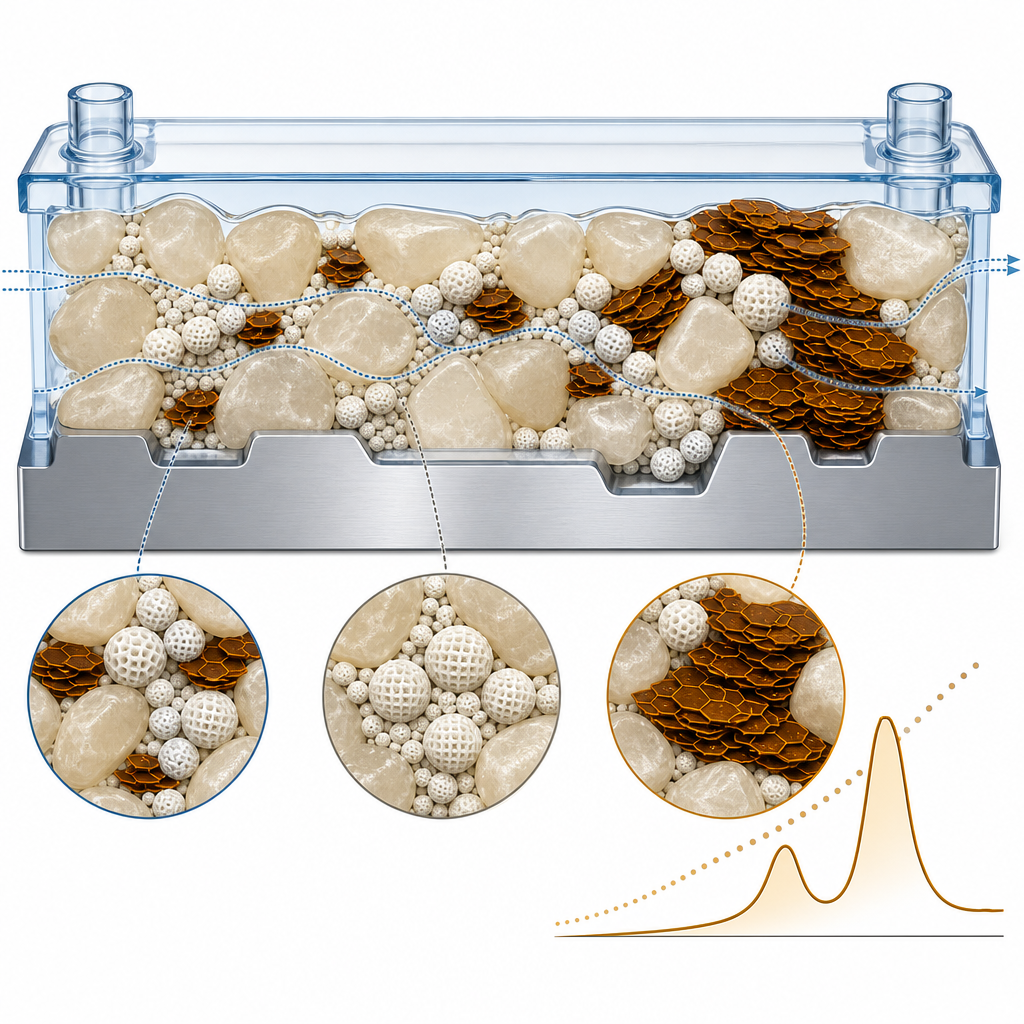
How ACS Material products were used
- HZSM-5 Zeolite (Al2O3/SiO2 molar ratios of 1/26 and 1/91) (Molecular Sieves) — “The zeolites HZSM-5 (Al2O3/SiO2 molar ratio of 1/26 and 1/91) were purchased from ACS Material, having a water content <5 wt %, a pore size ∼5 Å, a spherical crystal size of 300 nm, and a Brunauer−Emmett−Teller (BET) specific surface area of 362 m2·g−1.”
Product Performance in this Study
The two HZSM-5 zeolites with distinct Al2O3/SiO2 ratios were the core experimental variable, enabling the authors to quantify how aluminosilicate composition alters asphaltene precipitation, aggregate sheet size, and pore-bed occupancy in a quartz microreservoir. The 1/26 zeolite produced 13% larger asphaltene sheets and >10% greater bed occupancy than an Al2O3-free bed.
Related product categories
Frequently asked questions
How does the Al2O3/SiO2 ratio of HZSM-5 zeolite affect asphaltene deposition?
Increasing the Al2O3/SiO2 ratio from 1/91 to 1/26 increases the asphaltene aromatic sheet size by about 13% and the bed occupancy by more than 10% compared to an alumina-free quartz bed. The higher Al2O3 content delays initial nanoaggregation but biases adsorption toward larger asphaltene molecules, ultimately producing thicker deposits and requiring more injected pore volumes to plug pore throats.
Why is HZSM-5 zeolite used to simulate sandstone reservoir mineralogy?
HZSM-5 is a well-defined aluminosilicate available in tunable Al2O3/SiO2 ratios, allowing researchers to isolate the chemical effect of alumina content while keeping particle size, pore aperture, and surface area constant. In this study the zeolite had a 300 nm spherical crystal size, ~5 Å pores, and 362 m²·g⁻¹ BET surface area, which made it a reproducible proxy for the clay fines found in sandstone formations.
What characterization techniques quantify asphaltene deposition in a microreservoir?
The authors combined in situ confocal Raman spectroscopy with 2D and 3D mapping (about 24,600 nodes over 20.5 × 12.0 mm²), online UV–vis absorbance at 277 nm, residence-time-distribution measurements with an acetone tracer, and inline pressure transducers. Raman G/D1 band deconvolution gave asphaltene sheet size via the Tuinstra–Koenig relation, while quartz/asphaltene peak ratios provided quantitative bed occupancy.