-
HZSM-5 Zeolite for Yeast Lipid Cracking - University of Bath, 2014
Jun 19, 2026 | ACS MATERIAL LLCWagner, J. L., Ting, V. P., & Chuck, C. J. (2014). Catalytic cracking of sterol-Rich yeast lipid. *Fuel*. https://doi.org/10.1016/j.fuel.2014.04.048
Fuel · 2014
University of Bath researchers used ACS Material HZSM-5 zeolite to catalytically crack sterol-rich yeast lipid into a diesel-like biofuel in a single step.
About this research
Researchers at the University of Bath (Centre for Sustainable Chemical Technologies, Department of Chemical Engineering) used H+-ion exchanged ZSM-5 zeolite purchased from ACS Material to catalytically crack a sterol-rich yeast lipid into a single-step diesel-like hydrocarbon fuel, showing that the sterol fraction—long considered a liability for hydrotreating—can instead serve as an in-situ hydrogen donor. Working alongside Pd/C and HY zeolite benchmarks, the team converted both a model 50:50 cholesterol/rapeseed-oil mixture (RC50) and unrefined microbial oil from Metschnikowia pulcherrima at 350 °C and 400 °C in stainless-steel batch reactors. The resulting fuel reached >99% triglyceride conversion under optimized conditions and could be blended up to 50% (v/v) with ultra-low sulphur diesel.
Microbial lipids from oleaginous yeasts are an attractive route to drop-in transport fuels because they avoid food-versus-fuel conflicts and can be grown on industrial side-streams. However, yeast oils contain unusually high levels of sterols (notably cholesterol-type structures) relative to plant oils, and there has been concern that these multi-ring molecules could poison hydrotreating catalysts or yield off-specification cetane and cold-flow behaviour. Direct catalytic cracking is an attractive alternative to hydrotreating because it does not require external hydrogen and runs at moderate pressures. The open question this study addresses is whether the sterol fraction is in fact detrimental, neutral, or beneficial when an unrefined yeast lipid is processed over industrially relevant catalysts in a single step.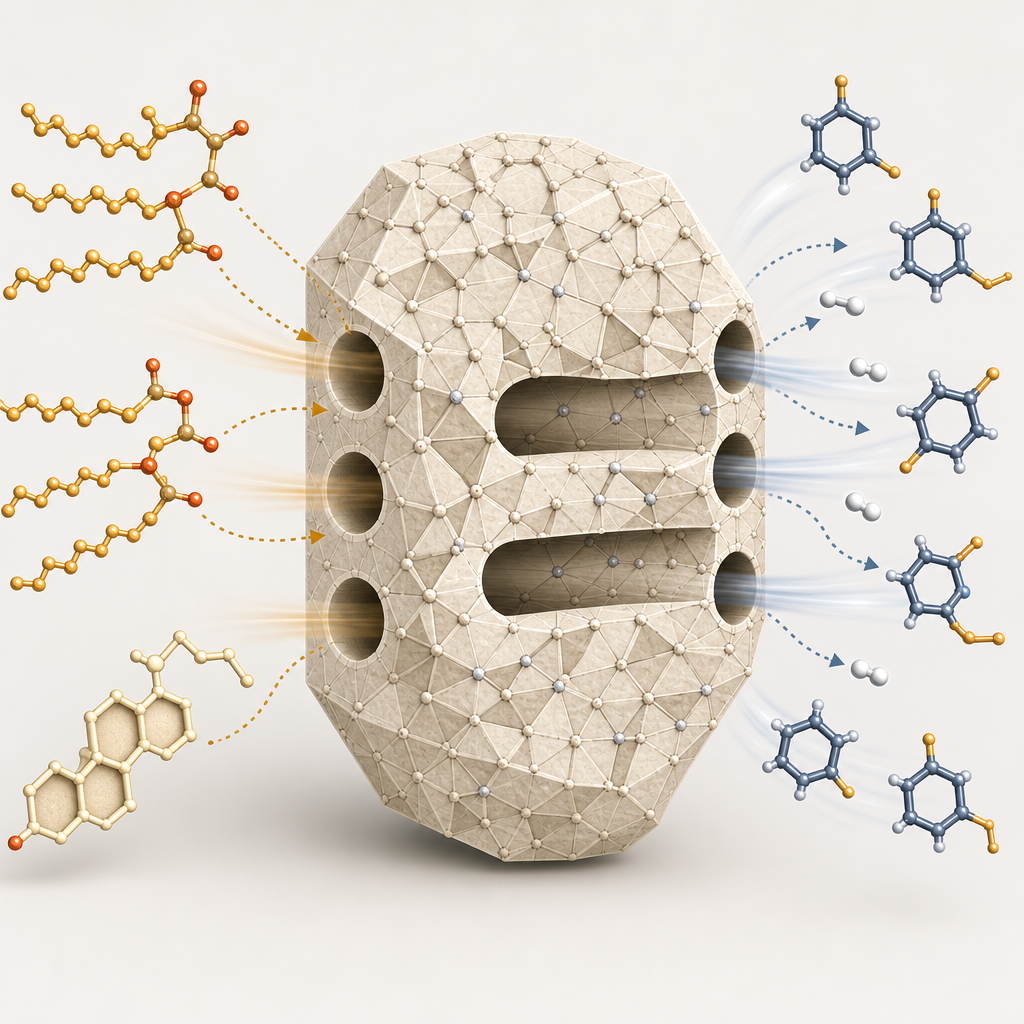
The HZSM-5 catalyst from ACS Material was supplied in pelleted form with a SiO2/Al2O3 ratio of 38, in the H+-ion-exchanged active form already suitable for acid-catalyzed cracking. The pellets were crushed, sieved and vacuum oven-dried at 80 °C overnight before use, and characterized by thermogravimetric analysis. 50 mL Swagelok batch reactors were loaded under argon with 3 g of feedstock (pure rapeseed oil, RC50 cholesterol/rapeseed-oil mixture, or pure cholesterol, plus unrefined M. pulcherrima oil for the final demonstration) and 0.5 g of catalyst, with HZSM-5 used at a 6:1 feed-to-catalyst mass ratio. Reactions were run for 1 h at 350 °C or 400 °C in a tubular pyrotherm furnace under autogenous pressure (estimated 2–40 bar). Liquid products were filtered, dried and analysed by 1H NMR (Bruker AV500), GC–MS (Agilent 7890A/5975C with DB-23 column) and elemental analysis. HZSM-5 served as the aromatic-selective benchmark against the dehydrogenating Pd/C and the larger-pore HY zeolite.
Quantitatively, HZSM-5 from ACS Material delivered ~80% triglyceride conversion on pure rapeseed oil at 350 °C in 1 h, rising to essentially complete conversion at 400 °C. Double-bond conversion on the RC50 sterol-rich feed reached close to 100% over HZSM-5 at 350 °C, and full sterol conversion was also achieved—matching Pd/C and outperforming HY zeolite, attributed to the higher density of strong acid sites in ZSM-5 versus Y. At 400 °C the HZSM-5 product from rapeseed oil contained no detectable carboxylic acids and only trace linear alkanes; instead it was dominated by C8–C18 single-ring aromatics such as 1-ethyl-2-methyl-benzene and dodecylbenzene, consistent with the 10-membered-ring pore geometry of ZSM-5 favouring monocyclic aromatic formation while suppressing polyaromatic coke. Coke yields over HZSM-5 actually fell with increasing sterol loading, contradicting the expectation that sterols would accelerate fouling. Across all catalysts the cracking of sterol liberated hydrogen, which hydrogenated olefinic intermediates and reduced the residual olefin content of the fuel. Pd/C delivered the most diesel-like distribution (high linear alkanes, ~10 wt% aromatics, oxygen content as low as 1.40% for RC50 at 400 °C), while the HZSM-5 fuel offered a complementary high-aromatic, high-octane-character blendstock. The unrefined yeast lipid was successfully converted to an energy-dense hydrocarbon fuel suitable for marine use neat or for road transport at 50% v/v blends with ULSD.
The practical implication is that sterol-rich microbial lipids no longer need to be viewed as a problematic feedstock for renewable diesel. Single-step catalytic cracking over commercially available HZSM-5 or Pd/C delivers a hydrocarbon blendstock with properties approaching those of petroleum ULSD, without external hydrogen input. The HZSM-5-derived product, rich in monocyclic aromatics, is particularly relevant for fuel formulators who need aromatic lubricity components and for researchers developing aromatic-rich jet-range biofuels. Follow-on work pointed to by the authors includes optimisation of catalyst loading, longer-duration cracking studies, scale-up to continuous flow, and integration with yeast cultivation on waste feedstocks. The findings also extend to algal oils and other high-unsaponifiable-content microbial lipids that share the sterol-burden problem.
For researchers pursuing biofuel upgrading, deoxygenation, or aromatic-selective cracking studies, pelleted H+-form ZSM-5 zeolite of the type used in this paper is available from ACS Material in the molecular sieves catalogue. The paper provides an external, peer-reviewed performance benchmark—percent conversion, product distribution, coke yield—against which laboratories evaluating new lipid feedstocks or modified zeolite catalysts can directly compare their own results.How ACS Material products were used
- Pelleted H+-ion exchanged ZSM-5 zeolite (SiO2/Al2O3 = 38) (Molecular Sieves) — “Pelleted H+-ion exchanged ZSM-5 zeolite (SiO2 to Al2O3 ratio of 38) was purchased from ACS Material, US, crushed, sieved and vacuum oven-dried at 80 °C overnight.”
Product Performance in this Study
HZSM-5 from ACS Material was one of three benchmark catalysts evaluated for the catalytic cracking of sterol-rich yeast lipid. It achieved nearly 80% triglyceride conversion at 350 °C and produced a product stream rich in single-ring aromatics such as 1-ethyl-2-methyl-benzene and dodecylbenzene at 400 °C, confirming the literature-reported aromatic selectivity of ZSM-5 in lipid cracking.
Related product categories
Frequently asked questionsCan sterol-rich yeast lipid be converted to a diesel-like fuel in a single step?
Yes. Catalytic cracking of unrefined Metschnikowia pulcherrima oil over Pd/C or HZSM-5 zeolite in a 1-hour batch reaction at 350–400 °C produces an energy-dense hydrocarbon fuel without external hydrogen. The product is suitable for marine use neat and for road transport when blended up to 50% v/v with ultra-low sulphur diesel, indicating that single-step cracking can bypass the multi-stage hydrotreating route.
How does HZSM-5 zeolite perform in catalytic cracking of microbial lipids?
HZSM-5 with a SiO2/Al2O3 ratio of 38 achieved ~80% triglyceride conversion at 350 °C and full conversion at 400 °C. Its 10-membered-ring pore geometry favors formation of monocyclic aromatics such as ethyl-methyl-benzene and dodecylbenzene, while suppressing polyaromatic coke. Sterol addition unexpectedly reduced coke yield, making HZSM-5 a robust catalyst for aromatic-rich biofuel blendstocks.
Why does the sterol content of yeast lipid help rather than hurt catalytic cracking?
Cracking of the multi-ring sterol structure liberates hydrogen in situ, which hydrogenates olefinic intermediates and reduces residual olefin content in the fuel. This raises oxidative stability and improves product distribution. Contrary to concerns from hydrotreating studies, sterol-rich feeds did not increase coking on HZSM-5 and even improved liquid yields on Pd/C, reframing sterols as a useful in-situ hydrogen donor rather than a poison.