-
Imidazole-Modified Graphene Quantum Dots for Self-Healing WORM Memory - Hanyang University, 2021
Jun 03, 2026 | ACS MATERIAL LLCAn, H. et al. (2021). Highly Self‐Healable Write‐Once‐Read‐Many‐Times Devices Based on Polyvinylalcohol‐Imidazole Modified Graphene Nanocomposites. *Small*. https://doi.org/10.1002/smll.202102772
Department of Electronic Engineering Hanyang University Seoul 04763 Republic of Korea · Small · 2021
Hanyang University used ACS Material imidazole-modified graphene quantum dots in PVA to build self-healing WORM memory devices stable over 600 cycles and ten-year retention.
About this research
Researchers at Hanyang University demonstrated a self-healable write-once-read-many-times (WORM) memory device whose active layer combines a polyvinyl alcohol (PVA) matrix with imidazole-modified graphene quantum dots (IMGQDs) purchased from ACS Material, achieving reliable switching over more than 600 cycles and an extrapolated ten-year retention time. The two-terminal Al/PVA-IMGQD/ITO device wrote at 1.7 V, maintained a stable on/off margin, and—critically—recovered its original electrical characteristics after the active layer was physically cut and allowed to self-heal. The work shows that surface chemistry on the graphene quantum dots, not just the polymer, is decisive for both electrical stability and autonomous repair, positioning the nanocomposite as a candidate active layer for damage-tolerant wearable electronics.
This research addresses a practical gap in flexible and wearable memory. Wearable systems are repeatedly folded, stretched, and impacted, and such mechanical damage degrades or destroys conventional two-terminal organic bistable devices (OBDs). Read-only memory holding firmware-like data must survive without losing its stored state, yet prior self-healing studies focused mainly on micro-crack recovery from bending rather than full rupture. The open challenge is an active layer that both delivers stable, non-volatile switching and heals completely after severe mechanical failure, restoring identical electrical behavior. By targeting WORM memory—where high reset voltages prevent accidental erasure—the authors couple data-storage robustness with mechanical resilience, a combination relevant to healthcare wearables, e-skin, and long-life flexible electronics where replacement is impractical and reliability is paramount.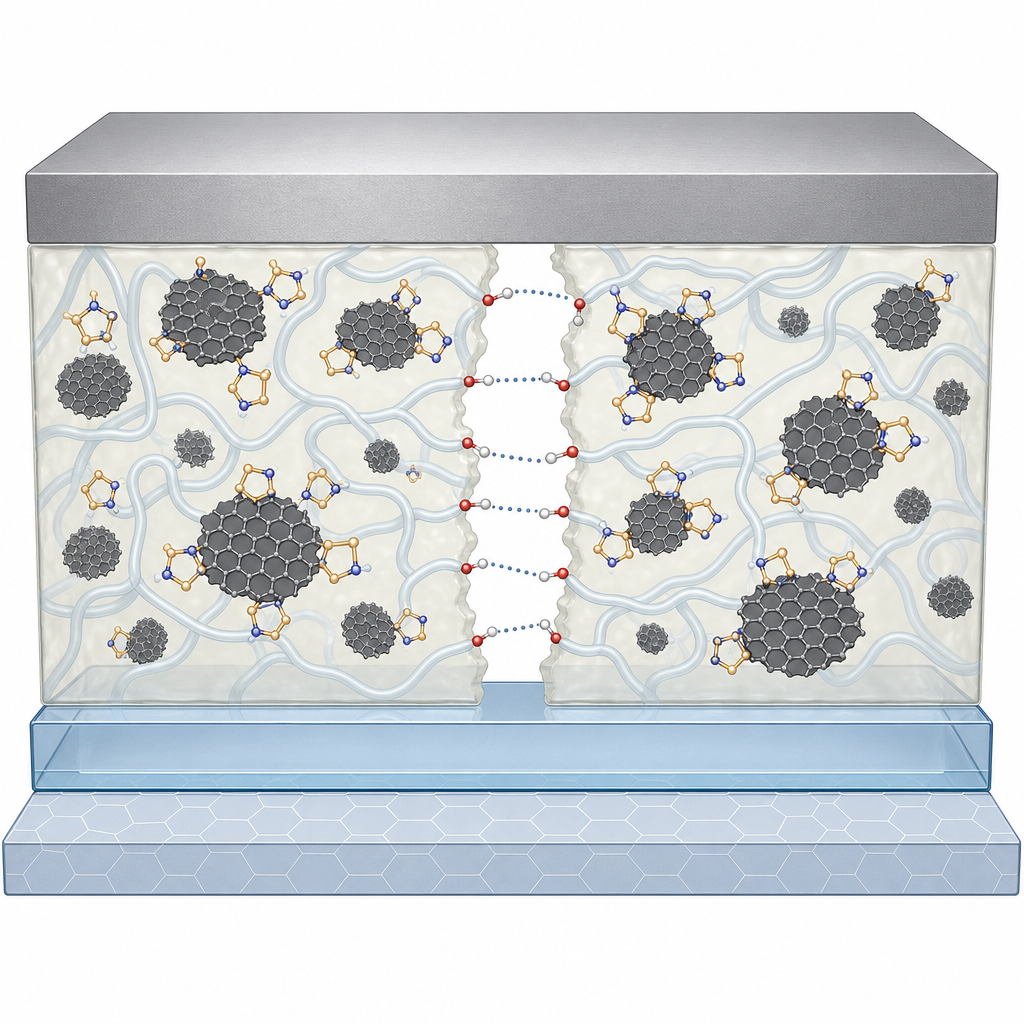 The ACS Material IMGQDs served as the functional filler dispersed in the PVA matrix. In fabrication, PVA (Sigma-Aldrich) and IMGQD (ACS Material) were dissolved in distilled water at a 10:1 mass ratio and stirred at 90 °C for 6 hours; the dispersion was spin-coated onto ITO through a multi-step ramp (1000–3000 rpm) to form a 20 nm active layer, then heat-treated at 80 °C for 2 hours, and topped with 200 nm of vacuum-evaporated aluminum. TEM showed the IMGQDs ranged from about 1 to 12 nm. N1s XPS confirmed nitrogen from the imidazole groups (peak near 400 eV) absent in pure GQDs, and a 2 eV shift in the nanocomposite confirmed hydrogen bonding between imidazole groups and PVA hydroxyls. These hydrogen bonds let the IMGQDs disperse uniformly, whereas unmodified GQDs agglomerated and precipitated. The same hydrogen-bonding network supplied the driving force for self-healing: PVA-IMGQD chains recombined across crack interfaces above the ~50 °C glass transition, and higher IMGQD loading increased healing rate by adding hydrogen-bonding sites.
The quantitative results establish both performance and reliability. The Al/PVA-IMGQD/ITO device wrote at 1.7 V within a −3 to 3 V window and was swept continuously more than 600 times with the read current at 1 V holding the same order of magnitude. Retention testing under forced degradation (80 °C, 80% humidity, 12 h) kept high- and low-resistance states stable, and extrapolation predicted data preservation beyond ten years; I–V characteristics were also unchanged over 28 days in ambient conditions. Conduction followed Ohmic behavior below 1 V (slope ≈1) transitioning to space-charge-limited conduction above 1 V (slope ≈2), with the IMGQD work function measured at about 5.1 eV by UPS. A doping study identified 10 wt% IMGQD as optimal: below 10% the current stayed low, at 10% it rose sharply, and 30–40 wt% sped healing but lowered the on/off ratio. Across 12 randomly selected electrodes, PVA-IMGQD devices gave uniform I–V curves and on/off ratios, unlike the irregular PVA-pure-GQD devices. Films self-healed completely in 1 h at 50 °C, and fully cut devices—including the ITO electrode—recovered from zero current to original characteristics, retaining stable retention and endurance even when bent to a 5 mm radius.
These findings enable mechanically robust, non-volatile memory for next-generation wearable and flexible electronic systems. Because the device tolerates bending radii down to 5 mm, survives full rupture, and restores identical electrical behavior, it suits e-skin, health-monitoring patches, and other body-attached electronics that experience repeated stress and impact. The WORM architecture is well matched to storing critical, non-erasable information such as firmware or identifiers. The two-terminal vertical structure further supports stacked integration for higher memory density. The authors point to functional self-healing nanocomposites as candidates for state-of-the-art wearable active layers, suggesting follow-up work on integration density, alternative flexible substrates such as PEN, and tuning quantum-dot surface chemistry to balance healing rate against on/off ratio.
For researchers pursuing self-healing electronics, flexible memory, or graphene quantum dot composites, the imidazole-modified graphene quantum dots used here are available from ACS Material's quantum dots catalog. The paper shows the IMGQDs performed as a stable electron-trapping filler that dispersed uniformly in PVA and supplied the hydrogen-bonding sites responsible for autonomous repair, supporting their use in nanocomposite active layers for wearable and flexible electronic devices where damage tolerance and long-term retention matter.How ACS Material products were used
- Imidazole-modified Graphene Quantum Dots (IMGQD) (Quantum Dots & Upconverting Nanoparticles) — “the PVA powder was purchased from Sigma-Aldrich, IMGQD was purchased from ACS Material”
Product Performance in this StudyThe imidazole-modified graphene quantum dots from ACS Material acted as the electron-trapping filler in the PVA matrix, enabling stable write-once-read-many-times memory behavior and providing hydrogen-bonding sites that drove uniform dispersion and complete self-healing of the active layer.
Related product categories
Frequently asked questionsHow do imidazole-modified graphene quantum dots enable self-healing in PVA memory devices?
The imidazole groups on the graphene quantum dots form hydrogen bonds with the hydroxyl groups of polyvinyl alcohol. Above the roughly 50 °C glass transition, PVA chains gain fluidity and recombine across crack interfaces through these hydrogen bonds. Higher quantum dot loading adds more bonding sites, accelerating healing, so films fully recover within one hour at 50 °C.
What is a write-once-read-many-times (WORM) memory device used for?
WORM devices store critical, non-erasable data such as firmware or identifiers. Their reset voltage is high enough that written information cannot be easily erased, distinguishing them from flash memory. In this work the two-terminal Al/PVA-IMGQD/ITO device wrote at 1.7 V, endured over 600 cycles, and retained data for an extrapolated ten years, suiting wearable and flexible electronic systems.
Why is uniform graphene quantum dot dispersion important for memory device stability?
Uniform filler distribution keeps the active-layer barrier consistent across the device, giving stable, repeatable I–V characteristics. Imidazole-modified quantum dots disperse uniformly in PVA via hydrogen bonding, producing matched on/off ratios across 12 randomly tested electrodes. Unmodified quantum dots agglomerate, creating uneven barriers and irregular, unstable electrical behavior.