-
Inkjet-Printed Graphene Circuits for Stem Cell Differentiation - Iowa State University, 2017
Jun 08, 2026 | ACS MATERIAL LLCDas, S. R. et al. (2017). Electrical Differentiation of Mesenchymal Stem Cells into Schwann-Cell-Like Phenotypes Using Inkjet-Printed Graphene Circuits. *Advanced Healthcare Materials*. https://doi.org/10.1002/adhm.201601087
Department of Mechanical Engineering Iowa State University Ames IA 50011 USA · Advanced Healthcare Materials · 2017
Iowa State researchers used ACS Material reduced graphene oxide to inkjet-print flexible IDE circuits that electrically differentiated MSCs into Schwann-cell-like phenotypes.
About this research
Researchers at the Department of Mechanical Engineering Iowa State University Ames IA 50011 USA used reduced graphene oxide from ACS Material (product GnP1L) to formulate an inkjet-printable conductive ink and fabricate flexible interdigitated electrode (IDE) circuits that electrically differentiated mesenchymal stem cells (MSCs) into Schwann-cell-like phenotypes without any chemical growth factors. Reporting in Advanced Healthcare Materials in 2017, the team led by Jonathan C. Claussen showed that approximately 85% of electrically stimulated MSCs expressed Schwann-cell glial markers and that paracrine nerve growth factor (NGF) secretion reached approximately 80 ng/mL, substantially higher than chemical induction. The paper demonstrates a route to fully printable, flexible neural interfaces for peripheral nerve regeneration.
Peripheral nerve injury remains a major clinical challenge because autologous Schwann cells (SCs), which form myelin sheaths and secrete neurotrophic factors, are difficult to harvest in sufficient numbers. MSCs are an attractive alternative because they are accessible, multipotent, and ethically uncomplicated, but standard transdifferentiation protocols rely on multi-step exposure to expensive growth factors such as forskolin, bFGF, PDGF, and heregulin β1. Eliminating the chemical cascade in favor of a defined electrical stimulus would simplify manufacturing, reduce cost, and open the door to implantable, spatially addressable bioelectronic scaffolds. Graphene-based materials are well-suited to this purpose because of their conductivity, mechanical robustness, and biocompatibility, and inkjet printing on flexible polyimide allows arbitrary circuit geometries that can conform to an injury site.
The graphene ink was formulated by vortexing pristine reduced graphene oxide from ACS Material (GnP1L, 3.5 mg/mL) in a cyclohexanone/terpineol (85:15) solvent system with ethyl cellulose binder, followed by probe and bath sonication and 0.45 µm filtration. The ink was printed on 125 µm DuPont Kapton polyimide using a Fujifilm Dimatix DMP-2800 with 10 pL nozzles at 30 µm drop spacing, yielding IDE fingers 400 µm wide with 250 µm spacing and a printed thickness of 5–7 µm. After printing, the electrodes were processed with a 355 nm Nd:YAG pulsed laser (15 ns pulse, 85 mJ/cm²) to convert the reduced graphene oxide flakes into a more graphitic, nanostructured petal-like surface. This step is essential: it drove sheet resistance from approximately 30 MΩ/sq down to 1 kΩ/sq (a three-order-of-magnitude improvement) and produced surface topography that promotes intimate cellular attachment without any additional ECM coating such as laminin. The resulting IDEs were mechanically robust under bending and washing.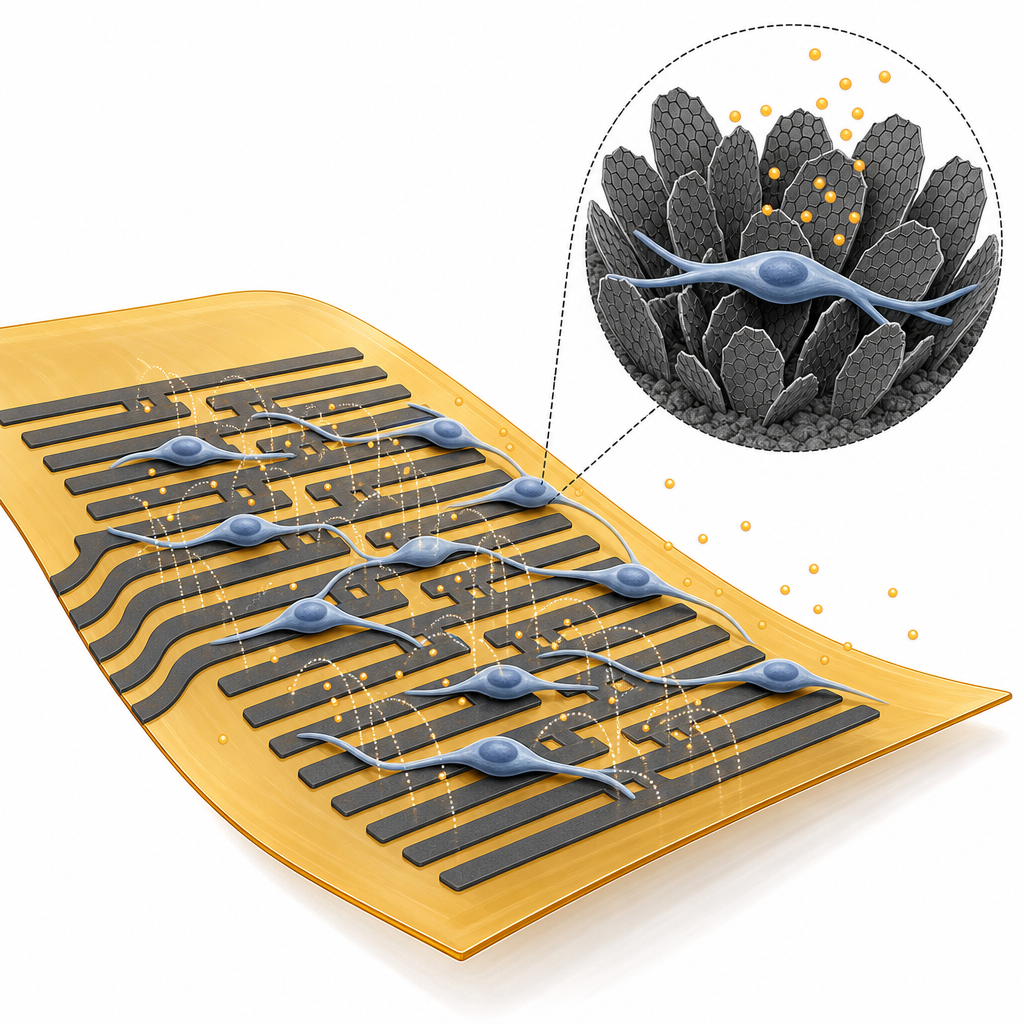
Brown Norway rat MSCs were seeded onto the laser-processed graphene IDEs at 1 × 10⁴ cells/cm² and stimulated with a 100 mV, 50 Hz signal applied for 10 minutes per day for 15 days via a CHI Instruments 600 series potentiostat. Immunocytochemistry against the Schwann-cell markers p75, S100, and S100β showed that more than 85% of electrically treated MSCs (etMSCs) on the graphene IDEs expressed all three markers, compared with about 75% for chemically treated MSCs (ctMSCs) on graphene. ELISA quantification of secreted neurotrophic factors gave 84.6 ± 4.6 ng/mL NGF for etMSCs on graphene, versus 54.5 ± 0.4 ng/mL for ctMSCs on graphene and only 28.5–30.4 ng/mL for untreated control cells on either substrate—approximately a threefold increase in NGF paracrine output attributable to electrical stimulation on the printed graphene. Modest improvements (3–5%) were also observed in GDNF and BDNF secretion. FESEM imaging confirmed extensive spreading and intimate contact between cells and the nanostructured petal-like graphene surface, consistent with π–π interaction and hydrophobic protein adsorption mechanisms reported in prior work. The DC conductivity of the laser-annealed printed graphene was approximately 143 S/m at 7 µm thickness.
The practical implications are significant for peripheral nerve regeneration, spinal-cord repair, and other regenerative medicine applications where flexible, conformable bioelectronic interfaces are required. Because graphene IDEs can be printed on polyimide, biodegradable polymers, or other flexible substrates, this platform suggests a path toward implantable artificial neural network circuits that could be stimulated internally or externally to direct in vivo stem-cell differentiation. The authors also point to dissolvable or absorbable formulations that would obviate a second surgical extraction. Adjacent application areas include electrochemical biosensors, flexible electronics, dielectrophoretic cell-patterning chips, and high-energy-density micro-supercapacitors that share the IDE geometry.
For researchers developing printable bioelectronics, conductive nanocomposite inks, or graphene-based tissue scaffolds, the reduced graphene oxide grade used in this study is available from ACS Material's graphene series. The paper demonstrates that a commercially sourced, low-defect reduced graphene oxide—when properly dispersed, printed, and laser-annealed—can deliver the conductivity, surface chemistry, and biocompatibility needed for sophisticated neural interface devices, making it a credible starting point for groups looking to reproduce or extend this electrically driven stem-cell differentiation platform.How ACS Material products were used
- Pristine Reduced Graphene Oxide (GnP1L) (Graphene Series) — “graphene ink (20 mL) was created by first vortexing pristine reduced graphene oxide (ACS Material, GnP1L) in a mixture of cyclohexanone (85%, Sigma-Aldrich 398241) with Terpineol (15%, Sigma-Aldrich T3407)”
Product Performance in this StudyThe ACS Material reduced graphene oxide served as the active conductive component of the inkjet-printable ink. After laser annealing, the printed graphene IDE achieved sheet resistance below 1 kΩ/sq and supported strong MSC attachment and electrical transdifferentiation, central to the paper's findings.
Related product categories
Frequently asked questionsHow does inkjet-printed graphene enable stem cell differentiation without growth factors?
Inkjet-printed graphene interdigitated electrodes deliver a localized electrical field (100 mV, 50 Hz, 10 min/day) directly to attached mesenchymal stem cells. The combination of the conductive, nanostructured graphene surface and amplified electric field activates signaling pathways such as FAK, MAPK, and calcium channels, driving transdifferentiation into Schwann-cell-like phenotypes with approximately 85% marker expression—without needing forskolin, bFGF, or other expensive growth factors.
Why is laser annealing important for printed reduced graphene oxide electrodes?
As-printed reduced graphene oxide is poorly conductive (around 30 MΩ/sq). A 355 nm Nd:YAG pulsed laser at 85 mJ/cm² reduces residual oxygen, restores sp² bonding, and creates petal-like nanostructures, dropping sheet resistance to about 1 kΩ/sq—a three-orders-of-magnitude improvement. The polyimide substrate is unaffected, so the electrodes remain flexible. The roughened surface also promotes cell attachment without requiring an additional ECM coating like laminin.
What grade of reduced graphene oxide is suitable for inkjet-printable conductive inks?
The paper used ACS Material reduced graphene oxide (GnP1L) at 3.5 mg/mL in cyclohexanone/terpineol (85:15) with ethyl cellulose binder. Successful inkjet formulation requires few-layer rGO with controlled flake size that can pass a 0.45 µm filter after probe and bath sonication. Low-defect or industrial-grade rGO products listed in ACS Material's graphene series are appropriate starting points for similar printable electronics applications.