-
Inkjet-Printed Graphene Ion Selective Electrodes - Iowa State University, 2017
Jun 11, 2026 | ACS MATERIAL LLCHe, Q. et al. (2017). Enabling Inkjet Printed Graphene for Ion Selective Electrodes with Postprint Thermal Annealing. *ACS Applied Materials & Interfaces*. https://doi.org/10.1021/acsami.7b00092
Iowa State University · ACS Applied Materials & Interfaces · 2017
Iowa State University researchers used ACS Material single-layer reduced graphene oxide to inkjet-print annealed potassium ion selective electrodes.
About this research
Researchers at Iowa State University used ACS Material single-layer reduced graphene oxide to formulate an inkjet-printable graphene ink for fabricating potassium ion selective electrodes (ISEs), achieving a sheet resistance reduction from 52.8 MΩ/□ in the as-printed film to 172.7 Ω/□ after thermal annealing at 950 °C. This work, published in ACS Applied Materials & Interfaces, demonstrates for the first time that inkjet-printed graphene (IPG) can serve as the conductive backbone of an ISE without lithography or vacuum CVD. The annealed electrodes were functionalized with a poly(vinyl chloride)/valinomycin membrane to detect potassium at clinically and physiologically relevant concentrations.
Ion selective electrodes are workhorse tools in clinical diagnostics, wearable sweat sensing, water-quality monitoring, and food safety, but conventional graphene-based ISEs rely on high-cost CVD growth, lithographic patterning, and vacuum processing. These barriers have slowed deployment in point-of-care and in-field formats where low-cost, scalable, and flexible electrodes are needed. Inkjet printing offers a route to additive, mask-free fabrication of graphene circuits, but as-printed films are normally too resistive to function as electrochemical transducers because the residual ethyl cellulose binder isolates the flakes. Resolving this conductivity gap, while preserving the surface chemistry needed for stable potentiometric response, is the central materials-science challenge the paper addresses.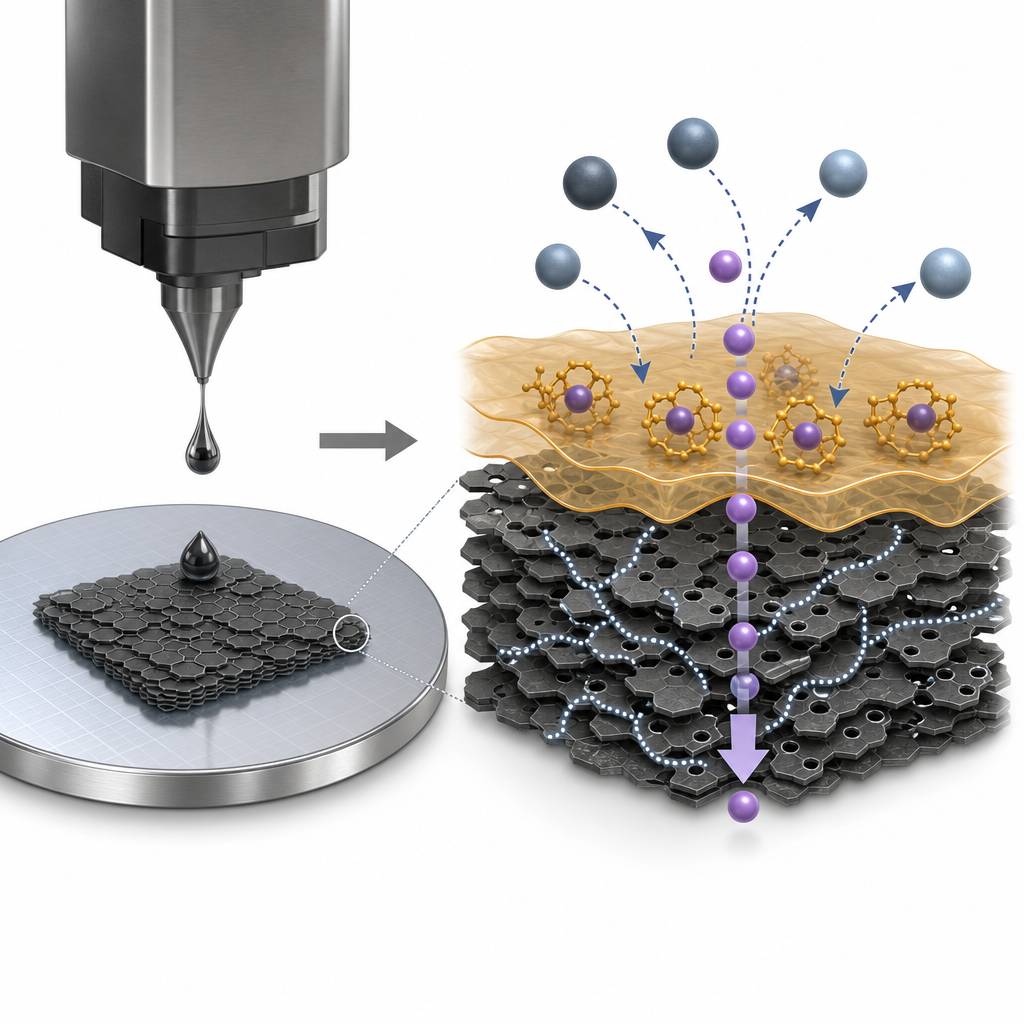
The ACS Material single-layer graphene, described in the methods as "completely reduced graphene oxide obtained via the Hummer's methods," was dispersed at 3.5 mg/mL in an 85 percent cyclohexanone and 15 percent terpineol solvent mixture with an equal mass of ethyl cellulose as a stabilizing binder. The slurry was vortex mixed, probe sonicated at 50 percent amplitude in three 30-minute cycles, bath sonicated for six hours, and filtered through a 0.45 μm syringe filter to yield a jettable ink with a viscosity of 10 cP. The ink was loaded into a Dimatix DMP 2800 inkjet printer fitted with 10 pL nozzles and printed onto Si/SiO2 (300 nm) wafers held at 60 °C, with 50 passes giving a 3.5 μm thick graphene film. The printed electrodes were then annealed in nitrogen at temperatures from 200 to 950 °C in a compact tube furnace to drive off the ethyl cellulose and improve flake-to-flake percolation.
Raman spectroscopy and field-emission SEM showed that the printed flakes began to smooth at 500 °C and then became more porous and electrically connected at 650 °C and above. The sheet resistance fell five orders of magnitude, from 52.8 ± 7.4 MΩ/□ for unannealed graphene to 172.7 ± 33.3 Ω/□ at 950 °C. XPS of the N 1s region tracked residual binder decomposition across the annealing series. The fully annealed IPG was drop-coated with 10 μL of a cocktail containing 1.0 wt % valinomycin ionophore, 66 wt % bis(2-ethylhexyl) sebacate plasticizer, and 33 wt % poly(vinyl chloride) at 15 wt % in tetrahydrofuran. The resulting potassium ISE displayed a wide linear sensing range from 0.01 to 100 mM, a low detection limit of 7 μM, and a minimal potentiometric drift of 8.6 × 10⁻⁶ V/s measured by chronopotentiometry at 1 nA. Selectivity tests against sodium, magnesium, and calcium and against artificial eccrine perspiration spiked with potassium showed negligible interference, indicating that the membrane-electrode interface is electrochemically stable in complex biological matrices.
The demonstrated performance positions inkjet-printed graphene ISEs for wearable sweat electrolyte monitoring, point-of-care plasma and serum potassium testing, agricultural soil sensing, and low-cost disposable diagnostic strips. Because the ink formulation and printing workflow are compatible with flexible substrates and large-area manufacturing, the same platform can be extended to other ionophore-membrane chemistries for sodium, ammonium, calcium, lead, and nitrate detection. The authors highlight integration with artificial eccrine perspiration as a step toward continuous, on-skin metabolic tracking, and the thermal-annealing protocol they describe is directly transferable to graphene inks formulated for printed electrochemical biosensors, supercapacitor electrodes, and conductive interconnects.
For researchers building printed electrochemical devices, the work shows that ACS Material reduced graphene oxide is suitable as the starting solid for high-loading, vortex-mixed graphene inks that survive aggressive sonication and produce reproducible films after thermal treatment. The Reduced Graphene Oxide (RGO) product and related graphene oxide grades remain available from ACS Material LLC for laboratories developing inkjet, screen-printed, or aerosol-jet electrodes, sensor platforms, and conductive coatings where post-print annealing is part of the workflow.How ACS Material products were used
- Reduced Graphene Oxide (RGO) (Graphene Series) — “graphene ink batches (20 mL) were synthesized by vortex mixing single layer dispersible graphene (ACS Materials, 'completely' reduced graphene oxide obtained via the Hummer's methods)”
Product Performance in this Study
The ACS Material single-layer reduced graphene oxide served as the active conductive filler for the inkjet-printable graphene ink. After thermal annealing at 950 °C, the printed graphene reached a sheet resistance of 172.7 Ω/□ and enabled construction of high-performance potassium ion selective electrodes.
Related product categories
Frequently asked questions
Why does inkjet-printed graphene need thermal annealing before use as an electrode?
As-printed graphene films contain ethyl cellulose binder and solvent residues that isolate the flakes, giving sheet resistance in the megaohm range. In this study, nitrogen annealing at 950 °C decomposed the binder and improved flake-to-flake contact, lowering sheet resistance from 52.8 MΩ/□ to 172.7 Ω/□, a five-order-of-magnitude drop, which is necessary for low-impedance potentiometric ion selective electrode operation.
How sensitive is the inkjet-printed graphene potassium ion selective electrode?
The annealed IPG potassium ISE, functionalized with a valinomycin/PVC membrane, showed a linear response over 0.01 to 100 mM potassium chloride, a detection limit of 7 μM, and a potentiometric drift of only 8.6 × 10⁻⁶ V/s. It maintained selectivity against sodium, magnesium, and calcium and operated reliably in artificial eccrine perspiration, making it suitable for sweat, plasma, and serum potassium analysis.
What grade of graphene is suitable for inkjet printing of electrochemical sensors?
The authors used single-layer reduced graphene oxide produced via the Hummers method. Dispersed at 3.5 mg/mL in a cyclohexanone/terpineol solvent with ethyl cellulose binder, probe and bath sonicated, and filtered through a 0.45 μm membrane, this material formed a jettable ink with a viscosity of 10 cP. Reduced graphene oxide combines easy solvent dispersion with the chemistry needed for post-print thermal restoration of conductivity.