-
Introducing Quantum Diamonds: Enabling the Next Generation of Quantum Technologies
May 19, 2025 | ACS MATERIAL LLCDiamond is famous for being the hardest natural material, but its most consequential role this decade may be as a host for quantum bits. A single atomic defect — the nitrogen-vacancy (NV) center — turns an ordinary-looking diamond chip into an optically addressable spin that works at room temperature, in air, even inside a living cell. That combination has made NV diamond one of the most productive platforms in quantum sensing, quantum information, and quantum metrology. This article surveys the physics that makes it work, the applications it now enables, and how ACS Material's quantum diamond product line maps onto each use case — with two interactive simulators along the way.
Quick answerA quantum diamond is a synthetic diamond engineered to contain nitrogen-vacancy (NV) centers — atomic defects whose electron spin can be initialized with green light, controlled with microwaves, and read out optically, all at room temperature. Diamond's spin-quiet lattice gives these qubits unusually long coherence, so a single chip becomes a platform for ultrasensitive magnetometry, nanoscale NMR, thermometry, biosensing, and quantum information. The defining trade-off is density versus coherence: single-NV diamond gives the finest resolution and longest coherence, while NV-ensemble diamond gives the largest signal and best field sensitivity — both built on ultra-pure electronic-grade material.
On this page- 1 The NV Center: An Atom-Like Qubit in a Crystal
- 2 Why Diamond? Room-Temperature Coherence
- 3 Coherent Spin Control
- 4 Quantum Sensing I: Magnetometry
- 5 Quantum Sensing II: NMR, Electric Field, Temperature
- 6 Quantum Sensing III: Biology and Imaging
- 7 Quantum Information and Networks
- 8 Beyond Sensing: Masers and Gyroscopes
- 9 Materials: From CVD Growth to NV Engineering
- 10 ACS Material Quantum Diamond Products
- 11 Frequently Asked Questions
- 12 References
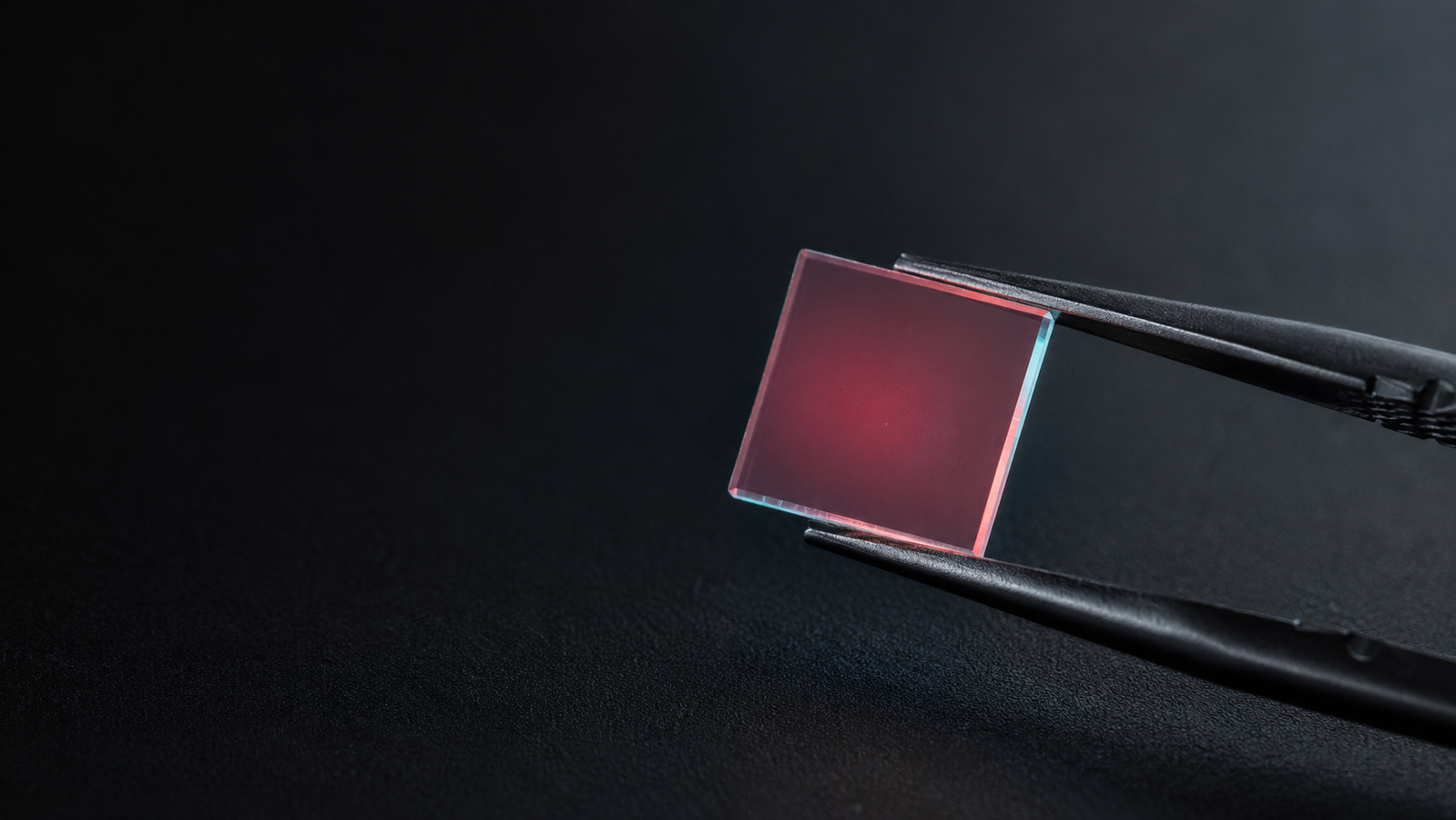
Figure 1. A research-grade quantum diamond — a polished single-crystal plate whose warm red glow is the fluorescence of its nitrogen-vacancy (NV) centers. Each NV is a nitrogen atom beside a lattice vacancy, giving the crystal an electron spin that can be read out optically at room temperature and turning a diamond into a quantum sensor. The NV center: an atom-like qubit in a crystal
The NV center forms when a substitutional nitrogen atom sits next to a missing carbon atom (a vacancy) in the diamond lattice. Its negatively charged state (NV−) has six electrons that form a spin-triplet ground state, and this is where the magic lives: the defect behaves like a single trapped atom, but it is locked permanently inside a transparent, chemically inert, mechanically rigid crystal 1. The first optical detection and magnetic resonance of a single NV center, reported in 1997, opened the door to using individual defects as quantum systems 2.
Three properties make the NV center uniquely useful. It can be initialized with green light (typically 532 nm), which optically pumps the spin into the ms=0 sublevel. It can be controlled with microwaves resonant with the ground-state transition. And it can be read out optically, because the ms=0 and ms=±1 states fluoresce with different brightness through a spin-selective intersystem-crossing pathway. The energy gap between ms=0 and ms=±1 at zero field — the zero-field splitting D ≈ 2.87 GHz — is the anchor for nearly every NV experiment 1. Because all of this happens at room temperature, the NV center became a cornerstone of the broader field of quantum sensing 3.
Why diamond? Room-temperature coherence
A qubit is only useful if it remembers its quantum phase long enough to compute or sense. Diamond is an almost ideal host because it is built from carbon, and the dominant isotope (12C) has no nuclear spin — so the magnetic noise that usually destroys coherence is sparse. Removing the residual 13C by isotopic engineering pushed single-spin coherence times into the millisecond range 4, and clever pulse control (dynamical decoupling) extends them further by filtering out slow noise 5. With nuclear-spin ancillae, a diamond spin qubit has stored quantum information for more than a second at room temperature 6, and engineered ensembles now reach dephasing times long enough for competitive sensing 7.
In practice three timescales matter. T1 is how long the spin keeps its polarization (often milliseconds). T2 is the coherence time under a spin echo (microseconds to milliseconds depending on grade). T2* is the shorter free-induction time set by static, inhomogeneous dephasing. These numbers directly determine sensitivity, and they are exactly the parameters specified for each ACS Material product grade.
Coherent spin control
Reading and writing an NV qubit means driving it coherently. A resonant microwave field rotates the spin between ms=0 and ms=−1, producing Rabi oscillations — the first coherent oscillations of a single defect spin were observed in 2004 8, and the same toolbox quickly yielded a two-qubit conditional gate between an electron and a nuclear spin 9 and coherent control of coupled electron–nuclear registers 10. A microwave pulse tuned to flip the spin completely is a π pulse, the elementary quantum gate; half of it is a π/2 pulse, which creates the superposition used in every sensing sequence. The simulator below lets you set the drive strength and detuning and watch the spin flip.
Quantum sensing I: magnetometry
The NV center's headline application is measuring magnetic fields. A field along the NV axis Zeeman-splits the ms=±1 levels, so an optically detected magnetic resonance (ODMR) spectrum shows two dips whose separation is proportional to the field — with a gyromagnetic ratio of about 28 MHz/mT. Single-spin magnetometry with nanoscale resolution was demonstrated in 2008 by two groups simultaneously 11, 12, alongside a theoretical framework for its ultimate sensitivity 13. The field has matured into two complementary strands, thoroughly reviewed in the literature: scanning single-NV magnetometry for nanoscale resolution 14, and dense NV ensembles for maximum sensitivity 15.
One feature is unique to diamond. NV centers occupy all four [111] crystallographic directions, so a single ensemble sees a magnetic field projected four different ways and can reconstruct the full three-dimensional field vector from one fixed sensor — the basis for imaging current flow, magnetic textures, and condensed-matter phenomena 16. The simulator below shows how rotating a field moves the four ODMR pairs and how the four splittings recover the vector.
Quantum sensing II: NMR, electric field, and temperature
Because a shallow NV center sits only nanometres below the diamond surface, it can sense the spins of molecules placed on top of it. NV sensors detected nuclear magnetic resonance from nanoscale and even (5 nm)3 sample volumes 17, 18, and later achieved chemical resolution in nanoscale NMR 19 and high-resolution spectra approaching conventional spectrometers 20, now packaged into practical quantum diamond spectrometers 21. The same defect also responds to electric fields through Stark shifts 22, and to temperature, because the zero-field splitting D drifts with temperature 23 — an effect used for fluorescence thermometry whose precision is sharpened by the spin's own coherence 24. This multimodal character — one defect reporting magnetic field, electric field, and temperature — is what makes NV diamond so versatile 25.
Quantum sensing III: biology and imaging
NV diamond is biocompatible and works in physiological conditions, so it has become a tool for the life sciences. Fluorescent nanodiamonds serve as non-bleaching cellular biomarkers 26, their spin can be tracked inside living cells 27, and wide-field NV imaging maps magnetic fields across whole cells 28 and with sub-cellular resolution 29. The flagship result — thermometry inside a single living cell 30 — captured how far the platform reaches, and the biomedical applications continue to broaden 31. Beyond biology, NV magnetometry images current flow in graphene 32, probes magnetic samples under extreme high pressure 33, and has become a general microscope for condensed-matter physics 16.
Quantum information and networks
The NV center is also a building block for quantum computers and the quantum internet. It is a stable, room-temperature source of single photons 34, 35, and its electron spin can be entangled with surrounding nuclear spins to form a small quantum register 36, 37. Diamond spins separated by 1.3 kilometres were entangled in a landmark loophole-free Bell test 38, multi-qubit registers now reach ten qubits with minute-scale memory 39, and a logical qubit has been operated fault-tolerantly inside a single diamond 40 — a concrete step toward scalable, networked quantum processors.
Beyond sensing: masers and gyroscopes
Two less obvious applications round out the picture. A polarized NV ensemble in a microwave cavity produces a continuous-wave maser at room temperature 41, a long-standing goal for low-noise microwave amplification. And because the NV nuclear spin accumulates a geometric phase under rotation, NV ensembles can act as solid-state gyroscopes 42. The strongly interacting spins in a dense diamond even let researchers observe an entirely new phase of matter, a discrete time crystal 43 — a reminder that engineered diamond is also a platform for fundamental physics.
Materials: from CVD growth to NV engineering
None of this works without materials control. Modern NV diamond is grown by chemical vapor deposition (CVD) with deliberate, low-level nitrogen doping, and the placement and depth of NV centers are engineered — for example by nitrogen delta-doping to create shallow, coherent spins near the surface 44. The trade-off that defines the product landscape is density versus coherence: isolated single NV centers give the longest coherence and the highest spatial resolution, while dense ensembles give the largest signal and the best field sensitivity 15. Underneath both sits electronic-grade diamond — ultra-pure CVD material with nitrogen below 5 ppb and very low background fluorescence — which serves as the substrate for creating NV centers to specification.
ACS Material quantum diamond products
ACS Material's quantum diamond line is built around exactly these distinctions, all available in 2×2×0.5 mm3 and 4×4×0.5 mm3 with customization on request:
- Single NV diamond — random & array. Individually addressable NV centers (T2 ≈ 200 µs) for fundamental studies and the highest-resolution sensing; the array grade patterns NVs at controlled depth (5–100 nm).
- NV ensemble diamond — 2D & bulk. Controlled-density layers and volumes (10–300 ppb) that trade some coherence for signal — the right choice for high-sensitivity magnetometry, wide-field imaging, and masers.
- Electronic-grade diamond. {100}-oriented, Ra < 3 nm, [N] < 5 ppb, low background fluorescence — the pristine substrate for NV creation.
Every product is grown, cut, polished, and quantum-characterized in house, so the coherence and concentration you order are verified before shipping. See the full specifications and quantum-property tables on the product page and the technical data sheet, browse the Quantum Diamonds category, or request a quote for a custom geometry, orientation, or NV configuration.
Frequently asked questions
What is a quantum diamond?
A quantum diamond is a synthetic, research-grade diamond engineered to contain nitrogen-vacancy (NV) centers — atomic defects whose electron spin can be initialized, controlled, and read out optically at room temperature. That makes the diamond a usable quantum sensor or qubit rather than just a gemstone.
Why does the NV center work at room temperature when most qubits need near absolute zero?
Although the NV ground-state spin splitting (about 2.87 GHz) is far smaller than room-temperature thermal energy, the spin can still be optically initialized — the green pump laser polarizes it into the ms=0 state through a spin-selective decay path — and optically read out through spin-dependent fluorescence, and neither step relies on thermal equilibrium. Diamond's wide bandgap, rigid lattice, and spin-quiet carbon environment then keep the spin coherent, so the platform delivers robust room-temperature sensing and control without cryogenics.
What is the difference between single-NV and NV-ensemble diamond?
Single-NV diamond contains isolated, individually addressable centers with the longest coherence and the finest spatial resolution, ideal for scanning magnetometry and fundamental studies. Ensemble diamond contains many NVs, giving far more signal and the best field sensitivity at the cost of somewhat shorter coherence — better for wide-field imaging and high-sensitivity magnetometry.
How does an NV diamond actually sense a magnetic field?
A field shifts the NV spin levels (the Zeeman effect), splitting the optically detected magnetic resonance into two dips separated by about 2 × 28 MHz/mT × B. Measuring that splitting gives the field. Because NVs lie along four crystal directions, one diamond can recover the full 3D field vector — both effects are shown in the simulators above.
What is electronic-grade diamond used for?
It is an ultra-pure substrate (nitrogen below 5 ppb, low background fluorescence) used to create your own single NVs or ensembles by implantation or doped overgrowth, and for experiments that need a clean optical and spin background.
Can quantum diamonds be customized?
Yes. ACS Material offers custom sizes, {111} orientations, ultra-thin slices, micron particles, custom-shaped cutting, and tailored NV concentrations, with technical support from an NV-research team. Request a quote or contact us to discuss a configuration.
References
1 Doherty MW, Manson NB, Delaney P, Jelezko F, Wrachtrup J, Hollenberg LCL. The nitrogen-vacancy colour centre in diamond. Phys Rep. 2013;528(1):1–45. DOI: 10.1016/j.physrep.2013.02.0012 Gruber A, Dräbenstedt A, Tietz C, Fleury L, Wrachtrup J, von Borczyskowski C. Scanning confocal optical microscopy and magnetic resonance on single defect centers. Science. 1997;276(5321):2012–2014. DOI: 10.1126/science.276.5321.20123 Degen CL, Reinhard F, Cappellaro P. Quantum sensing. Rev Mod Phys. 2017;89(3):035002. DOI: 10.1103/RevModPhys.89.0350024 Balasubramanian G, Neumann P, Twitchen D, Markham M, Kolesov R, Mizuochi N, et al. Ultralong spin coherence time in isotopically engineered diamond. Nat Mater. 2009;8(5):383–387. DOI: 10.1038/nmat24205 de Lange G, Wang ZH, Ristè D, Dobrovitski VV, Hanson R. Universal dynamical decoupling of a single solid-state spin from a spin bath. Science. 2010;330(6000):60–63. DOI: 10.1126/science.11927396 Maurer PC, Kucsko G, Latta C, Jiang L, Yao NY, Bennett SD, et al. Room-temperature quantum bit memory exceeding one second. Science. 2012;336(6086):1283–1286. DOI: 10.1126/science.12205137 Bauch E, Hart CA, Schloss JM, Turner MJ, Barry JF, Kehayias P, et al. Ultralong dephasing times in solid-state spin ensembles via quantum control. Phys Rev X. 2018;8(3):031025. DOI: 10.1103/PhysRevX.8.0310258 Jelezko F, Gaebel T, Popa I, Gruber A, Wrachtrup J. Observation of coherent oscillations in a single electron spin. Phys Rev Lett. 2004;92(7):076401. DOI: 10.1103/PhysRevLett.93.1305019 Jelezko F, Gaebel T, Popa I, Domhan M, Gruber A, Wrachtrup J. Observation of coherent oscillation of a single nuclear spin and realization of a two-qubit conditional quantum gate. Phys Rev Lett. 2004;93(13):130501. DOI: 10.1103/PhysRevLett.93.13050110 Childress L, Gurudev Dutt MV, Taylor JM, Zibrov AS, Jelezko F, Wrachtrup J, et al. Coherent dynamics of coupled electron and nuclear spin qubits in diamond. Science. 2006;314(5797):281–285. DOI: 10.1126/science.113187111 Maze JR, Stanwix PL, Hodges JS, Hong S, Taylor JM, Cappellaro P, et al. Nanoscale magnetic sensing with an individual electronic spin in diamond. Nature. 2008;455(7213):644–647. DOI: 10.1038/nature0727912 Balasubramanian G, Chan IY, Kolesov R, Al-Hmoud M, Tisler J, Shin C, et al. Nanoscale imaging magnetometry with diamond spins under ambient conditions. Nature. 2008;455(7213):648–651. DOI: 10.1038/nature0727813 Taylor JM, Cappellaro P, Childress L, Jiang L, Budker D, Hemmer PR, et al. High-sensitivity diamond magnetometer with nanoscale resolution. Nat Phys. 2008;4(10):810–816. DOI: 10.1038/nphys107514 Rondin L, Tetienne JP, Hingant T, Roch JF, Maletinsky P, Jacques V. Magnetometry with nitrogen-vacancy defects in diamond. Rep Prog Phys. 2014;77(5):056503. DOI: 10.1088/0034-4885/77/5/05650315 Barry JF, Schloss JM, Bauch E, Turner MJ, Hart CA, Pham LM, et al. Sensitivity optimization for NV-diamond magnetometry. Rev Mod Phys. 2020;92(1):015004. DOI: 10.1103/RevModPhys.92.01500416 Casola F, van der Sar T, Yacoby A. Probing condensed matter physics with magnetometry based on nitrogen-vacancy centres in diamond. Nat Rev Mater. 2018;3:17088. DOI: 10.1038/natrevmats.2017.8817 Mamin HJ, Kim M, Sherwood MH, Rettner CT, Ohno K, Awschalom DD, et al. Nanoscale nuclear magnetic resonance with a nitrogen-vacancy spin sensor. Science. 2013;339(6119):557–560. DOI: 10.1126/science.123154018 Staudacher T, Shi F, Pezzagna S, Meijer J, Du J, Meriles CA, et al. Nuclear magnetic resonance spectroscopy on a (5 nm)3 sample volume. Science. 2013;339(6119):561–563. DOI: 10.1126/science.123167519 Aslam N, Pfender M, Neumann P, Reuter R, Zappe A, Fávaro de Oliveira F, et al. Nanoscale nuclear magnetic resonance with chemical resolution. Science. 2017;357(6346):67–71. DOI: 10.1126/science.aam869720 Glenn DR, Bucher DB, Lee J, Lukin MD, Park H, Walsworth RL. High-resolution magnetic resonance spectroscopy using a solid-state spin sensor. Nature. 2018;555(7696):351–354. DOI: 10.1038/nature2578121 Bucher DB, Aude Craik DPL, Backlund MP, Turner MJ, Ben Dor O, Glenn DR, et al. Quantum diamond spectrometer for nanoscale NMR and ESR spectroscopy. Nat Protoc. 2019;14(9):2707–2747. DOI: 10.1038/s41596-019-0201-322 Dolde F, Fedder H, Doherty MW, Nöbauer T, Rempp F, Balasubramanian G, et al. Electric-field sensing using single diamond spins. Nat Phys. 2011;7(6):459–463. DOI: 10.1038/nphys196923 Acosta VM, Bauch E, Ledbetter MP, Waxman A, Bouchard LS, Budker D. Temperature dependence of the nitrogen-vacancy magnetic resonance in diamond. Phys Rev Lett. 2010;104(7):070801. DOI: 10.1103/PhysRevLett.104.07080124 Toyli DM, de las Casas CF, Christle DJ, Dobrovitski VV, Awschalom DD. Fluorescence thermometry enhanced by the quantum coherence of single spins in diamond. Proc Natl Acad Sci USA. 2013;110(21):8417–8421. DOI: 10.1073/pnas.130682511025 Schirhagl R, Chang K, Loretz M, Degen CL. Nitrogen-vacancy centers in diamond: nanoscale sensors for physics and biology. Annu Rev Phys Chem. 2014;65:83–105. DOI: 10.1146/annurev-physchem-040513-10365926 Fu CC, Lee HY, Chen K, Lim TS, Wu HY, Lin PK, et al. Characterization and application of single fluorescent nanodiamonds as cellular biomarkers. Proc Natl Acad Sci USA. 2007;104(3):727–732. DOI: 10.1073/pnas.060540910427 McGuinness LP, Yan Y, Stacey A, Simpson DA, Hall LT, Maclaurin D, et al. Quantum measurement and orientation tracking of fluorescent nanodiamonds inside living cells. Nat Nanotechnol. 2011;6(6):358–363. DOI: 10.1038/nnano.2011.6428 Le Sage D, Arai K, Glenn DR, DeVience SJ, Pham LM, Rahn-Lee L, et al. Optical magnetic imaging of living cells. Nature. 2013;496(7446):486–489. DOI: 10.1038/nature1207229 Steinert S, Ziem F, Hall LT, Zappe A, Schweikert M, Götz N, et al. Magnetic spin imaging under ambient conditions with sub-cellular resolution. Nat Commun. 2013;4:1607. DOI: 10.1038/ncomms258830 Kucsko G, Maurer PC, Yao NY, Kubo M, Noh HJ, Lo PK, et al. Nanometre-scale thermometry in a living cell. Nature. 2013;500(7460):54–58. DOI: 10.1038/nature1237331 Aslam N, Zhou H, Urbach EK, Turner MJ, Walsworth RL, Lukin MD, et al. Quantum sensors for biomedical applications. Nat Rev Phys. 2023;5(3):157–169. DOI: 10.1038/s42254-023-00558-332 Tetienne JP, Dontschuk N, Broadway DA, Stacey A, Simpson DA, Hollenberg LCL. Quantum imaging of current flow in graphene. Sci Adv. 2017;3(4):e1602429. DOI: 10.1126/sciadv.160242933 Lesik M, Plisson T, Toraille L, Renaud J, Occelli F, Schmidt M, et al. Magnetic measurements on micrometer-sized samples under high pressure using designed NV centers. Science. 2019;366(6471):1359–1362. DOI: 10.1126/science.aaw432934 Kurtsiefer C, Mayer S, Zarda P, Weinfurter H. Stable solid-state source of single photons. Phys Rev Lett. 2000;85(2):290–293. DOI: 10.1103/PhysRevLett.85.29035 Aharonovich I, Greentree AD, Prawer S. Diamond photonics. Nat Photonics. 2011;5(7):397–405. DOI: 10.1038/nphoton.2011.5436 Gurudev Dutt MV, Childress L, Jiang L, Togan E, Maze J, Jelezko F, et al. Quantum register based on individual electronic and nuclear spin qubits in diamond. Science. 2007;316(5829):1312–1316. DOI: 10.1126/science.113983137 Neumann P, Mizuochi N, Rempp F, Hemmer P, Watanabe H, Yamasaki S, et al. Multipartite entanglement among single spins in diamond. Science. 2008;320(5881):1326–1329. DOI: 10.1126/science.115723338 Hensen B, Bernien H, Dréau AE, Reiserer A, Kalb N, Blok MS, et al. Loophole-free Bell inequality violation using electron spins separated by 1.3 kilometres. Nature. 2015;526(7575):682–686. DOI: 10.1038/nature1575939 Bradley CE, Randall J, Abobeih MH, Berrevoets RC, Degen MJ, Bakker MA, et al. A ten-qubit solid-state spin register with quantum memory up to one minute. Phys Rev X. 2019;9(3):031045. DOI: 10.1103/PhysRevX.9.03104540 Abobeih MH, Wang Y, Randall J, Loenen SJH, Bradley CE, Markham M, et al. Fault-tolerant operation of a logical qubit in a diamond quantum processor. Nature. 2022;606(7916):884–889. DOI: 10.1038/s41586-022-04819-641 Breeze JD, Salvadori E, Sathian J, Alford NM, Kay CWM. Continuous-wave room-temperature diamond maser. Nature. 2018;555(7697):493–496. DOI: 10.1038/nature2597042 Ledbetter MP, Jensen K, Fischer R, Jarmola A, Budker D. Gyroscopes based on nitrogen-vacancy centers in diamond. Phys Rev A. 2012;86(5):052116. DOI: 10.1103/PhysRevA.86.05211643 Choi S, Choi J, Landig R, Kucsko G, Zhou H, Isoya J, et al. Observation of discrete time-crystalline order in a disordered dipolar many-body system. Nature. 2017;543(7644):221–225. DOI: 10.1038/nature2142644 Ohno K, Heremans FJ, Bassett LC, Myers BA, Toyli DM, Bleszynski Jayich AC, et al. Engineering shallow spins in diamond with nitrogen delta-doping. Appl Phys Lett. 2012;101(8):082413. DOI: 10.1063/1.4748280This article is an educational overview of nitrogen-vacancy (NV) center quantum diamond and ACS Material's quantum diamond products. Quantitative figures — the 2.87 GHz zero-field splitting, the ~28 MHz/mT gyromagnetic ratio, NV concentrations, and coherence times T1, T2, and T2* — are representative values from the cited literature and from our product specifications; the actual values for a given sample depend on grade, depth, and measurement conditions and are confirmed by our in-house quantum characterization and stated on the product technical data sheet. The two interactive simulators are simplified teaching models — an idealized Rabi formula and an idealized multi-Lorentzian ODMR model — not measured data or predictive design software. Disclaimer: ACS Material, LLC believes the information here is accurate and represents the best and most current information available to us, but makes no representations or warranties, express or implied, regarding suitability for any purpose or the accuracy of the information, and will not be responsible for damages resulting from use of or reliance upon this information.