-
Jarosite/rGO Li-Ion Battery Cathode — Louisiana State University, 2016
Jun 05, 2026 | ACS MATERIAL LLCXu, W. et al. (2016). Direct growth of an economic green energy storage material: a monocrystalline jarosite-KFe 3 (SO 4) 2 (OH) 6-nanoplates@ rGO hybrid as a superior lithium-ion …. *Journal of Materials Chemistry A*. https://doi.org/10.1039/c5ta10622b
Department of Mechanical & Industrial Engineering · Journal of Materials Chemistry A · 2016
LSU researchers used ACS Material single-layer graphene oxide to template monocrystalline KFe3(SO4)2(OH)6 nanoplates, yielding a high-rate Li-ion battery cathode.
About this research
Researchers at Louisiana State University, working with collaborators at Wuhan University of Technology, used single-layer graphene oxide supplied by ACS Material to template the direct growth of monocrystalline jarosite-KFe3(SO4)2(OH)6 hexagonal nanoplates on reduced graphene oxide, producing a low-cost iron-sulfate cathode that retains 88% of its peak capacity over 100 cycles at 2 C. The work, published in the Journal of Materials Chemistry A in 2016, demonstrates a facile solution-phase oxidation route to a polyanionic Li-ion cathode built entirely from earth-abundant elements, with electrochemistry that rivals more expensive established chemistries.
Commercial lithium-ion batteries still rely heavily on LiCoO2 and other cobalt-rich cathodes that are expensive, supply-constrained and environmentally problematic. Iron-based polyanionic compounds — LiFePO4, LiFeSiO4, LiFeBO3 and related materials — offer a much cheaper, safer alternative thanks to the Fe2+/Fe3+ redox couple and strong covalent X–O bonding. Jarosite KFe3(SO4)2(OH)6 is particularly attractive: it is found in natural acid minerals, contains only Fe, S, K, O and H, has a layered T–O–T (tetrahedral–octahedral–tetrahedral) structure that can host up to three Li+ per formula unit, and has a theoretical capacity of 166 mAh/g between 1.5 and 4 V vs. Li/Li+. The challenge has been engineering a morphology that allows fast Li+ and electron transport without the poor conductivity and pulverization that plague bulk jarosite.
To solve this, the authors used ACS Material single-layer graphene oxide as both a structure-directing agent and a conductive growth platform. As stated in the Experimental section, "10 mg single-layered GO sheets (ACS material) were sonicated in 30 mL deionized water for one hour." Potassium nitrate (0.20 g) and ferrous sulfate (1.68 g) were dissolved in the suspension, 10 µL of concentrated H2SO4 was added, and the mixture was held at 80 °C for 12 h. The oxygen-containing functional groups on the GO surface electrostatically bind Fe2+, which is then oxidized to Fe3+ during heating; this same electron-transfer step partially reduces the GO. Tiny KFe3(SO4)2(OH)6 nuclei form preferentially at these surface sites, then diffuse and recrystallize into well-defined hexagonal monocrystalline nanoplates roughly 800 nm wide and 100 nm thick. A subsequent hydrazine treatment fully reduces the GO to rGO. EDS mapping shows the rGO content is about 9.6 wt%, and XPS confirms loss of C=O peaks consistent with reduction. Without the GO substrate, jarosite grows into irregular micron-sized aggregates, underscoring how essential the single-layer graphene oxide is to the morphology.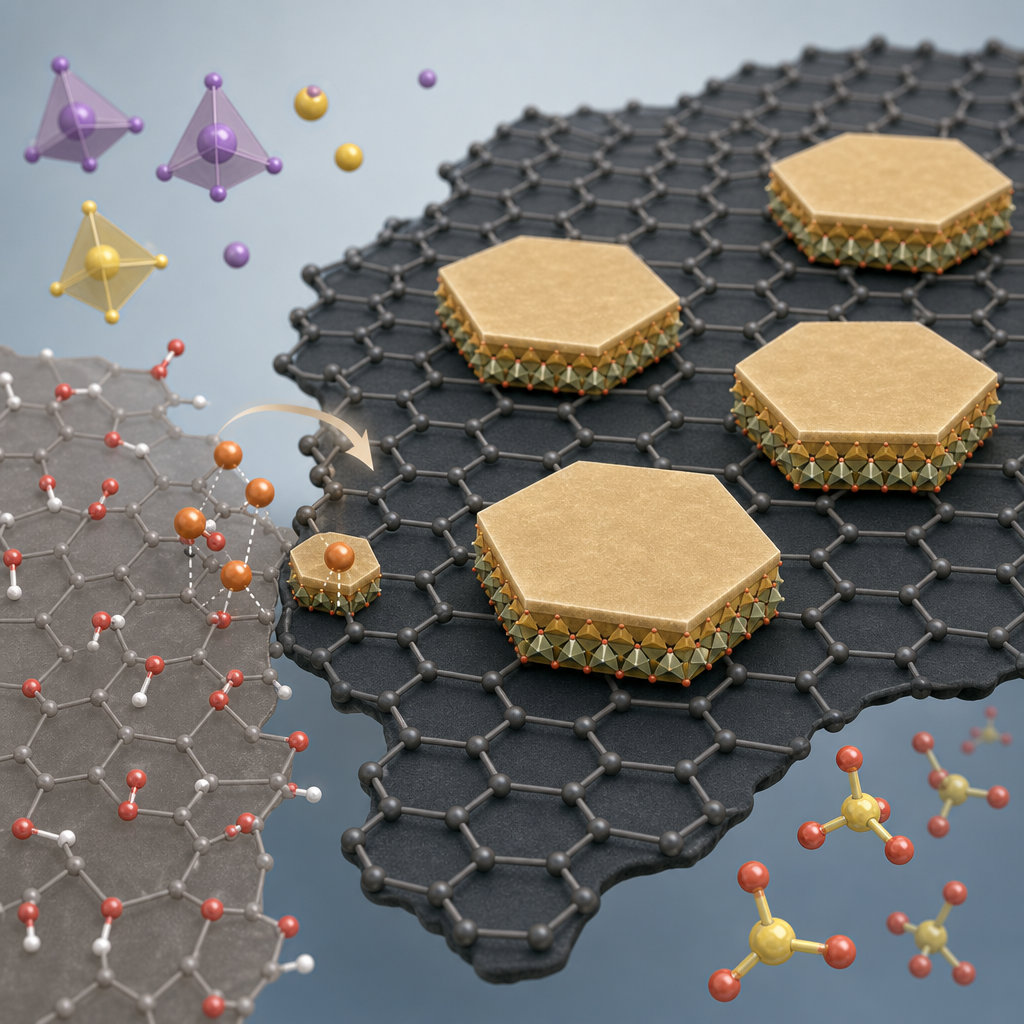
The electrochemical results are substantial. CV curves between 1.5 and 4 V vs. Li/Li+ show paired anodic peaks at 2.488 and 2.186 V and cathodic peaks at 2.578 and 3.068 V (first cycle) corresponding to Li+ intercalation/deintercalation in the layered structure. The first discharge and charge capacities at 1 C are 143.7 and 146.8 mAh/g, corresponding to reversible cycling of ~2.5 Li per formula unit. At 2 C the hybrid delivers 110 mAh/g initially, rises to a maximum of 135 mAh/g by the 40th cycle, and retains 120.5 mAh/g after 100 cycles — 88% of the maximum — with Coulombic efficiency stabilizing at 100%. Rate testing produced 143.6, 113.9, 98.2, 83.9 and 65.9 mAh/g at 1, 2, 5, 10 and 20 C respectively, and capacity rebounded to 134.4 mAh/g when the rate returned to 1 C. At a punishing 10 C rate, the hybrid still delivered 70.7 mAh/g after 300 cycles (78.2% retention) versus less than 30 mAh/g for bulk jarosite. EIS analysis shows the charge-transfer resistance dropped from 423 Ω (bulk) to 84.6 Ω (hybrid), and the Li+ diffusion coefficient increased nearly an order of magnitude from 2.34 × 10⁻¹¹ to 1.35 × 10⁻¹⁰ cm²/s. Ex-situ SEM after 300 cycles shows the hexagonal nanoplates remain intact on rGO, while bulk jarosite particles are severely pulverized.
These results have direct implications for grid-scale and stationary energy storage, where cost per kWh and cycle life dominate over gravimetric energy density. Jarosite uses only iron, sulfate and potassium — elements that are far cheaper and more abundant than cobalt or even phosphate — and the synthesis is a low-temperature, solution-phase route with no high-temperature sintering, which is well-suited to scale-up. The same plate-on-sheet template strategy is transferable to other polyanionic cathodes (silicates, borates, fluorosulfates) and to sodium-ion analogues where NaFe3(SO4)2(OH)6 is already known to insert alkali ions. Follow-up work pointed to by the authors includes exploring deeper Li insertion, optimizing rGO loading, and adapting the chemistry for Na-ion cells.
For researchers working on graphene-templated electrode materials, the relevant product — single-layer graphene oxide — is available from ACS Material in the Graphene Series catalog. The paper makes clear that the GO must be genuinely single-layer with abundant surface functional groups to act as both a nucleation template and a precursor to a conductive rGO network; both functions are essential to the rate and cycling performance reported.How ACS Material products were used
- Single-Layer Graphene Oxide Sheets (Graphene Series) — “10 mg single-layered GO sheets (ACS material) were sonicated in 30 mL deionized water for one hour.”
Product Performance in this StudyThe single-layer graphene oxide from ACS Material acted as both a structure-directing agent and a growth platform that templated monocrystalline hexagonal KFe3(SO4)2(OH)6 nanoplates, while simultaneously being reduced to rGO to form a conductive network. Without this GO substrate, the jarosite aggregated into irregular micron-sized particles with markedly worse electrochemical performance.
Related product categories
Frequently asked questionsWhy use single-layer graphene oxide to grow jarosite KFe3(SO4)2(OH)6 nanoplates?
Single-layer graphene oxide provides two functions simultaneously. Its oxygen-containing surface groups electrostatically bind Fe2+ ions and serve as preferred nucleation sites, directing the growth of monocrystalline hexagonal KFe3(SO4)2(OH)6 nanoplates with uniform 800 nm width. During the same reaction the GO is reduced to rGO, creating a conductive network in intimate chemical contact with the active material. Without GO, jarosite grows into irregular micron-sized aggregates with poor cycling.
What capacity and cycle life does the jarosite/rGO cathode achieve in lithium-ion batteries?
At 1 C the hybrid delivers 143.7 mAh/g first-cycle discharge capacity, corresponding to roughly 2.5 Li+ per formula unit. At 2 C it reaches a maximum of 135 mAh/g and retains 120.5 mAh/g after 100 cycles (88% retention). At a very high 10 C rate it still delivers 70.7 mAh/g after 300 cycles, a 78.2% capacity retention. Bulk jarosite without rGO drops below 30 mAh/g after 50 cycles at 10 C.
Is jarosite KFe3(SO4)2(OH)6 cheaper than LiFePO4 as a lithium-ion cathode?
Yes. Jarosite uses only Fe, S, K, O and H — all earth-abundant and inexpensive — and the reported synthesis is a 80 °C solution-phase oxidation that requires no high-temperature sintering, making it well-suited to scale-up. LiFePO4 typically requires expensive lithium precursors and high-temperature calcination. The trade-off is operating voltage and theoretical capacity (166 mAh/g for jarosite versus 170 mAh/g for LiFePO4), but raw materials cost is significantly lower.