-
Mesoporous Activated Carbon for Asymmetric Aqueous Supercapacitors — Université de Montpellier, 2019
Jun 19, 2026 | ACS MATERIAL LLCLannelongue, P. et al. (2019). Electrochemical study of asymmetric aqueous supercapacitors based on high density oxides: C/Ba0. 5Sr0. 5Co0. 8Fe0. 2O3-δ and FeWO4/Ba0. 5Sr0. 5Co0. 8Fe0 …. *Electrochimica Acta*.
Electrochimica Acta · 2019
Researchers at Université de Montpellier paired ACS Material mesoporous activated carbon with BSCF perovskite to build asymmetric aqueous supercapacitors reaching 2.7 Wh L⁻¹.
About this research
Researchers at Université de Montpellier (Institut Charles Gerhardt Montpellier, ICGM) used mesoporous activated carbon supplied by ACS Material as the negative electrode in two asymmetric aqueous supercapacitors, achieving a volumetric energy density of 2.7 Wh L⁻¹ in a C/Ba0.5Sr0.5Co0.8Fe0.2O3-δ (BSCF) configuration. Published in Electrochimica Acta (2019), the work by Lannelongue, Le Vot, Fontaine, Brousse and Favier compares a carbon/BSCF device operated up to 1.6 V and a FeWO4/BSCF device operated up to 1.4 V, both in 5 M LiNO3. The study quantifies how high-density multicationic oxides can lift the volumetric energy density of aqueous electrochemical capacitors while preserving long cycle life.
Electrochemical double-layer capacitors built from activated carbon offer high power and good gravimetric energy (~10 Wh kg⁻¹), but their volumetric energy density is typically limited to 5–7 Wh L⁻¹. For applications where the available volume is constrained—electric vehicles, grid buffering at the substation level, portable electronics—this is a real bottleneck. Pseudocapacitive oxides such as RuO2, MnO2 and Fe3O4 already provide higher densities than porous carbons, and emerging multicationic systems including perovskites (ABO3) and tungstates (MWO4) can push density even further. BSCF, well known as a solid-oxide fuel-cell cathode, has a bulk density much higher than carbon and is therefore a promising positive electrode for volumetric energy density gains, provided a suitable negative electrode and aqueous electrolyte can be matched to its operating window.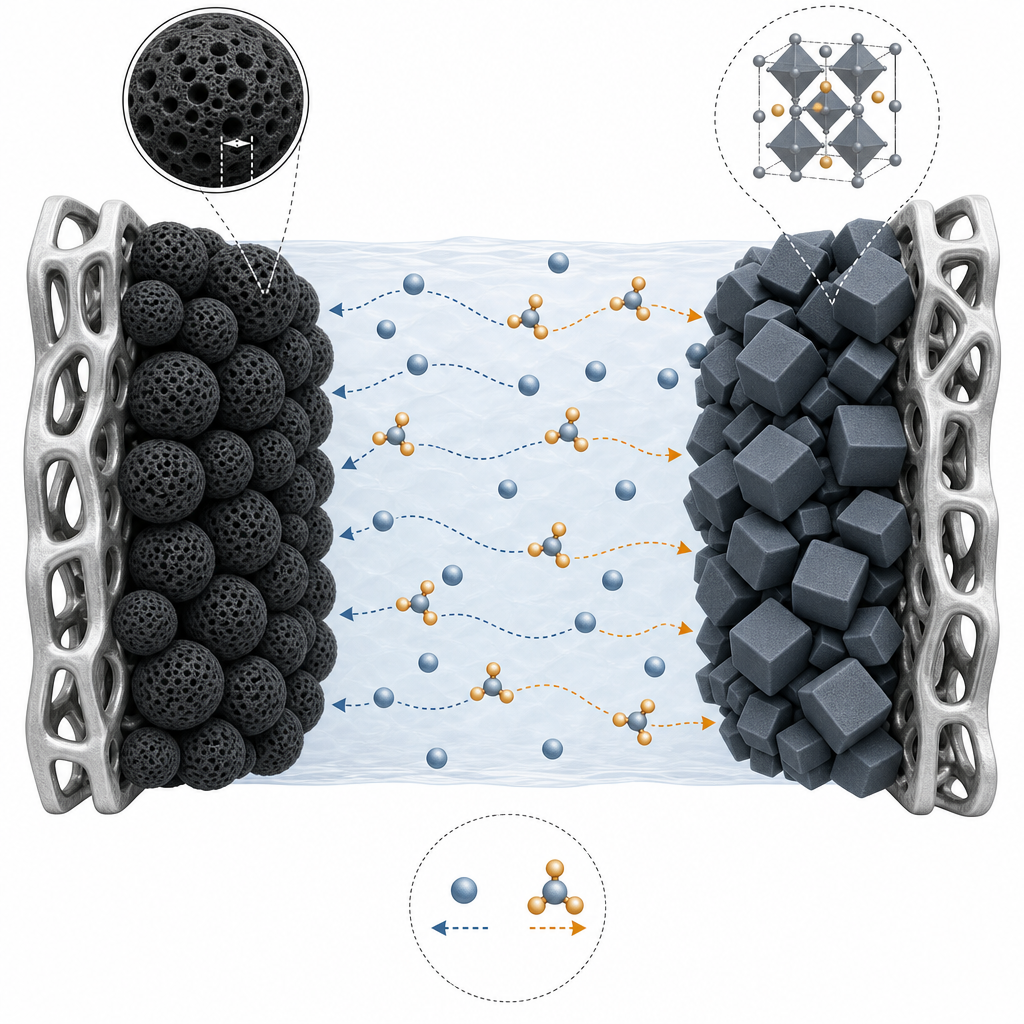
The activated carbon used in this study was purchased from ACS Material and described in the experimental section as mesoporous powder with an average particle size of 5 μm, a pore size distribution between 2 and 2.2 nm, and a BET specific surface area of 2,000 m² g⁻¹. It was integrated into composite electrodes by mixing with acetylene black and PTFE binder (75:15:10 by weight) in ethanol. After solvent evaporation, the paste was cold-rolled into a uniform film, cut into 10 mm disks, and pressed at 10 tons onto stainless steel grids for three-electrode characterization, or onto nickel foam at 10 tons for assembly into 6 mm Swagelok-type asymmetric cells. Electrode loadings were 3.2–4.0 mg_carbon cm⁻², chosen so that charge balance with the BSCF positive electrode could be tuned. The carbon electrode was first benchmarked by cyclic voltammetry at 5 mV s⁻¹ in 5 M LiNO3 against an Ag/AgCl reference, defining its accessible potential window before pairing it with the perovskite cathode.
The C/BSCF asymmetric device operated stably between 0 and 1.6 V in 5 M LiNO3 and delivered a volumetric energy density up to 2.7 Wh L⁻¹ at low current densities, calculated using the combined volume of both electrodes and their nickel foam current collectors. It retained its capacitance over 10,000 galvanostatic cycles in the 0.2–4 A g⁻¹ range, demonstrating that the pseudocapacitive contribution from BSCF, paired with the double-layer response of the ACS Material activated carbon, did not degrade the overall device. The companion FeWO4/BSCF device, where FeWO4 synthesized by a Fe/W chloride–tungstate precipitation route replaced activated carbon as the negative electrode, was operated up to 1.4 V and showed exceptional cycling stability over 45,000 cycles. XRD confirmed that BSCF (synthesized by a modified glycine-nitrate process with EDTA as co-complexant, calcined at 850 °C) crystallized in the expected Pm-3m perovskite structure. Specific capacitances were extracted from cyclic voltammetry using the standard area-integration formula, and energy and power densities were computed from galvanostatic charge–discharge curves with equivalent series resistance taken from ohmic drop measurements. A percolation study showed that 30 wt% acetylene black was needed for BSCF and FeWO4 electrodes, whereas the ACS Material carbon achieved adequate electronic conductivity with just 15 wt% conductive additive, reflecting its higher intrinsic conductivity and high surface area.
These findings outline a practical route to higher volumetric energy density in aqueous supercapacitors using earth-abundant, environmentally benign chemistries. Asymmetric devices that combine carbon electrodes with dense pseudocapacitive oxides are especially relevant for transportation electrification, grid-connected fast-response storage, and back-up power for telecom and data-center infrastructure, where space is the binding constraint rather than weight. The strong cycling stability—45,000 cycles for FeWO4/BSCF—also makes these chemistries attractive for industrial duty cycles such as crane regenerative braking and elevator energy recovery. Follow-up directions identified in the paper include further densification of the perovskite electrode, optimization of mass balancing between high-density oxide and carbon, and exploration of other multicationic oxides (spinels, additional tungstates) with the same matching strategy.
For researchers building aqueous supercapacitor cells, the negative electrode chemistry matters as much as the active oxide on the positive side. The mesoporous, 2,000 m² g⁻¹ activated carbon available through ACS Material's Carbon Series is the type of high-surface-area, well-characterized starting material that supports this kind of asymmetric device design and accelerates iteration on cell voltage, mass balance, and electrolyte selection. Predictable porosity and particle size also simplify scale-up to thicker, higher-loading electrodes—an important consideration when moving from lab coin cells toward Swagelok and pouch formats.How ACS Material products were used
- Activated Carbon (mesoporous, ~5 μm particle size, 2–2.2 nm pore size, BET ~2000 m²/g) (Carbon Series) — “Activated carbon was purchased from ACS Material®. The particle average size is 5 mm. Activated carbon from ACS Material® is mesoporous with a pore size distribution from 2 to 2.2 nm and its BET specific surface area is 2,000 m2 g-1.”
Product Performance in this StudyThe ACS Material mesoporous activated carbon served as the negative electrode in the asymmetric C/BSCF supercapacitor, enabling stable operation up to 1.6 V over 10,000 cycles and contributing to a volumetric energy density of 2.7 Wh L⁻¹.
Related product categories
Frequently asked questionsWhat activated carbon is used as the negative electrode in aqueous asymmetric supercapacitors?
In this 2019 study, the negative electrode was mesoporous activated carbon supplied by ACS Material with an average particle size of 5 μm, a pore size distribution of 2–2.2 nm, and a BET specific surface area of about 2,000 m² g⁻¹. It was combined with acetylene black and PTFE in a 75:15:10 weight ratio and paired with a BSCF perovskite positive electrode in 5 M LiNO3.
Why pair activated carbon with a BSCF perovskite electrode in a supercapacitor?
BSCF (Ba0.5Sr0.5Co0.8Fe0.2O3-δ) has a much higher bulk density than activated carbon, so using it as the positive electrode and pairing it with high-surface-area carbon as the negative electrode raises the device's volumetric energy density without sacrificing cycle life. In this work the C/BSCF asymmetric device reached 2.7 Wh L⁻¹ at low current density and operated stably up to 1.6 V in 5 M LiNO3 over 10,000 cycles.
How does mesoporous activated carbon affect electrode conductivity in supercapacitor cells?
The ACS Material activated carbon used here is intrinsically conductive enough that only 15 wt% acetylene black was needed to reach the percolation threshold for good electrode performance. By contrast, BSCF and FeWO4 oxide electrodes required 30 wt% conductive additive to obtain comparable electronic conductivity. Lower required additive content means more active material per unit volume and higher device-level energy density.