-
MFI Zeolite Membrane for Acidic Mining Water - Victoria University, 2018
Jun 16, 2026 | ACS MATERIAL LLCZhu, B. et al. (2018). Diffusion behaviour of multivalent ions at low pH through a MFI-Type zeolite membrane. *Desalination*. https://doi.org/10.1016/j.desal.2017.09.033
Desalination · 2018
Victoria University researchers used ACS Material ZSM-5 seeds to grow an MFI zeolite membrane achieving 97% Fe3+ rejection from pH 2 multivalent ion solutions.
About this research
Researchers at Victoria University used MFI-type ZSM-5 zeolite seeds (SiO2/Al2O3 = 360) purchased from ACS Material to fabricate a tubular zeolite membrane that achieved 97% Fe3+ rejection from a highly acidic, multivalent-ion-rich model mining wastewater. Published in Desalination (2018), the work by Zhu, Morris, Moon, Gray and Duke is the first detailed examination of how MFI zeolite membranes behave when challenged with concentrated Fe3+, Al3+, Ca2+ and Mg2+ solutions at pH 2.03 and pressures up to 7 MPa. The team systematically resolved ion-by-ion rejection trends and uncovered an unusual temperature-enhanced rejection effect that distinguishes multivalent ion transport from the more familiar monovalent case.
Why this research matters. Acidic mine drainage and metal-bearing process effluents represent one of the most stubborn problems in industrial water treatment. These streams combine low pH with high concentrations of trivalent metals (Fe3+, Al3+) and hardness ions (Ca2+, Mg2+), conditions that destroy conventional polymeric reverse osmosis membranes. Zeolite membranes are chemically robust, withstand low pH, and can in principle reject ions by a combination of size exclusion, electrostatics, and solubility-diffusivity transport through grain boundaries. However, almost all prior zeolite desalination studies focused on NaCl or seawater-like feeds. The transport mechanisms governing multivalent ions in MFI frameworks at industrially relevant pressures were essentially unmapped, leaving a critical gap for mining, hydrometallurgy and metals recovery applications.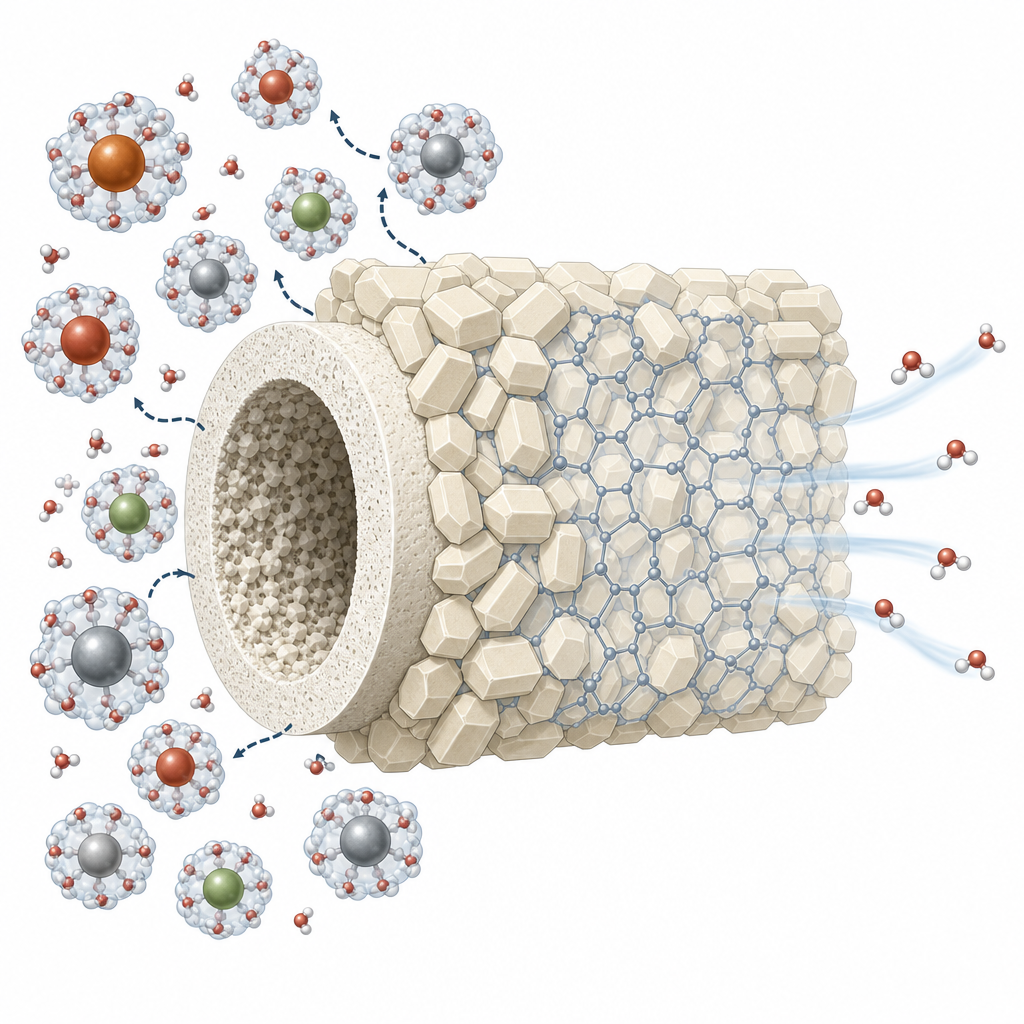
How the ACS Material product was used. The MFI-type ZSM-5 seeds with a SiO2/Al2O3 ratio of 360 were sourced from ACS Material, USA, and served as the nucleation foundation for the entire membrane. Particle size distribution measured by Zetasizer showed the seeds ranged from 1,000 to 3,000 nm, peaking near 1,800 nm. The seeds were deposited onto the outer surface of a porous α-Al2O3 tubular support (15 mm OD, 10 mm ID, 25 mm long) by a rubbing method. The seeded support was then placed in a Teflon-lined autoclave with a growth solution of 2 mL 1 M TPAOH, 2 mL TEOS, and 36 mL DI water, and hydrothermally treated at 180 °C for 16 h. After washing, the membrane was calcined at 500 °C for 4 h to remove the structure-directing agent. This seeded secondary growth method decouples nucleation from crystal growth, reduces consumption of expensive structure-directing agents, and produces a continuous MFI film on the support whose quality directly depends on the uniformity and crystallinity of the starting ACS Material seeds.
Key results. The fabricated membrane was challenged with a synthetic multivalent feed of TDS 97,000 mg/L containing 5,200 mg/L Al3+, 4,900 mg/L Fe3+, 9,000 mg/L Mg2+, 140 mg/L Ca2+ and 78,000 mg/L SO42− at pH 2.03. At 7 MPa and 21 °C the membrane delivered 97% rejection of Fe3+, 80% rejection of both Al3+ and Mg2+, and 50% rejection of Ca2+, with an EC rejection of 71% and a water flux around 0.25 L m−2 h−1. By comparison, a 3,000 mg/L NaCl feed gave only 31% rejection at the same conditions, confirming size-based selectivity since the multivalent hydrated ions (0.82–0.95 nm) are much larger than hydrated Na+ (0.716 nm). Rejection generally tracked hydrated diameter, but Al3+ rejection was anomalously lower than Fe3+, attributed to Al3+'s strong affinity for the aluminosilicate framework and higher effective solubility-diffusivity. Increasing pressure from 3 to 7 MPa raised flux by more than 50% and pushed Fe3+ rejection from below 60% to 97%. Most strikingly, rejection rose with temperature up to 70 °C—the opposite of the activated transport seen with dilute monovalent feeds—because elevated temperature drove multivalent ions further into the zeolite intergranular pores, synergistically blocking further ion passage.
Applications and outlook. The findings point directly at treatment of acid mine drainage, hydrometallurgical bleeds, and concentrated battery-recycling leachates, where polymeric RO cannot survive but selective recovery of Fe and Al would be economically valuable. The unusual temperature-enhanced rejection suggests that thermal operation, often considered detrimental for polymeric membranes, could actually be exploited with zeolite membranes to boost performance. Future work flagged by the authors includes engineering grain-boundary dimensions to tune Al3+ versus Fe3+ selectivity, optimizing SiO2/Al2O3 ratio for charge control at low pH, and integrating these membranes into multi-stage acidic effluent treatment trains for metals concentration and recovery.
Why this matters for researchers. The work demonstrates that commercial ZSM-5 seeds with a well-defined SiO2/Al2O3 = 360 ratio can serve as the foundation for reproducible secondary-growth MFI membranes capable of operating in extreme chemistries. ZSM-5 and related MFI-type molecular sieves are available from ACS Material, supporting investigators working on zeolite membrane fabrication, acidic wastewater RO, ion-selective separations and catalysis in aluminosilicate frameworks.How ACS Material products were used
- MFI-type zeolite seeds (ZSM-5, SiO2/Al2O3 = 360) (Molecular Sieves) — “The MFI-type zeolite seeds (ZSM-5, SiO2/Al2O3 = 360) were purchased from ACS Material, USA.”
Product Performance in this StudyThe ZSM-5 seeds from ACS Material were deposited onto an α-Al2O3 tubular support by a rubbing method and used as nucleation centers for hydrothermal secondary growth. The seeds enabled formation of a continuous MFI-type zeolite membrane that achieved 97% Fe3+ rejection and effective separation of multivalent ions from a synthetic acidic mining wastewater.
Related product categories
Frequently asked questionsHow does an MFI zeolite membrane reject multivalent ions like Fe3+ and Al3+?
MFI zeolite membranes reject multivalent ions through a combination of size exclusion at intra-crystal pores (~0.56 nm) and constrained diffusion through intergranular spaces (~1 nm). Hydrated Fe3+ (0.914 nm), Al3+ (0.950 nm), Mg2+ (0.856 nm) and Ca2+ (0.824 nm) are all too large to enter the crystal pores, so rejection is governed by their hydrated diameter, surface charge interactions, and solubility-diffusivity within the grain boundaries.
Why does rejection increase with temperature for multivalent ion solutions on zeolite membranes?
Unlike monovalent or dilute solutions, where higher temperature accelerates ion transport through the membrane, multivalent ions at low pH show the opposite trend. The authors attribute this to temperature-accelerated infiltration of Fe3+, Al3+, Mg2+ and Ca2+ into the zeolite grain boundaries. As more ions occupy these intergranular sites, they progressively block further ion passage, synergistically raising rejection at elevated temperatures up to 70 °C.
What SiO2/Al2O3 ratio of ZSM-5 seeds is suitable for MFI zeolite membrane synthesis?
In this study, ZSM-5 seeds with a SiO2/Al2O3 ratio of 360 were used to prepare the MFI membrane. The high silica content limits aluminum availability during secondary growth, helping maintain a relatively pure-silica MFI framework. The seeds, with particle sizes of 1,000–3,000 nm peaking at 1,800 nm, were deposited on an α-Al2O3 tubular support by a rubbing method and grown hydrothermally at 180 °C for 16 hours.