-
MFI ZSM-5 Zeolite Membrane Defect Repair - Victoria University, 2017
Jul 01, 2026 | ACS MATERIAL LLCZhu, B. et al. (2017). A method for defect repair of MFI-Type zeolite membranes by multivalent ion infiltration. *Microporous and Mesoporous Materials*. https://doi.org/10.1016/j.micromeso.2016.09.011
Microporous and Mesoporous Materials · 2017
Researchers used ACS Material ZSM-5 (SiO2/Al2O3=360) seeds to fabricate MFI zeolite membranes and repair defects via multivalent ion infiltration for desalination.
About this research
Researchers at Victoria University, working with collaborators at Sunchon National University and industrial partners, used MFI-type ZSM-5 zeolite seeds (SiO2/Al2O3 = 360) supplied by ACS Material to fabricate tubular zeolite membranes and demonstrate a multivalent ion infiltration approach that repairs intercrystalline defects. The headline result: pressurised exposure of the as-synthesised membrane to a Fe3+/Al3+/Ca2+/Mg2+/SO4(2-)/Cl- solution at 7 MPa progressively blocked non-zeolitic pathways, raising ion rejection while preserving intrinsic zeolite microporosity. The work proposes a simple, scalable post-treatment that converts imperfect zeolite films into membranes suitable for water desalination and ion separations.
Defects in polycrystalline zeolite membranes — grain-boundary cracks and pinholes wider than the zeolite micropore — are the dominant cause of poor selectivity in real desalination and gas separation applications. Hydrothermal synthesis on porous α-Al2O3 supports almost always leaves a population of such defects, and conventional repair strategies (counter-diffusion silicalite regrowth, CVD silica deposition, polymer plugging) are complex, expensive, or block productive flux. A method that selectively occludes only the defective region using benign aqueous chemistry would lower the manufacturing cost of MFI membranes for produced-water treatment, sour-gas dehydration, and seawater reverse osmosis pretreatment. This paper addresses that gap by exploiting the surface chemistry of MFI zeolites in acidic, multivalent-ion-rich feed water.
The ACS Material ZSM-5 seeds played a central role in producing reproducible membranes for the study. The seeds were directly rubbed onto α-Al2O3 tubular supports (95.7% Al2O3, 34.9% porosity, ~12.2 µm mean pore size, 15 mm OD × 10 mm ID × 25 mm) and then subjected to hydrothermal secondary growth in a TPAOH/TEOS/water solution at 180 °C for 16 h, followed by calcination at 500 °C for 4 h. The seed particle size distribution between 1,000 and 3,000 nm (peaking near 1,800 nm) ensured uniform coverage of the support without penetration into the substrate pores. The same ZSM-5 powder was used in parallel batch ion-infiltration experiments to characterise the intrinsic adsorption capacity of the MFI framework toward Fe3+, Al3+, Ca2+, Mg2+ and SO4(2-) ions. Zeta potential measurements showed the zeolite carried only +9.16 mV at the feed pH of 2.03, minimising electrostatic interference and allowing ions to diffuse to defect sites driven primarily by hydraulic pressure.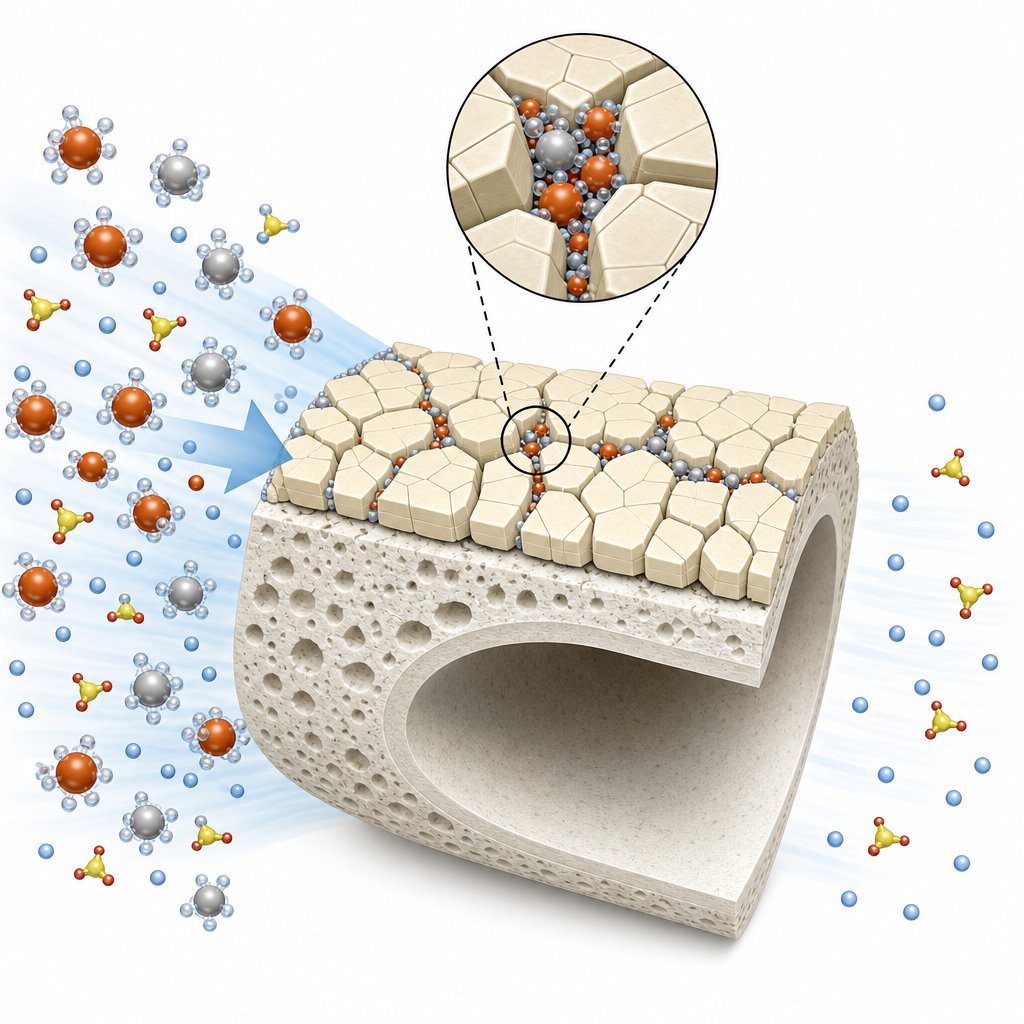
Ion infiltration measurements showed that the membrane adsorbed substantial amounts of trivalent cations: Fe3+ and Al3+ were taken up far more efficiently than divalent Ca2+ and Mg2+, consistent with the higher charge density and stronger framework affinity of trivalent species. During pressurised filtration at 7 MPa and 5 mL/min cross-flow, ion rejection rose continuously over the infiltration period as defects became plugged. ICP-OES analysis confirmed that rejections of Fe3+ and Al3+ exceeded those of the divalent ions, and overall electrical conductivity rejection improved markedly compared with the as-calcined membrane. Rietveld refinement of XRD data on powder samples showed that the MFI framework itself was structurally preserved after exposure to the multivalent ion solution, while N2 porosimetry confirmed that the intrinsic micropore volume was largely retained. Gas permeation testing at 100 °C with He and N2 corroborated the conclusion that defect-related flow was reduced without choking the zeolitic micropores. EDS mapping of the membrane surface revealed enrichment of Fe and Al at grain boundaries — direct visual evidence that the multivalent cations preferentially deposited in defect regions rather than uniformly across the film.
This defect-repair approach has direct relevance for desalination, produced-water treatment, and selective ion separation from acidic industrial streams (mine drainage, hydrometallurgical leachates). Because the feed itself contains the repair agents, the chemistry is potentially self-healing: any defect that opens during operation would tend to re-occlude in service. The authors point to further work on long-term stability, reversibility, and extension to other zeolite frameworks (e.g., LTA, CHA) for high-temperature gas separations and on tuning the cation mixture to optimise rejection of monovalent species like Na+ in seawater applications. The work also suggests that ZSM-5 membranes used in petrochemical separations could be field-repaired without removal from process service.
For researchers working on zeolite membrane fabrication, the high-silica ZSM-5 powder (SiO2/Al2O3 = 360) used here is the same grade catalogued by ACS Material under its Molecular Sieves product line. The narrow particle size distribution and high Si/Al ratio make this seed material well suited to seeded-secondary-growth protocols on alumina, stainless steel, and other porous supports. Reproducible seed quality is the single most important factor in zeolite membrane yield, and ACS Material supplies ZSM-5 with consistent crystallinity and morphology for membrane, catalysis, and adsorption applications.How ACS Material products were used
- MFI-type ZSM-5 zeolite seeds (SiO2/Al2O3 = 360) (Molecular Sieves) — “The MFI-type zeolite seeds (ZSM-5, SiO2/Al2O3 = 360) used for seed-deposition were supplied by ACS Material, USA.”
Product Performance in this StudyThe ACS Material ZSM-5 seeds, with a SiO2/Al2O3 ratio of 360 and a particle size of 1-3 μm (peak ~1.8 μm), enabled reproducible seed deposition by direct rubbing on the α-Al2O3 support and subsequent hydrothermal growth into a continuous MFI membrane suitable for defect-repair studies.
Related product categories
Frequently asked questionsHow does multivalent ion infiltration repair defects in MFI zeolite membranes?
Under 7 MPa pressurised filtration, multivalent cations such as Fe3+ and Al3+ preferentially flow into intercrystalline defects (cracks and pinholes) that are wider than the zeolite micropore. The cations deposit at grain boundaries where local flow is highest, progressively occluding the non-zeolitic pathways. Because the deposits are larger than the MFI micropore, the intrinsic zeolitic pores remain open and the membrane gains selectivity without losing productive flux.
Why is a high SiO2/Al2O3 ratio important for ZSM-5 membrane seeds?
A high SiO2/Al2O3 ratio such as 360 yields a near-silicalite framework that is hydrothermally and chemically robust, producing membranes stable in acidic feeds and aggressive separations. High-silica ZSM-5 seeds also have low surface charge density, which reduces electrostatic aggregation during deposition and gives more uniform seed coverage on alumina supports, leading to thinner, more defect-tolerant membranes after secondary growth.
What applications benefit from defect-repaired MFI zeolite membranes?
Defect-repaired MFI membranes are useful for reverse osmosis pretreatment, desalination, produced-water and mine-drainage treatment, hydrometallurgical leachate separation, and selective recovery of divalent and trivalent metal ions. Their thermal and chemical stability also makes them attractive for solvent dehydration, organic-aqueous separations, and high-temperature gas separations where polymeric membranes fail.