-
Monolayer WS2 Nanosheets for CO Gas Sensing - NIMS, 2023
Jun 15, 2026 | ACS MATERIAL LLCKim, J. et al. (2023). Self-heated CO gas sensor based on Au-decorated Sb-implanted WS2 nanosheets. *Sensors and Actuators B: Chemical*. https://doi.org/10.1016/j.snb.2023.133501
Sensors and Actuators B: Chemical · 2023
NIMS used ACS Material monolayer WS2 nanosheets to build a self-heated, Au-decorated, Sb-implanted CO gas sensor reaching a response of 3.9 to 50 ppm CO.
About this research
Researchers at the National Institute for Materials Science (NIMS) used monolayer tungsten disulfide (WS2) nanosheets supplied by ACS Material LLC to build a self-heated carbon monoxide (CO) gas sensor whose response to 50 ppm CO reached 3.9 after Sb ion implantation and Au nanoparticle decoration. The work demonstrates that combining cation implantation, noble-metal decoration, and self-heating operation can transform a pristine p-type WS2 nanosheet film into a sensitive, selective, low-power n-type CO sensor. The starting material was specified as WS2 nanosheets with a monolayer ratio over 90%, dispersed in 2-propanol and drop-cast onto silicon substrates before processing.
This research addresses the need for sensitive, low-power CO detection. CO is odorless, colorless and highly toxic, with an 8-hour exposure limit of 10 ppm, so reliable sensing is essential for safety. Two-dimensional transition metal dichalcogenides (TMDs) such as WS2 are attractive for gas sensing because their layered structure offers high surface area and allows lower operating temperatures than conventional metal-oxide sensors. However, pristine WS2 typically shows weak response and slow recovery. Strategies including doping, heterojunction formation, UV irradiation and noble-metal decoration have been explored to overcome these limits, but doped WS2 sensors remain under-studied. The paper introduces Sb ion implantation - reportedly the first use of Sb implantation in WS2 for sensing - as a route to tailor carrier type and generate beneficial defects.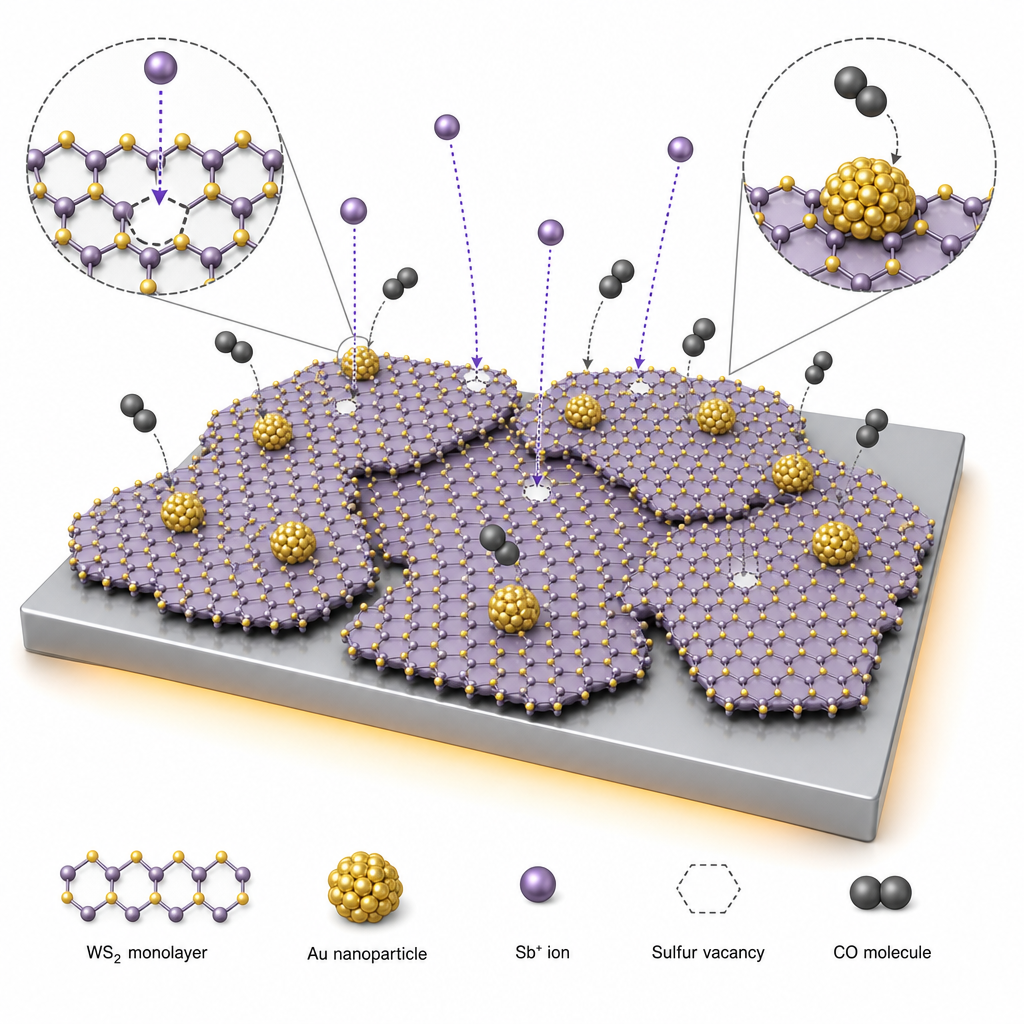
The ACS Material WS2 nanosheets functioned as the active sensing layer throughout the workflow. After dispersing the nanosheets in 2-propanol for 15 minutes and dropping them onto Si substrates, 30 keV Sb+ ions were implanted at room temperature (P = 1e-7 Torr; ion current density 10 nA/cm2) at doses ranging from 2e11 to 2e14 ions/cm2, with a calculated implant depth of 12.4 nm and 6.1 nm straggling. Samples were annealed at 200 C and 500 C in N2. XPS confirmed an Sb5+:Sb3+ ratio of about 7:3, with Sb5+ acting as a donor that converted the WS2 from p-type to n-type. The optimized samples were then decorated with Au nanoparticles by dipping in a gold chloride/2-propanol solution, UV irradiation (360 nm) and a final 500 C anneal in N2. TEM-EDS, XRD, XPS and UPS confirmed Sb incorporation, S-vacancy generation, and a 0.6 eV work-function shift toward the conduction band.
The quantitative results show systematic improvement at each processing step. Before annealing, pristine WS2 gave almost no response (1.01) to 50 ppm CO at 20 C, while Sb-implanted samples gave 1.19-1.27, with the 2e13 ions/cm2 dose best. Annealing further raised the response: the 2e13 dose annealed at 500 C reached 1.67. Operating in self-heating mode, the response peaked at an applied voltage of 4.8 V, corresponding to an estimated surface temperature near 140 C. Au decoration of the optimal sensor raised the response to 50 ppm CO to 3.90 and improved selectivity against C7H8 (2.62), C2H5OH (2.45), C6H6 (2.73), CH4 (2.54) and H2S (2.22). The Au-decorated sensor showed higher Rair/RN2 ratios (100 versus 71). Compared with a prior Ru-implanted p-type WS2 sensor, the CO response improved from 3.6 to 3.9, the optimal voltage dropped by 0.1 V, and the response/recovery times fell dramatically from 339/567 s to 23/410 s. Humidity studies showed only modest degradation in response and timing up to 60% RH, supporting practical viability. The enhancements were attributed to increased O ionosorption via S vacancies, Au/Sb-WS2 Schottky heterojunctions, and Au catalytic and spillover effects.
This work enables compact, low-power CO sensors for safety monitoring in homes, vehicles and industrial settings, where self-heating eliminates the need for external heaters and reduces energy consumption. More broadly, the demonstrated ability to convert WS2 between p- and n-type by controlled ion implantation is valuable for many semiconductor and sensing applications that require deliberate carrier-type control. The combination of defect engineering and noble-metal decoration outlined here offers a transferable design route for other TMD-based chemiresistors targeting toxic and volatile gases. The authors note that detailed analysis of implantation-induced defects is a subject for future work.
For researchers pursuing similar 2D-material gas sensors, the high monolayer purity of the WS2 nanosheets used here was important for reproducible, surface-dominated sensing behavior. ACS Material's monolayer WS2 nanosheet product, listed under the Graphene-like Materials category, is available to groups working on chemiresistive sensing, electrocatalysis, and TMD device research. The results in this paper indicate the material is a suitable, well-characterized starting point for defect-engineering and decoration studies aimed at selective, low-power gas detection.How ACS Material products were used
- Monolayer Tungsten Disulfide (WS2) (Graphene-like Materials) — “We used WS2 NSs (ACS Material LLC, USA), where a monolayer ratio is over 90%.”
Product Performance in this StudyThe ACS Material WS2 nanosheets (>90% monolayer) served as the base sensing material. After Sb implantation and Au decoration, the sensor showed a CO response of 3.9 to 50 ppm in self-heating mode, confirming the WS2 nanosheets provided a high-quality, high-surface-area 2D platform suitable for chemiresistive gas sensing.
Related product categories
Frequently asked questionsHow does Sb ion implantation improve WS2 CO gas sensing?
Sb implantation introduces Sb5+ ions that act as donors, converting WS2 nanosheets from p-type to n-type while generating sulfur vacancies. These vacancies increase oxygen ionosorption, and the n-type behavior gives larger resistance changes upon CO exposure. In this study a 2e13 ions/cm2 dose annealed at 500 C produced the highest CO response, since n-type sensors generally outperform p-type ones.
What role does Au nanoparticle decoration play in the CO sensor?
Au nanoparticles improve both response and selectivity to CO. They form Au/Sb-WS2 Schottky heterojunctions that widen the electron depletion layer, catalytically oxidize CO with a low energy barrier (about 0.21 eV), and promote a spillover effect that dissociates oxygen for greater ionosorption. After Au decoration the response to 50 ppm CO rose to 3.90 with markedly improved selectivity.
Why is self-heating mode useful for WS2 gas sensors?
Self-heating uses Joule heat from the applied bias voltage to reach the optimal sensing temperature without an external heater, cutting power consumption. In this work the response peaked at 4.8 V, corresponding to an estimated surface temperature near 140 C. The Fermi-level shift after Sb implantation lowers resistance, allowing sufficient Joule heating at lower voltage and enabling low-power operation.