-
Ni(OH)2/Graphene Oxide ORR Catalyst - CUNY, 2013
Jun 05, 2026 | ACS MATERIAL LLCFarjami, E., Rottmayer, M. A., & Deiner, L. J. (2013). Evidence for oxygen reduction reaction activity of a Ni(OH)2/Graphene oxide catalyst. *Journal of Materials Chemistry A*. https://doi.org/10.1039/c3ta13351f
Journal of Materials Chemistry A · 2013
Researchers at City University of New York used ACS Material graphite oxide to build a Ni(OH)2/graphene oxide ORR catalyst with +110 mV peak shift.
About this research
Researchers at the City University of New York (New York City College of Technology), working with the Air Force Research Laboratory, used graphite oxide supplied by ACS Material to develop a Ni(OH)2/graphene oxide composite electrocatalyst that shows substantial oxygen reduction reaction (ORR) activity in alkaline media, with a peak potential of 310 mV vs. Ag/AgCl, a +110 mV improvement over unsupported Ni(OH)2 nanoparticles. The paper, published in Journal of Materials Chemistry A in 2013, combines microwave-assisted synthesis with detailed cyclic voltammetry, rotating disk electrode (RDE), chronoamperometry, and electrochemical impedance spectroscopy (EIS) to argue that specific chemical interactions between the Ni(OH)2 phase and the graphene oxide support drive the enhancement in catalytic activity.
The oxygen reduction reaction is one of the kinetically slowest steps in alkaline fuel cells and metal/air batteries, and platinum-based catalysts remain expensive and vulnerable to OH⁻ poisoning. The field has therefore pursued non-noble metal alternatives, especially nanostructured manganese and nickel oxides. Earlier work hypothesized that Ni(OH)2/NiOOH species stabilize active MnOx phases and assist charge transfer to oxygen. This paper isolates the role of Ni(OH)2 itself when supported on graphene oxide, providing direct evidence that the carbon nanostructure is not merely a conductive scaffold but participates in tuning the ORR pathway. Establishing such non-precious-metal options is central to lowering the cost of alkaline energy conversion devices.
The ACS Material graphite oxide was used exactly as received. To form the catalyst support, 50 mg of graphite oxide was dispersed in 100 mL of water and sonicated for two hours in an ultrasonic bath, yielding the stable brown dispersion characteristic of exfoliated graphene oxide. The dispersion remained stable for months, confirming effective conversion of the bulk graphite oxide into single- and few-layer graphene oxide sheets. Nickel(II) acetate (1.64 g) and urea (6.77 g) were then added and stirred for 30 min before microwave treatment at roughly 700 W for 7 min in ambient conditions. The microwave step simultaneously decomposed urea, precipitated Ni(OH)2 onto the graphene oxide sheets, and partially reduced the support. The black product was filtered, washed, and vacuum-dried at 100 °C. Pure Ni(OH)2 controls were prepared by the same procedure without the ACS Material graphene oxide. Catalyst inks were formed by dispersing 1 mg of material in 1 mL of DMF and drop-casting 5 µL onto a 3 mm glassy carbon electrode for electrochemical testing.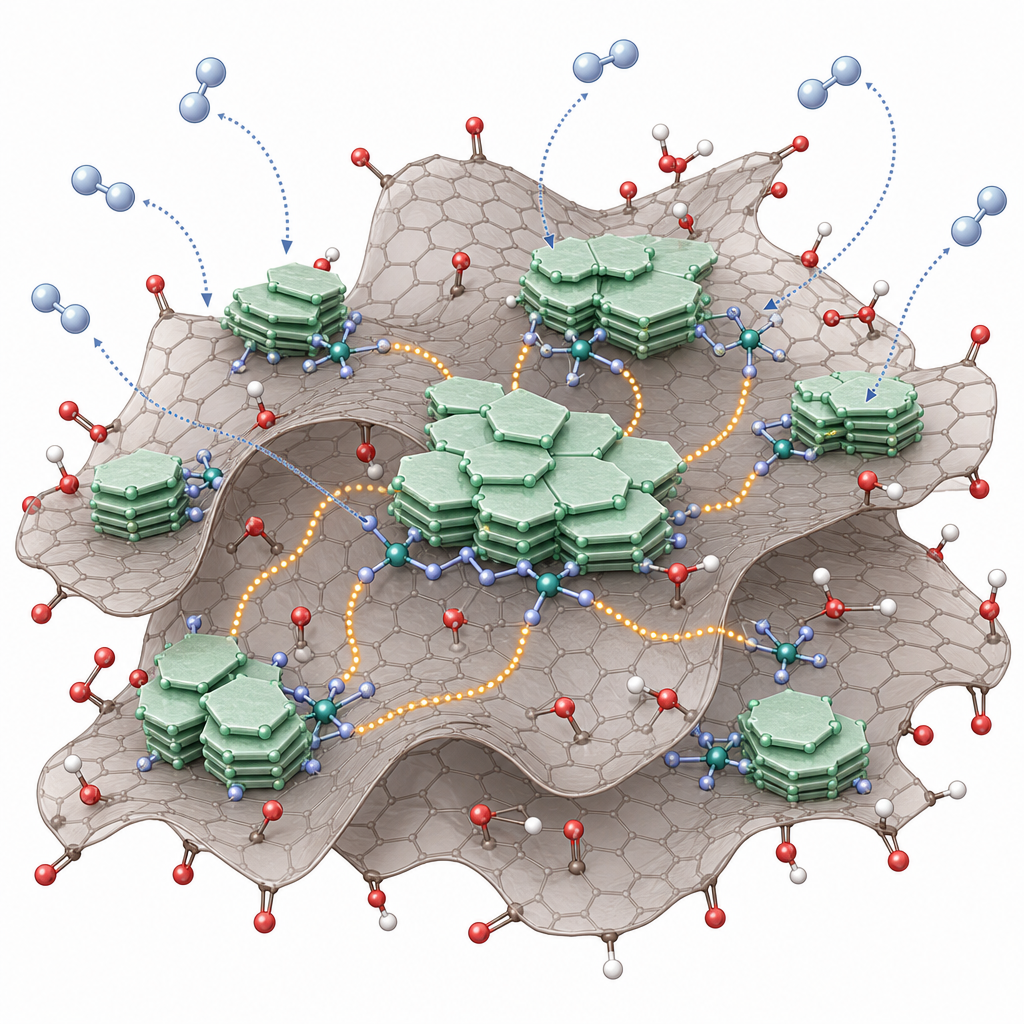
The Ni(OH)2/graphene oxide catalyst showed a cyclic voltammetry ORR peak potential of 310 mV vs. Ag/AgCl in 0.5 M NaOH, representing a +110 mV shift relative to unsupported Ni(OH)2 nanoparticles and a +90 mV shift relative to the graphene oxide support alone. Rotating disk electrode measurements, conducted between 100 and 2500 rpm at 5 mV s⁻¹, gave a limiting current density of 1.3 mA cm⁻² and a Koutecký–Levich-derived electron transfer number of 3.5, indicating a pathway dominated by 4-electron reduction with a residual 2-electron contribution. Chronoamperometry showed that the ORR current density on the Ni(OH)2/graphene oxide composite stabilized at roughly 60% of its initial value, demonstrating useful operational stability for a non-precious-metal catalyst. Electrochemical impedance spectroscopy across 100 kHz to 0.1 Hz revealed that the charge transfer resistance of the composite was markedly lower than that of either pure Ni(OH)2 or pure graphene oxide, consistent with electronic coupling at the Ni(OH)2–GO interface. Supporting DRIFTS analysis indicated specific bonding interactions between Ni(OH)2 and oxygen-containing functional groups on the graphene oxide surface, supporting the authors' interpretation that the composite is more than a mechanical mixture.
The results have direct implications for alkaline fuel cells, zinc–air and other metal–air batteries, and any electrochemical energy conversion system that relies on ORR catalysts but cannot tolerate the cost or supply constraints of platinum. The work also suggests a broader design principle: pairing earth-abundant transition metal hydroxides with oxygen-rich carbon supports synthesized from graphite oxide can deliver favorable ORR kinetics through controllable interfacial chemistry. Follow-on work pointed to in the paper includes tuning Ni(OH)2 crystallinity, phase, and particle size, doping with additional transition metals, and combining the Ni(OH)2/GO motif with MnxOy systems to harness reported synergistic effects.
For researchers developing non-precious-metal ORR catalysts, capacitor electrodes, or other graphene-oxide-supported nanocomposites, the graphite oxide and related graphene oxide products in the ACS Material Graphene Series provide a starting material that, as this paper demonstrates, exfoliates reliably into stable aqueous graphene oxide dispersions suitable for microwave-assisted hybrid catalyst synthesis. The performance reported here is grounded in standard electrochemical characterization and provides a useful benchmark for groups pursuing similar Ni(OH)2/carbon or M(OH)2/carbon architectures.How ACS Material products were used
- Graphite Oxide (Graphene Series) — “Graphite oxide (GO) was used as received (ACS Materials).”
Product Performance in this StudyGraphite oxide from ACS Material was exfoliated by sonication to graphene oxide and served as the support phase for Ni(OH)2 nanoparticles. The graphene oxide support was essential to the catalyst's performance, yielding a +110 mV positive shift in ORR peak potential versus unsupported Ni(OH)2 and significantly reduced charge transfer resistance.
Related product categories
Frequently asked questionsHow does graphene oxide enhance Ni(OH)2 oxygen reduction reaction activity?
Supporting Ni(OH)2 on graphene oxide shifts the oxygen reduction peak potential 110 mV more positive than unsupported Ni(OH)2 in 0.5 M NaOH. Electrochemical impedance spectroscopy shows charge transfer resistance drops substantially relative to either component, and DRIFTS indicates specific bonding between Ni(OH)2 and oxygen-containing groups on the graphene oxide. The interface, not just the conductivity, drives the kinetic improvement.
What is the electron transfer number for the Ni(OH)2/graphene oxide ORR catalyst?
Rotating disk electrode measurements between 100 and 2500 rpm, analyzed using the Koutecký–Levich equation, give an electron transfer number of approximately 3.5 for the Ni(OH)2/graphene oxide catalyst in alkaline solution. This indicates that oxygen reduction proceeds predominantly through the desired four-electron pathway to hydroxide, with a smaller contribution from the two-electron peroxide route.
Why use graphite oxide instead of pre-made graphene oxide for catalyst synthesis?
Starting from graphite oxide gives the researcher control over exfoliation. In this study, 50 mg of graphite oxide was sonicated for two hours in water to produce a stable graphene oxide dispersion that remained colloidal for months. This in-situ exfoliation lets Ni(OH)2 nucleate directly on freshly exposed graphene oxide sheets during the subsequent microwave step, promoting strong interfacial contact in the final composite.