-
NiO/rGO Anodes for Li-Ion Batteries — University of Connecticut, 2018
Jun 02, 2026 | ACS MATERIAL LLCPalmieri, A. et al. (2018). Explaining the role and mechanism of carbon matrices in enhancing reaction reversibility of metal oxide anodes for high performance Li ion batteries. *Carbon*.
Carbon · 2018
Palmieri et al. use ACS Material graphene oxide to build NiO/rGO Li-ion battery anodes and quantify how electronic conductivity controls cycling reversibility.
About this research
Researchers led by William E. Mustain at the University of Connecticut used Graphene Oxide (SKU#GNOS0010) purchased from ACS Material to construct NiO/reduced-graphene-oxide (NiO/rGO) composite anodes and, for the first time, directly correlate the electrode's measured electronic conductivity with the reversibility of the lithium-ion conversion reaction. Published in Carbon (2018), the work pinpoints why carbon matrices improve metal-oxide anode performance — moving the field beyond the qualitative consensus that "adding carbon helps" to a quantitative, mechanistically grounded design rule. The team prepared NiO embedded in 2.5, 5, and 10 wt% rGO, and a parallel series of NiO physically mixed with 0–40 wt% Vulcan XC-72R carbon black for comparison.
Metal oxide anodes such as NiO are attractive for next-generation lithium-ion batteries (LIBs) because their conversion reactions deliver theoretical capacities (~718 mAh/g for NiO) far above commercial graphite (372 mAh/g). However, conversion-type anodes suffer from large volume changes, poor electronic conductivity of the lithiated Li2O phase, and fast capacity fade. The community has empirically demonstrated that mixing or compositing the oxide with conductive carbons — carbon black, CNTs, graphene, or rGO — restores cyclability, but no prior study had simultaneously measured electrode electronic conductivity, carrier concentration, and electrochemical performance across a controlled carbon-loading series. This gap matters because optimizing additive content is a direct economic and energy-density lever: minimizing inactive carbon while preserving cycle life is essential for LIBs to penetrate cost-sensitive markets such as grid storage and electric vehicles.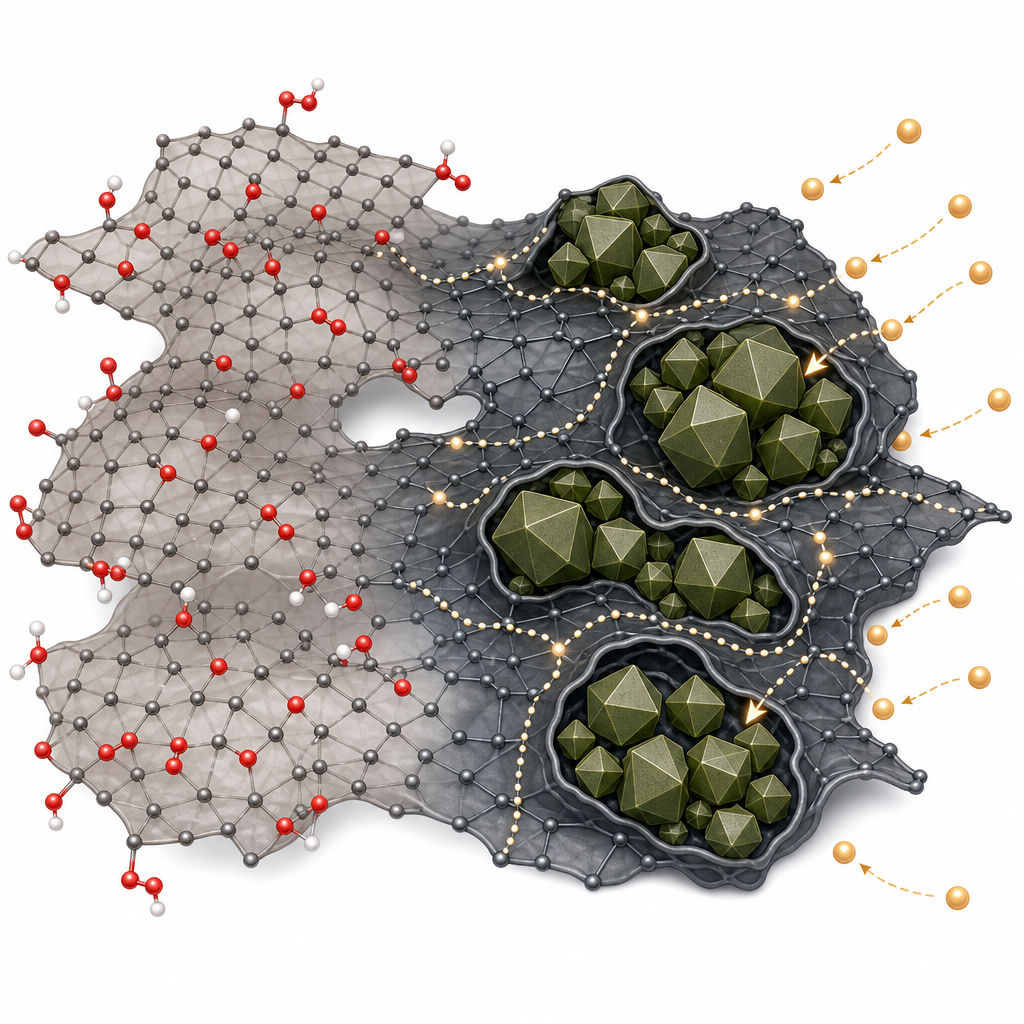
ACS Material's graphene oxide (GNOS0010) served as the carbon precursor for the rGO matrix. In a typical synthesis, GO (37.8 mg for the 10 wt% product) was dispersed in 100 mL deionized water and ultrasonicated for 20 minutes to exfoliate the sheets. A urea solution was added, followed by nickel acetylacetonate. The mixture was refluxed at 185 °C for 24 hours after adding 1 mL of hydrazine, which simultaneously precipitated Ni(OH)2 and reduced GO to rGO. The Ni(OH)2/rGO solids were washed, vacuum-dried, and annealed at 400 °C for 3.5 h in argon to yield NiO/rGO. Identical procedures with adjusted GO mass produced 2.5 and 5 wt% rGO composites. TGA confirmed the final rGO content. For comparison, NiO synthesized via NaOH precipitation was physically mixed with Vulcan XC-72R in NMP at 10, 20, 30, and 40 wt% loadings. Electronic conductivity and carrier concentration were measured by a customized four-probe Van der Pauw setup on pressed pellets and sprayed films.
The key finding is a logarithmic increase in electronic conductivity and carrier concentration with carbon loading, and a strong, quantitative correlation between conductivity and capacity retention. In the rGO series, even 2.5 wt% rGO substantially improved cycling versus carbon-free NiO; the 10 wt% rGO sample delivered the best balance of capacity and stability. The Vulcan series required much higher loadings (≥20–30 wt%) to reach comparable conductivity, confirming that rGO's high intrinsic conductivity and 2D wrapping geometry deliver electron percolation at far lower mass fractions. As context, prior literature reported NiO/MWCNT composites stabilizing near 800 mAh/g at C/14 for 50 cycles, and NiO/graphene hybrids at 700 mAh/g for 35 cycles at C/7; the present work shows that such capacities track directly with the engineered electrode conductivity. Electrochemical impedance spectroscopy and Tafel slope analysis further indicated that increased electronic conductivity reduces charge-transfer resistance and stabilizes small Ni + Li2O domain sizes during cycling, which preserves both mass transport and residual electronic pathways through the Li2O phase. Identical-location TEM from companion work supports this nanostructural picture.
The implications extend across conversion-type and alloying anodes — Fe2O3, Co3O4, SnO2, and silicon composites — where the same conductivity-versus-loading trade-off governs cycle life. By providing a measurable design parameter (electrode-level electronic conductivity) rather than a qualitative "add more carbon" heuristic, the study helps battery engineers minimize inactive mass, raise volumetric energy density, and reduce cost. The methodology — Van der Pauw on sprayed electrode films coupled with rate and EIS analysis — is broadly transferable to electrocatalysis layers, supercapacitor electrodes, and printed electronic inks. The authors point toward extending the framework to other metal-oxide chemistries and to optimizing rGO oxygen functionality and lateral flake size.
For researchers pursuing similar composite-anode designs, the graphene oxide grade used here is available from ACS Material as part of the Graphene Series catalog, alongside related reduced graphene oxide, single-layer GO, and functionalized graphene products suitable for solution-phase composite synthesis. The paper's value lies less in record-breaking capacity numbers than in establishing a reproducible, conductivity-anchored framework — and the consistency of that framework depends on starting from a well-characterized, batch-stable GO source.How ACS Material products were used
- Graphene Oxide (S Method) (Graphene Series) — “Graphene Oxide (GO, SKU#GNOS0010) was purchased from ACS Material.”
Product Performance in this Study
The ACS Material graphene oxide was reduced in situ to rGO and used as the conductive carbon matrix embedding NiO particles, enabling systematic study of how rGO loading governs electronic conductivity and reaction reversibility in Li-ion battery anodes.
Related product categories
Frequently asked questions
Why does adding graphene oxide improve NiO anode performance in lithium-ion batteries?
Reduced graphene oxide (rGO) derived from graphene oxide wraps NiO particles in a conductive 2D network, raising electrode electronic conductivity logarithmically with loading. Higher conductivity sustains the conversion reaction Ni + Li2O ⇌ NiO by keeping Ni and Li2O domains small and electronically accessible, which directly translates to better capacity retention, lower charge-transfer resistance, and higher rate capability than carbon-free NiO.
How does rGO compare to Vulcan carbon black as a conductive additive for metal oxide anodes?
On a mass basis rGO is far more effective. In this study only 2.5–10 wt% rGO produced electrode conductivities that required 20–40 wt% Vulcan XC-72R to match. The advantage stems from rGO's high intrinsic conductivity and two-dimensional sheet morphology, which percolates electrons across NiO particles with minimal inactive mass — preserving volumetric energy density while improving cycle life.
What grade of graphene oxide is suitable for lithium-ion battery composite anode synthesis?
Single-layer or low-defect graphene oxide that disperses well in aqueous media and reduces cleanly is preferred. The authors used ACS Material graphene oxide (SKU#GNOS0010), exfoliated by 20 minutes of ultrasonication and reduced in situ with hydrazine during reflux synthesis. Consistent oxygen content and flake size are important for reproducible rGO loadings and reliable Van der Pauw conductivity measurements across sample batches.