-
Nitroxide-Grafted CVD Graphene on SiO2 - QUT, 2013
Jun 15, 2026 | ACS MATERIAL LLCBlinco, J. P. et al. (2013). Spin-Coated carbon. *Chemical Science*. https://doi.org/10.1039/c3sc51396c
Chemical Science · 2013
Queensland University of Technology researchers covalently grafted persistent nitroxide radicals onto ACS Material CVD graphene-on-SiO2, confirmed by Raman D/G=3.
About this research
Researchers at Queensland University of Technology (Blinco, Chalmers, Chou, Fairfull-Smith, and Bottle) used CVD monolayer graphene on SiO2 supplied by ACS Material to demonstrate that persistent aryl-diazonium nitroxide (ADIN) radicals can be covalently grafted onto a range of carbon surfaces, producing nitroxide-decorated graphene with a Raman D/G ratio of 3. Published in Chemical Science in 2013, the study established a unified chemistry that extends from glassy carbon electrodes to single-walled carbon nanotubes and monolayer graphene, using either electrochemical reduction or simple surfactant-mediated stirring to anchor the spin-active functional group.
Nitroxide radicals are stable, redox-active organic molecules widely used as spin probes, antioxidants, mediators in controlled radical polymerization, and battery cathode materials. Attaching them covalently to sp2 carbon surfaces converts inert graphitic materials into functional, reactive platforms for sensing, energy storage, and free-radical chemistry. The challenge has been to do this with a single, broadly applicable chemistry that works on glassy carbon, carbon fibre, carbon nanotubes, and especially atomically thin graphene, where the available reactive sites are limited and characterization is non-trivial. The authors address this by combining well-defined aryl-diazonium chemistry with a stable isoindoline nitroxide, then tracking the grafting reaction by cyclic voltammetry, Raman spectroscopy, EPR, XPS, and TGA across different substrates.
For the 2D portion of the study, monolayer CVD graphene on SiO2 obtained from ACS Material was used "as received" and served as the planar test bed for nitroxide attachment. Two grafting protocols were applied. In the electrochemical route, the graphene/SiO2 was used as the working surface in an acetonitrile solution containing 0.05 M ADIN 2 and 0.05 M tetra-n-butylammonium tetrafluoroborate, with a potential of -1.0 V vs Ag/Ag+ applied for 30 minutes to reduce the diazonium group and form a covalent C–C bond with the graphene basal plane. In the second route, the graphene wafer was suspended in 1% aqueous sodium dodecyl sulfate (SDS) with ADIN 2 and stirred at 45 °C for 8 h. Both protocols rely on the as-received Raman fingerprint of the ACS Material CVD graphene (narrow G at 1585 cm-1 and 2D at 2689 cm-1) as the reference baseline for quantifying covalent modification.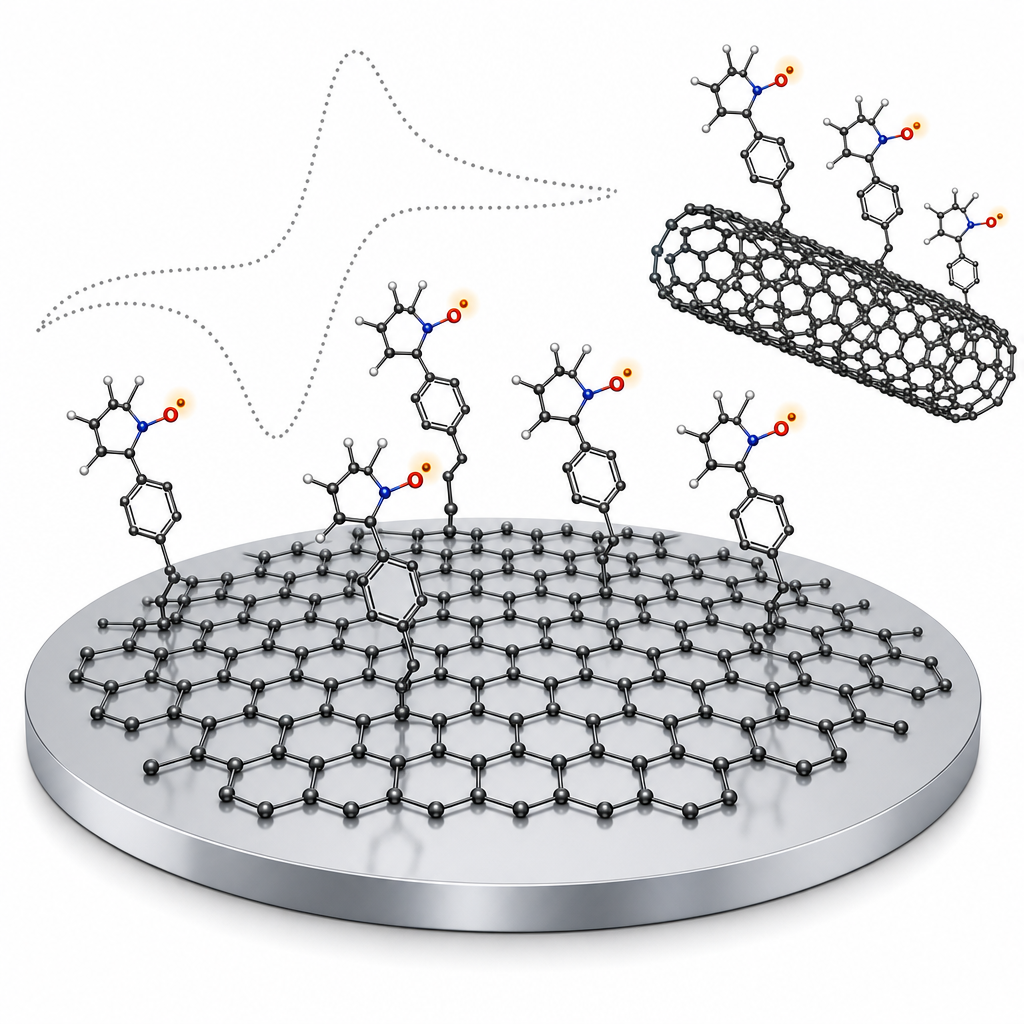
The key spectroscopic outcomes are quantitative. After electrochemical grafting, the G band shifted from 1585 to 1590 cm-1 and a defect-induced D' band emerged at 1618 cm-1, while the D band at 1340 cm-1 grew strongly; the resulting D/G intensity ratio reached approximately 3, well above the 1.2 threshold typically cited for confirmed covalent functionalization of graphene. Raman mapping across the wafer showed correlated spatial enhancement of the D and G features, indicating that sp2-to-sp3 conversion was distributed rather than localized to edges or pre-existing defects. The milder SDS-mediated route gave a more modest D/G ratio of 0.24 (versus 0.10 for the pristine graphene), reflecting the limited dispersing power of surfactant on a planar wafer. On glassy carbon electrodes, cyclic voltammetry yielded a surface coverage of ~8 × 10^-10 mol/cm2, close to the monolayer maximum of 12 × 10^-10 mol/cm2, while HiPCO SWNTs reached D/G = 5 with XPS confirmation of the nitroxide N1s peak at 400.4 eV.
These results enable the use of nitroxide-grafted graphene and related carbons in a range of applications: as redox-active electrodes for organic radical batteries, as spin labels for EPR-based sensors, as mediators for nitroxide-mediated polymerization initiated from a surface, and as antioxidant coatings on carbon-based devices. The demonstration that the same ADIN chemistry works across glassy carbon, carbon fibre, CVD graphene, and SWNTs is particularly valuable for groups building hybrid carbon architectures, since a single functionalization protocol can decorate every component with the same redox-active handle. The authors flag further work on tuning the aromatic substitution to shift the nitroxide/oxoammonium redox potential and on extending the chemistry to multilayer and reduced graphene oxide systems.
For researchers planning similar surface-chemistry studies, the relevant starting material — CVD monolayer graphene on SiO2 — is available from ACS Material, along with CVD graphene on copper, quartz, and PET substrates that support comparable diazonium-based functionalization workflows. Reliable, well-characterized 2D substrates are essential when the experimental signal of interest is a Raman D/G shift of a few tenths, and consistent baseline material allows grafting chemistries to be benchmarked across laboratories.How ACS Material products were used
- CVD Graphene on SiO2 Substrate (Graphene-like Materials) — “the "as received" CVD graphene on SiO2 from ACS materials”
Product Performance in this StudyThe CVD graphene-on-SiO2 wafer served as the pristine 2D carbon substrate that was covalently functionalized with aryl-diazonium nitroxide (ADIN) radicals. Raman spectroscopy of the as-received material showed sharp G (1585 cm-1) and 2D (2689 cm-1) bands consistent with high-quality monolayer graphene, providing a clean baseline against which the sp2-to-sp3 conversion after grafting (D/G ratio of 3) could be confidently quantified.
Related product categories
Frequently asked questionsHow is covalent functionalization of CVD graphene confirmed by Raman spectroscopy?
Pristine CVD graphene shows narrow G and 2D Raman bands near 1585 and 2689 cm-1 and a very weak D band. After covalent grafting, the D band at ~1340 cm-1 grows sharply, a defect-induced D' band appears near 1618 cm-1, and the G band slightly blueshifts as sp2 carbons convert to sp3. A D/G intensity ratio above 1.2 is commonly accepted as proof of covalent attachment; in this work the ratio reached 3.
Why use CVD graphene on SiO2 as a substrate for diazonium chemistry?
CVD monolayer graphene on a SiO2 wafer provides a flat, optically clean, and Raman-friendly platform whose vibrational fingerprint is well characterized before reaction. The SiO2 underlayer is electrically insulating and chemically inert under diazonium conditions, so spectral changes can be attributed unambiguously to chemistry occurring on the graphene. This makes it the substrate of choice for benchmarking new covalent functionalization protocols on 2D carbon.
What is aryl diazonium nitroxide (ADIN) grafting used for on carbon surfaces?
ADIN compounds attach a persistent nitroxide radical to sp2 carbon through a covalent C–C bond formed during diazonium reduction. The resulting radical-decorated surface is redox-active and can serve as an electrode for organic radical batteries, a spin label for EPR sensing, an antioxidant coating, or a tethered initiator for nitroxide-mediated radical polymerization. The same chemistry works on glassy carbon, carbon fibre, carbon nanotubes, and monolayer graphene.