-
Pd/SSZ-13 Chabazite for Passive NOx Adsorption - ORNL, 2021
Jun 03, 2026 | ACS MATERIAL LLCKunal, P. et al. (2021). Deactivation trends of Pd/SSZ-13 under the simultaneous presence of NO, CO, hydrocarbons and water for passive NOx adsorption. *Applied Catalysis B: Environmental*. https://doi.org/10.1016/j.apcatb.2021.120591
Applied Catalysis B: Environmental · 2021
ORNL used ACS Materials NH4-SSZ-13 chabazite to build Pd/SSZ-13 passive NOx adsorbers and mapped deactivation under NO, CO, hydrocarbons and water.
About this research
Researchers at Oak Ridge National Laboratory used NH4-SSZ-13 chabazite zeolite (Si:Al = 12) procured from ACS Materials LLC to synthesize Pd/SSZ-13 passive NOx adsorbers (PNA), and showed that the simultaneous presence of CO drives an irreversible ~20% decline in NO uptake over ten consecutive U.S. DRIVE low-temperature-combustion diesel (LTC-D) trials. The team prepared a 1 wt% Pd loading by solution-phase ion exchange of the ACS Materials chabazite, then evaluated NO storage and temperature-programmed desorption under a chemically complex feed containing NO, CO, hydrocarbons and water. The study isolates how each exhaust species individually affects Pd-site chemistry, particle sintering and desorption behavior, providing a benchmark for low-temperature automotive emission control.
Passive NOx adsorption matters because modern lean-burn and advanced-combustion engines run at exhaust temperatures too low for selective catalytic reduction (SCR) to reduce NOx during cold-start. PNA materials—palladium-functionalized zeolites such as Pd/CHA, Pd/BEA and Pd/ZSM-5—trap NOx below 100 °C and release it above 200 °C, when the downstream SCR catalyst becomes active. Pd/SSZ-13 (chabazite) is attractive for its hydrothermal stability, but most prior work characterized it under simplified feeds. This paper addresses the open challenge of durability under realistic, multi-component exhaust, where reductants like CO and hydrocarbons coexist with water. Understanding which species cause irreversible deactivation is essential before PNA technology can be integrated into vehicle aftertreatment systems that must meet 150,000-mile emission-durability standards.
The ACS Materials NH4-SSZ-13 was the foundational substrate for the entire study. An aqueous Pd(NO3)2·2H2O solution was added dropwise to a stirred 80 °C suspension of 3.960 g NH4-SSZ-13 in water at 250 RPM, exchanged for 20 hours, filtered through a Whatman GF/F glass microfiber filter, dried at room temperature, and calcined in air at 500 °C for 5 hours. Samples were sieved to 250–500 µm pellets. ICP confirmed an actual Pd loading of 0.98 wt%, matching the 1 wt% target. Powder X-ray diffraction verified that the chabazite framework, micro-porosity and lattice spacing of the ACS Materials zeolite stayed intact after Pd loading, with no PdO or bulk-Pd reflections, indicating Pd remained primarily ionic. The same parent SSZ-13 was also evaluated unfunctionalized as a control to confirm that Pd sites, not the zeolite alone, drive PNA. In-situ DRIFTS on the Pd/SSZ-13 identified the [O=N–Pd2+(OH)–Z], [O=N–Pd2+(Z2)] and water-coordinated [O=N–Pd2+(H2O)y–Z] complexes responsible for NO binding.
Under the full LTC-D feed (100 ppm NO, 2000 ppm CO, 3000 ppm total hydrocarbons, 12% O2, 6% CO2, 6% H2O), the Pd/SSZ-13 reached an initial NO:Pd molar uptake of ~0.50 (0.047 mmol NO/g Pd), declining systematically to ~0.40 (0.037 mmol NO/g Pd) after 10 trials, with an average maximum-desorption temperature of ~311 °C—well within the ideal >200 °C window for SCR coupling. Control feeds revealed the cause: the NO-only feed gave a stable NO:Pd of ~0.27 with no decline, while NO + CO started at ~0.40 but declined sharply over 8 trials. TEM showed CO-induced sintering, with average Pd particle size growing from 3.1 ± 2.3 nm (fresh) to 9.0 ± 5.3 nm after NO + CO exposure (versus 8.2 ± 5.9 nm for full LTC-D), and ~79% of particles exceeding 5 nm. The NO + H2 feed held a constant uptake of ~0.17 across 10 trials. Hydrocarbon feeds showed no deactivation: unsaturated alkenes (C2H4, C3H6) gave higher uptakes (NO:Pd ~0.46–0.51) than saturated HCs (C3H8, C10H22, ~0.17). HC trapping reached 1.5, 1.7 and 11.9 mg/g-SSZ-13 for C2H4, C3H6 and C10H22 respectively, with Pd/SSZ-13 trapping more hydrocarbon than bare SSZ-13.
This work enables more durable cold-start NOx control for diesel and lean-burn gasoline aftertreatment, directly relevant to vehicle technology offices and emission-catalyst developers. By pinpointing CO as the dominant irreversible deactivation pathway—through reduction of ionic Pd and particle aggregation—the study guides PNA formulation and operating-strategy design to mitigate sintering. The distinct desorption signatures for saturated versus unsaturated hydrocarbons, and the identification of inner-sphere water-coordinated Pd complexes, inform mechanistic models of zeolite-supported PNA. The authors flag the unresolved atomistic details of decane adsorption on chabazite framework O and Al sites as a target for follow-up, and position Pd/SSZ-13 as a benchmark for evaluating alternative PNA materials under realistic U.S. DRIVE feeds.
For researchers pursuing passive NOx adsorption, zeolite catalysis, or low-temperature emission control, the chabazite parent material is the practical starting point, and NH4-form SSZ-13 zeolite is available within the ACS Material molecular-sieves catalog. As this study demonstrates, framework integrity after Pd ion exchange and a well-defined Si:Al ratio are essential for reproducible PNA behavior, and a reliable chabazite source underpins comparable benchmarking work across laboratories investigating Pd-zeolite NOx adsorbers.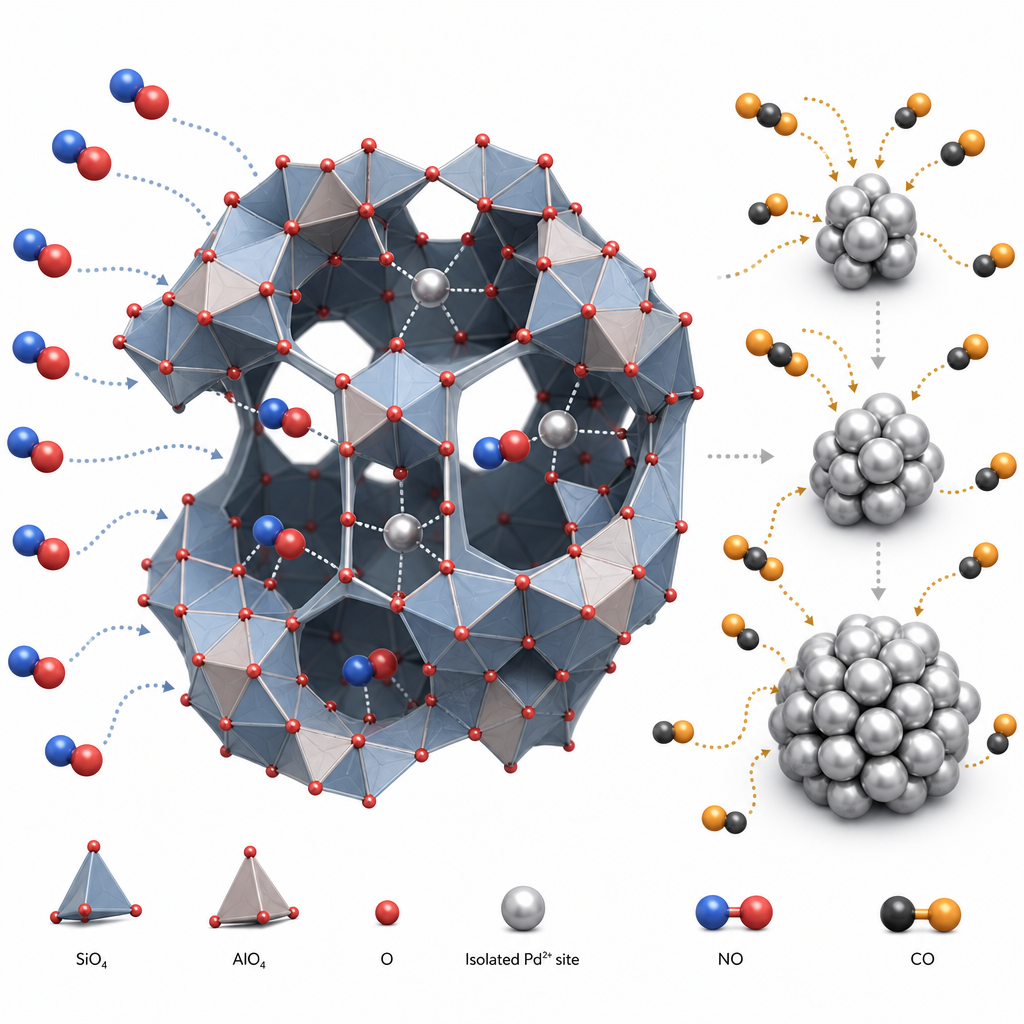
How ACS Material products were used
- NH4-SSZ-13 zeolite (chabazite, Si:Al = 12) (Molecular Sieves) — “NH4-SSZ-13 with Si:Al ratio of 12 and Pd(NO3)2⋅2H2O were procured from ACS Materials LLC and Sigma A6ldrich, respectively.”
Product Performance in this Study
The ACS Materials NH4-SSZ-13 served as the parent chabazite zeolite for ion-exchange synthesis of the 1 wt% Pd/SSZ-13 passive NOx adsorber. PXRD confirmed the chabazite framework was preserved after Pd loading, and the material supported the full performance study.
Related product categories
Frequently asked questions
What is SSZ-13 zeolite used for in passive NOx adsorption?
SSZ-13 is a chabazite-structured zeolite that, when ion-exchanged with palladium, forms a passive NOx adsorber (PNA). It traps NOx at temperatures below 100 °C during engine cold-start and releases it above 200 °C when the downstream SCR catalyst is active. Its small-pore chabazite framework and hydrothermal stability make Pd/SSZ-13 a robust benchmark material for low-temperature diesel emission control.
How does CO cause deactivation of Pd/SSZ-13 NOx adsorbers?
CO acts as a reductant that reduces ionic Pd sites, the active centers for NOx storage, and promotes Pd particle aggregation. In this Oak Ridge study, NO + CO feed caused a ~20% irreversible decline in NO uptake over eight trials, and TEM showed average Pd particle size growing from 3.1 nm to 9.0 nm. This sintering is not reversible by regeneration.
Why is the Si:Al ratio important for Pd/SSZ-13 performance?
The Si:Al ratio controls the density of negatively charged framework aluminum sites that anchor exchanged Pd cations. A defined Si:Al of 12, as in the NH4-SSZ-13 used here, ensures reproducible ionic Pd loading and stable chabazite micro-porosity. PXRD confirmed the framework and lattice spacing stayed intact after Pd loading, which is essential for consistent passive NOx adsorption behavior.