-
Reduced Graphene Oxide Films via Ionic Reduction — University of Florida, 2014
May 22, 2026 | ACS MATERIAL LLCZhang, M., Gao, B., Vanegas, D., & McLamore, E. (2014). Simple approach for large-scale production of reduced graphene oxide films. *Chemical Engineering Journal*. https://doi.org/10.1016/j.cej.2014.01.019
Chemical Engineering Journal · 2014
University of Florida researchers used ACS Material graphene oxide (0.5–5 µm) to produce conductive reduced graphene oxide films at 90 °C without toxic reductants.
About this research
University of Florida researchers led by Bin Gao demonstrated a simple, scalable route to reduced graphene oxide (Re-GO) films by reducing ACS Material graphene oxide (1–5 µm flakes) with common ionic solutions at only 90 °C, avoiding hydrazine, dimethylformamide, vacuum annealing, and post-growth transfer. The process produces conductive Re-GO films directly on glass, mica, metal, and plastic substrates, and when applied to platinum/iridium electrodes yields Re-GO–metal nanocomposites with high electroactive surface area and fast amperometric response. This work, published in Chemical Engineering Journal (2014), establishes a low-cost, environmentally benign manufacturing pathway suitable for large-area graphene films.
Graphene's commercialization in flexible electronics, energy storage, transparent electrodes, and biosensors has long been hampered by the trade-off between film quality and process safety. Mechanical exfoliation gives high quality but low throughput, while CVD requires complex equipment and film transfer that fractures large-area films. Wet chemical reduction of GO is the most economical route, but the standard reductants — hydrazine, DMF, NMP, sodium-ammonia — are toxic, explosive, or expensive to handle at scale. The community has therefore been searching for one-pot reductions that proceed in water, at low temperature, and that deposit films directly on functional substrates. The Florida team addresses this gap by exploiting cation-mediated cross-linking and redox chemistry already known from graphene hydrogel work, but extended to thin films cast on arbitrary substrates.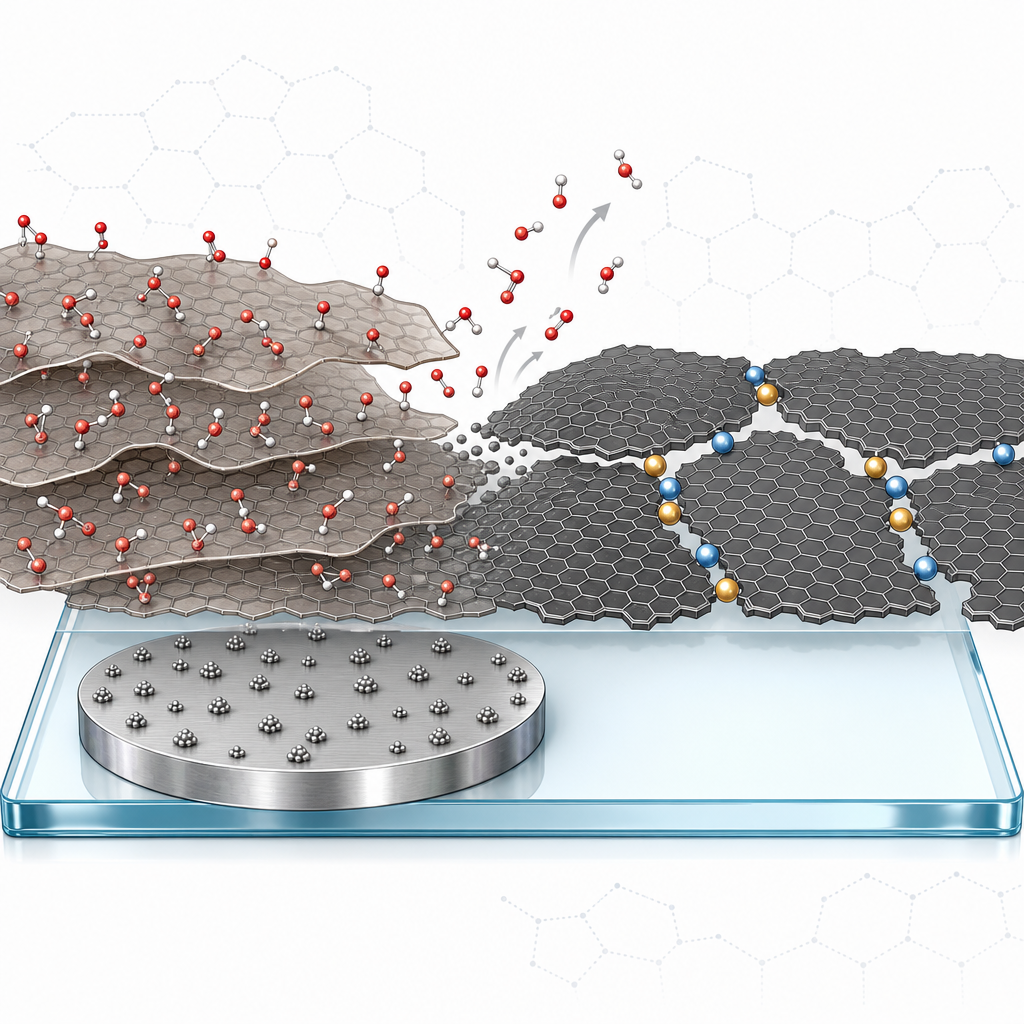
The ACS Material graphene oxide (0.5–5 µm flake size) was used as the sole GO precursor throughout the study. Following the Experimental section, the authors dispersed it at 2 mg/mL in deionized water, then added 0.5 mmol of one chemical reduction reagent — NaCl, AgNO3, MgCl2, FeSO4, CuCl2, or AlCl3 — to 10 mL of GO suspension in a 25 mL cylindrical vial. After 30 s of vortex mixing the GO–Xy solution was drop-cast directly onto borosilicate glass slides (and, in supplementary experiments, mica, metal, and plastic). Substrates were baked at 90 °C in air for 6 h. The reaction relies on the consistent flake size and clean surface chemistry of the GO starting material: divalent cations such as Mg2+, Fe2+, and Cu2+ act as an electrical "glue," simultaneously reducing oxygen functionalities and bridging adjacent GO sheets to form continuous, mechanically integral films without any lift-off transfer step.
All GO–ion films showed a clear color change from brown to grey on heating, consistent with restoration of the sp2 carbon network. XPS confirmed a substantial drop in C–O and C=O components relative to as-cast GO, while XRD and Raman showed restacking and recovery of the graphitic D/G signature. SEM and AFM imaging revealed continuous single- to few-layer films with the cations distributed at sheet–sheet junctions. The reduced films exhibited markedly improved electrical conductivity compared with thermally cast GO; divalent cations such as Mg2+ and Cu2+ outperformed monovalent Na+, supporting the cation-bridge mechanism. When deposited on platinum/iridium working electrodes (BASi MF-2013, 1.6 mm diameter) and decorated with electrodeposited amorphous platinum nanoclusters (from 0.728% chloroplatinic acid with 0.002% lead acetate at 10 V for 90 s), the Re-GO–metal hybrid films delivered a very large electroactive surface area and fast amperometric response in cyclic voltammetry with 4 mM ferro/ferricyanide redox probe in PBS. The films retained adhesion through multiple wash and CV cycles, indicating that the cation cross-links are robust under aqueous electrochemical conditions.
The direct, transfer-free deposition is particularly relevant to applications where large-area integrity matters: glucose and dopamine biosensors, environmental electrochemical sensors, flexible electrodes on plastic, transparent conductive coatings, and supercapacitor current collectors. Because the reduction works on glass, mica, metal, and plastic, the same chemistry can be adapted to printed electronics workflows and roll-to-roll lines that cannot tolerate hydrothermal pressure vessels or high-vacuum annealing. The authors point to Re-GO–metal nanocomposites as a near-term opportunity for non-enzymatic electrochemical sensors, where the high electroactive surface area of graphene combines with the catalytic activity of supported Pt, Ag, or Cu species.
For researchers reproducing or extending this work, the consistent flake size and oxygen content of the GO starting material is critical: variability in starting GO directly translates into variable reduction kinetics and film morphology. ACS Material's single-layer graphene oxide products, including the 0.5–5 µm flake grade used here, remain available to support similar large-area Re-GO film and sensor electrode studies. Groups working on low-temperature, transfer-free graphene processing can use this paper as a procedural template for ionic-reduction film fabrication.How ACS Material products were used
- Single Layer Graphene Oxide Flake (Graphene Series) — “Graphene oxide (GO) with size of 0.5–5 µm was obtained from ACS Material.”
Product Performance in this Study
The ACS Material GO served as the sole graphene precursor for the entire study. Its 0.5–5 µm flake size enabled uniform dispersion in water, smooth drop-casting on glass and other substrates, and effective ionic-solution reduction at 90 °C to form continuous, conductive Re-GO films.
Related product categories
Frequently asked questions
How can graphene oxide be reduced without hydrazine or high-temperature annealing?
This study shows that GO can be reduced at only 90 °C in air using common ionic solutions such as MgCl2, FeSO4, CuCl2, or AlCl3. Divalent cations both remove oxygen functionalities from the GO sheets and cross-link adjacent sheets through cation bridges, producing conductive reduced graphene oxide films directly on the target substrate without toxic reductants or vacuum equipment.
What flake size of graphene oxide works best for solution-cast Re-GO films?
The authors used graphene oxide with a 0.5–5 µm flake size from ACS Material. This range balances dispersion stability in water at 2 mg/mL with sufficient sheet overlap during drop-casting to form continuous films. Smaller flakes tend to produce more defects at sheet junctions, while much larger flakes can settle out of suspension before reduction is complete.
Why do divalent cations work better than monovalent ions for reducing graphene oxide?
Divalent cations such as Mg2+, Fe2+, and Cu2+ can simultaneously coordinate to oxygen groups on two adjacent GO sheets, acting as an electrical glue that bridges and electrically connects the sheets. Monovalent cations such as Na+ cannot form this bridge as efficiently, so films made with them show higher resistance and weaker mechanical integrity even after the same 90 °C treatment.