-
Reduced Graphene Oxide for Bio-Based PU Coatings - Pittsburg State, 2022
Jul 01, 2026 | ACS MATERIAL LLCSuthar, V. et al. (2022). Effect of graphene oxide and reduced graphene oxide on the properties of sunflower oil-based polyurethane Films. *Polymers*. https://doi.org/10.3390/polym14224974
Pittsburg State University · Polymers · 2022
Pittsburg State University used ACS Material reduced graphene oxide to reinforce sunflower oil-based polyurethane films, boosting hardness and hydrophobicity.
About this research
Researchers at Pittsburg State University used reduced graphene oxide (rGO) supplied by ACS Material as a nanofiller in sunflower oil-based polyurethane (BPU) films, demonstrating that loadings as low as 0.05 wt.% raise Shore D hardness from 51 to 60 and increase the water contact angle to roughly 100°. The study synthesized a bio-renewable polyol from sunflower oil through an epoxidation/ring-opening route, then blended it with methylene diphenyl diisocyanate (MDI) and small amounts of graphene oxide (GO) or rGO to fabricate composite coatings. The team systematically compared the two carbon nanomaterials across mechanical, thermal, and surface properties to map their distinct reinforcing behaviors.
This research matters because polyurethanes dominate protective coatings, elastomers, and dispersions across automotive, footwear, and construction industries, yet they remain heavily dependent on petrochemical feedstocks. Substituting vegetable-oil-derived polyols reduces this dependence and improves sustainability credentials. A persistent challenge is that bio-based polyurethanes often need property enhancement to compete with petroleum-based analogues. Carbon nanofillers such as GO and rGO offer high mechanical strength plus thermal and chemical stability, but their notoriously poor dispersibility in polymer matrices causes agglomeration and phase separation. Understanding how oxygen-functionalized GO versus reduced rGO interact with the hard and soft segments of a polyurethane network is therefore directly relevant to formulators developing sustainable composite coatings, anticorrosion layers, and moisture barriers.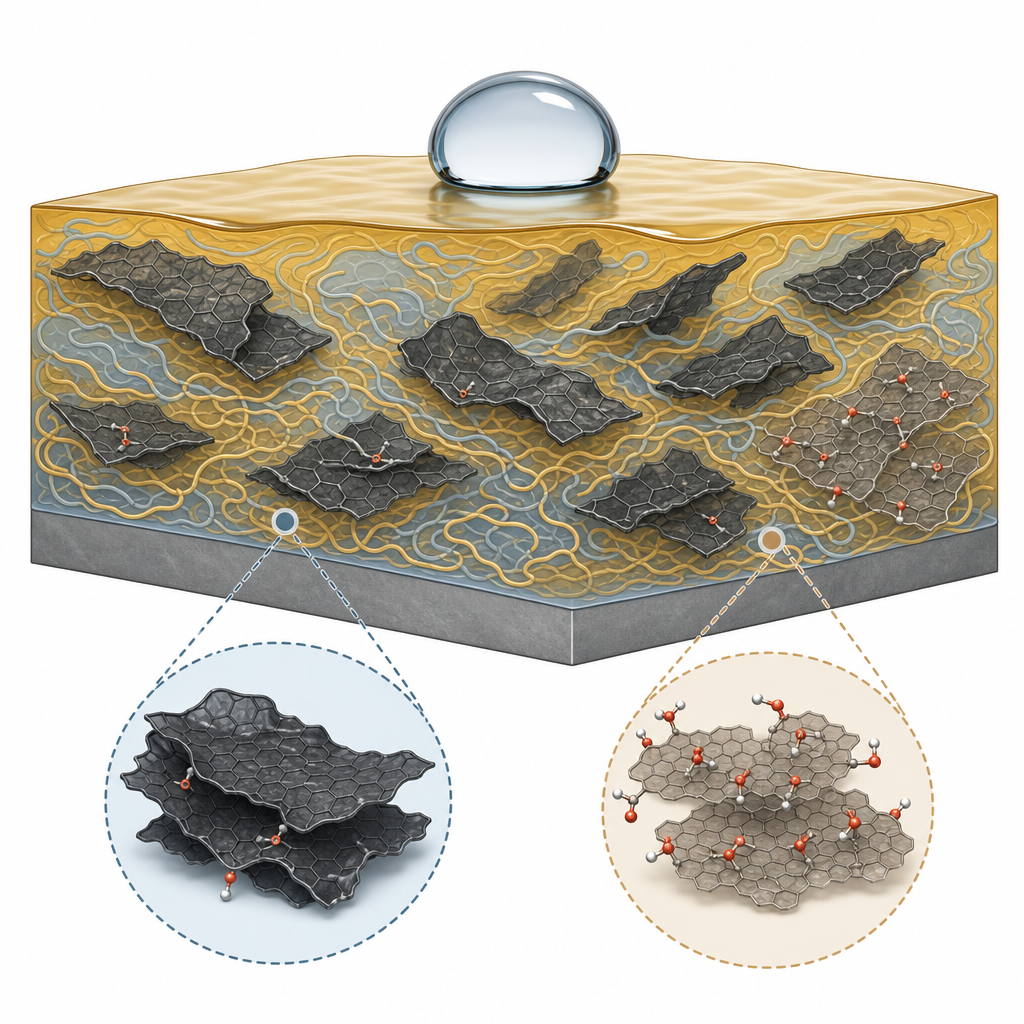
The ACS Material reduced graphene oxide was incorporated using a straightforward sonication-and-blend workflow. Different amounts of rGO (0.01, 0.02, and 0.05 wt.% of the total weight) were dispersed into 25 mL of sunflower oil polyol using a bath sonicator for 120 minutes. After dispersion, 12 mL of isocyanate was added and mechanically stirred for three to five minutes before casting into a petri dish. Films were cured at room temperature for one day and then post-cured at 70 °C for 90 minutes, producing rectangular specimens for testing. The rGO was characterized by XRD, which showed a narrow (002) peak near 2θ = 24.92° and a broad turbostratic band around 42.6°, confirming a more amorphous, oxygen-depleted graphitic structure relative to GO. This reduced oxygen content governed how the rGO interacted with the polyurethane's aliphatic soft segments rather than the polar hard segments.
The quantitative results clearly distinguished the two fillers. For GO-containing films, tensile strength rose from a neat value of 22.5 MPa to 32.5 MPa at 0.02 wt.% GO and 26 MPa at 0.05 wt.%, while the storage modulus climbed from 900 MPa (neat) to 1000 and 1700 MPa at 0.02 and 0.05 wt.% GO. In contrast, rGO lowered tensile strength to about 12.5 MPa at 0.01 and 0.02 wt.% and 15 MPa at 0.05 wt.%, attributed to rGO's preferential interaction with flexible soft segments that increased chain mobility. For storage modulus, rGO films reached 630, 900, and 810 MPa at 0.01, 0.02, and 0.05 wt.% respectively. Hardness, however, increased steadily with rGO, reaching 60 Shore D at 0.05 wt.% versus 67 Shore D for 0.05 wt.% GO and 51 for the neat film. Flexural testing showed 0.02 wt.% rGO delivered a notable improvement to about 14 N force. Water contact angle increased from 78.15° (neat) to 100.20° for 0.02 wt.% rGO, indicating enhanced hydrophobicity. TGA showed both fillers gave only minor thermal-stability gains, raising char residue above 600 °C, and DSC confirmed an amorphous matrix with Tg near 50–55 °C.
These findings enable formulation of sustainable, vegetable-oil-derived polyurethane coatings tailored to specific performance targets. Where high tensile strength and stiffness are needed, GO is the better choice; where increased hardness, flexibility, and hydrophobicity are priorities, rGO performs well. Such bio-based composite coatings are candidates for protective layers against mechanical impact, piercing, and moisture, and align with broader interest in anticorrosion coatings, self-healing polymer composites, and flexible protective films. The reproducible epoxidation/ring-opening approach is generalizable to virtually any unsaturated vegetable oil, giving researchers a flexible platform for sustainable coating development and for exploring further filler functionalization to improve dispersion.
For researchers pursuing similar work, this paper shows that even very low loadings of reduced graphene oxide measurably tune the hardness and surface wettability of bio-based polyurethanes. The reduced graphene oxide used here was sourced from ACS Material, whose graphene series including GO and rGO products is available to laboratories developing composite coatings, nanocomposites, and protective films. The clear, quantitative contrast between GO and rGO behavior offers a useful reference point for selecting the right carbon nanomaterial grade for a target coating property.How ACS Material products were used
- Reduced Graphene Oxide (RGO) (Graphene Series) — “GO and rGO were purchased from Sigma-Aldrich (St. Louis, MO, USA) and ACS Material (Pasadena, CA, USA), respectively.”
Product Performance in this StudyThe ACS Material reduced graphene oxide was used as a filler in bio-based polyurethane films. Adding rGO increased hardness (51 to 60 Shore D at 0.05 wt.%) and water contact angle (up to 100.2°), but reduced tensile strength compared to the neat film.
Related product categories
Frequently asked questionsHow does reduced graphene oxide affect polyurethane film hardness?
In this study, adding reduced graphene oxide to sunflower oil-based polyurethane films steadily increased hardness. The neat film measured 51 Shore D, while a film containing 0.05 wt.% rGO reached 60 Shore D. The improvement is attributed to interlinkage of rGO nanosheets interacting with the polyurethane soft segments due to similar polarity.
What is the difference between GO and rGO as fillers in bio-based polyurethane?
Graphene oxide carries oxygenated groups that bond strongly with the polyurethane hard segments, boosting tensile strength to 32.5 MPa and storage modulus to 1700 MPa. Reduced graphene oxide has fewer oxygen groups and interacts mainly with flexible soft segments, lowering tensile strength but increasing chain mobility, hardness, and hydrophobicity in the films.
Why is graphene oxide dispersion important for composite coating properties?
Carbon nanomaterials tend to agglomerate and cause phase separation in polymer matrices, which weakens mechanical performance. Good dispersion ensures the nanosheets reinforce the polyurethane uniformly. In this work, 120 minutes of bath sonication dispersed GO and rGO into the polyol, enabling measurable gains in tensile strength, hardness, and water contact angle at very low loadings.