-
Reduced Graphene Oxide for Cardiomyocyte Maturation - UT Arlington, 2024
Jun 26, 2026 | ACS MATERIAL LLCTaylor, A. et al. (2024). Reduced graphene-oxide-doped elastic biodegradable polyurethane fibers for cardiomyocyte maturation. *ACS Biomaterials Science & Engineering*. https://doi.org/10.1021/acsbiomaterials.3c01908
University of Texas at Arlington · ACS Biomaterials Science & Engineering · 2024
ACS Material reduced graphene oxide (rGO, SKU GNCR0001) doped into elastic biodegradable polyurethane fibers boosted conductivity and cardiomyocyte maturation.
About this research
Researchers at the University of Texas at Arlington fabricated elastic biodegradable polyurethane (PU) fibers doped with ACS Material reduced graphene oxide (rGO, SKU GNCR0001) and demonstrated that a 10% rGO loading raised membrane conductivity to levels close to native heart tissue while improving cardiomyocyte maturation. The aligned electrospun PU-rGO membranes retained anisotropic viscoelastic behavior similar to the porcine left ventricle and provided a conductive microenvironment that promoted sarcomere development, gap junction formation, and synchronous beating in both neonatal rat cardiomyocytes (NRCMs) and human induced pluripotent stem cell-derived cardiomyocytes (hiPSC-CMs). The study systematically compared PU, PU-4%rGO, and PU-10%rGO membranes across mechanical, electrical, and biological metrics.
This research addresses a central challenge in cardiac tissue engineering: conventional, nonconductive culture substrates produce immature cardiomyocytes that poorly mimic native myocardium. Because the heart depends on coordinated electrical impulses for synchronous contraction, introducing conductive elements into a biomaterial scaffold can support ion regulation, sarcomere alignment, and connexin-43 (CX-43) gap junction formation. Reduced graphene oxide is an attractive conductive additive owing to its electrical properties, protein adsorption, and ability to facilitate cellular interactions. While rGO has been combined with collagen, GelMA, PLCL, and silk fibroin, integrating rGO into a biodegradable, elastic polyurethane that mechanically mimics the dynamic heart wall had been less explored. The work targets in vitro cardiomyocyte maturation platforms and, longer term, conductive matrices relevant to myocardial infarction repair, where restoring electrical integrity in scar tissue improves contractile function.
The ACS Material rGO (specified as ~1 nm thick with conductivity greater than 500 S/m) was used as received. To prepare the spinning dope, rGO at 4% and 10% w/w was stirred in HFIP for 24 hours, then sonicated in an ice bath to disperse the flakes. After replenishing evaporated solvent, biodegradable PU (synthesized from polycaprolactone diol, hexamethylene diisocyanate, and putrescine) was added at 8% w/v and stirred overnight, followed by a further ice-bath sonication step. The PU-rGO solution was extruded at 1 mL/h, 15 cm from a steel mandrel rotating at 2500 rpm and charged at 25 kV (mandrel at -5 kV) for 8 hours, producing aligned nanofibrous membranes. The rGO thus acted as the embedded conductive phase within each fiber, with SEM confirming rGO flakes on the fiber surfaces and increasing membrane darkening with higher rGO content.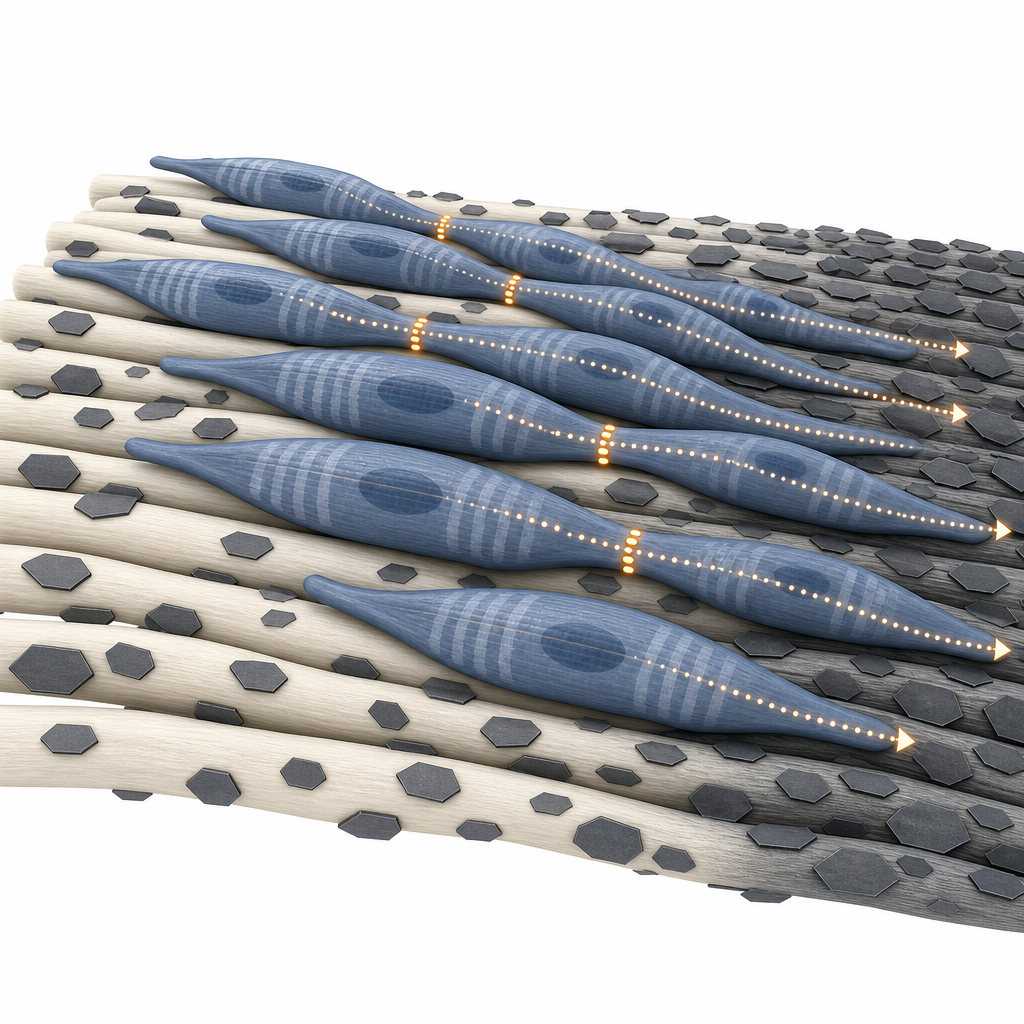
Membrane characterization showed all groups were highly aligned and nanofibrous with no beading. PU fibers measured 464 ± 87 nm in diameter with a fiber angle of 87 ± 11°; PU-10%rGO had the largest diameters. After 24 hours in PBS at 37 °C, PU-10%rGO maintained the largest fiber diameter at 845 ± 255 nm. ATR-FTIR confirmed rGO doping through decreasing transmission, especially in the 3200-3400 cm⁻¹ region. Electrically, PU-10%rGO exhibited the highest conductivity, approaching native myocardial values, while PU-rGO membranes preserved anisotropic viscoelastic behavior comparable to the porcine left ventricle and offered superior tensile strength. Biologically, NRCMs and hiPSC-CMs cultured on PU-rGO membranes displayed enhanced maturation, cell alignment, and improved sarcomere structure, with PU-10%rGO yielding the most improved sarcomere organization and the strongest CX-43 (connexin-43) presence indicating robust gap junction formation. hiPSC-CMs on PU-rGO membranes exhibited uniform, synchronous beating, contrasting with the less coordinated activity on plain PU. Calcium transient measurements of genetically edited (GCaMP) hiPSC-CMs were used to assess functional behavior. Overall, PU-10%rGO delivered the best balance of conductivity, mechanical match to myocardium, and cardiomyocyte maturation.
The conductive PU-rGO membranes provide a promising in vitro matrix for cardiomyocyte culture with enhanced maturation and functionality, and the authors point toward potential applications in cardiac disease treatment, including conductive cardiac patches for myocardial infarction. Because the substrate is elastic, biodegradable, and mechanically tuned to the left ventricular wall, it is relevant to engineered heart tissue models, drug-testing platforms, and regenerative medicine approaches that require restored electrical integrity in damaged myocardium. The systematic mechanical and electrical characterization against native porcine tissue offers a useful design template for researchers developing conductive, degradable scaffolds for excitable tissues such as cardiac and neural constructs.
For researchers pursuing conductive biomaterials, this study illustrates how a defined reduced graphene oxide grade can be dispersed and integrated into electrospun polymer fibers to tune both conductivity and biological response. The reduced graphene oxide used here is available from ACS Material's graphene product line, making it accessible to groups working on cardiac tissue engineering, conductive scaffolds, and related electroactive composite research. The reported results reflect the performance achieved under the paper's specific processing conditions and rGO loadings.How ACS Material products were used
- Reduced Graphene Oxide (RGO) (Graphene Series) — “reduced graphene oxide (thickness: ∼1 nm, conductivity: >500 S/m) (rGO, ACS Material, SKU# GNCR0001)”
Product Performance in this StudyThe ACS Material rGO served as the conductive dopant in electrospun polyurethane fibers. At 10% w/w loading it produced the highest membrane conductivity, approaching native heart tissue values, and improved cardiomyocyte maturation, sarcomere structure, and gap junction (CX-43) formation.
Related product categories
Frequently asked questionsHow does reduced graphene oxide improve cardiomyocyte maturation?
Reduced graphene oxide makes the polyurethane fiber membranes electrically conductive, creating a microenvironment that supports ion regulation, sarcomere development, and connexin-43 gap junction formation. In this study, the 10% rGO membrane reached conductivity near native heart tissue and produced the most improved sarcomere structure, strongest CX-43 presence, and uniform synchronous beating in cultured cardiomyocytes compared with plain polyurethane.
What grade of reduced graphene oxide was used in the conductive scaffold?
The authors used ACS Material reduced graphene oxide (SKU GNCR0001) specified with a thickness of approximately 1 nm and a conductivity greater than 500 S/m. It was used as received, dispersed in HFIP by stirring and ice-bath sonication, then combined with biodegradable polyurethane at 4% and 10% w/w before electrospinning into aligned nanofibrous membranes.
Why is conductivity important for cardiac tissue engineering scaffolds?
The heart relies on coordinated electrical impulses for synchronous beating, so conductive scaffolds can help propagate electrical signals and resynchronize contractions. Conductive matrices support cardiomyocyte maturation in vitro, improving contractile force, myofibril structuring, and gap junction formation. The PU-10%rGO membrane in this study approached native myocardial conductivity, enabling synchronous beating of human iPSC-derived cardiomyocytes.