-
Reduced Graphene Oxide for Vanadium Flow Batteries - Imperial College London, 2017
Jul 09, 2026 | ACS MATERIAL LLCChakrabarti, B. et al. (2017). Performance enhancement of reduced graphene oxide‐modified carbon electrodes for vanadium redox‐flow systems. *ChemElectroChem*. https://doi.org/10.1002/celc.201600402
Department of Earth Science & Engineering Imperial College London, South Kensington London SW7 2AZ UK · ChemElectroChem · 2017
Imperial College London used ACS Material reduced graphene oxide on carbon paper electrodes, cutting VO2+/VO2+ charge-transfer resistance by ~60% in vanadium redox flow batteries.
About this research
Researchers at Imperial College London demonstrated that reduced graphene oxide (rGO) purchased from ACS Material, electrophoretically deposited onto carbon paper electrodes, lowered the VO2+/VO2+ charge-transfer resistance by roughly 60% in all-vanadium redox flow battery (VRFB) systems. Working with collaborators at Delft University of Technology, the team coated commercial PEM-fuel-cell-grade carbon paper with rGO using electrophoretic deposition (EPD) in N,N'-dimethylformamide and characterized the modified electrodes with cyclic voltammetry, electrochemical impedance spectroscopy, BET, Raman, and—for the first time on such electrodes—X-ray computed micro-tomography (XMT). The work establishes a versatile, binder-free route to improving carbon paper electrodes for grid-scale energy storage.
Vanadium redox flow batteries are attractive for grid-scale energy storage because power and energy can be scaled independently, but the sluggish charge-transfer kinetics of the VO2+/VO2+ couple on standard carbon electrodes limits efficiency and power density. The rearrangement of vanadium coordination structures and the high redox potential (around 1.0 V) in concentrated sulfuric acid make it difficult to find stable, catalytically active surfaces beyond carbon itself. Most prior modification efforts focused on carbon felts rather than carbon paper, even though carbon paper paired with serpentine or interdigitated flow fields yields lower ohmic and pressure drops. This study fills a literature gap by examining rGO modification of carbon paper specifically for the positive VRFB electrolyte.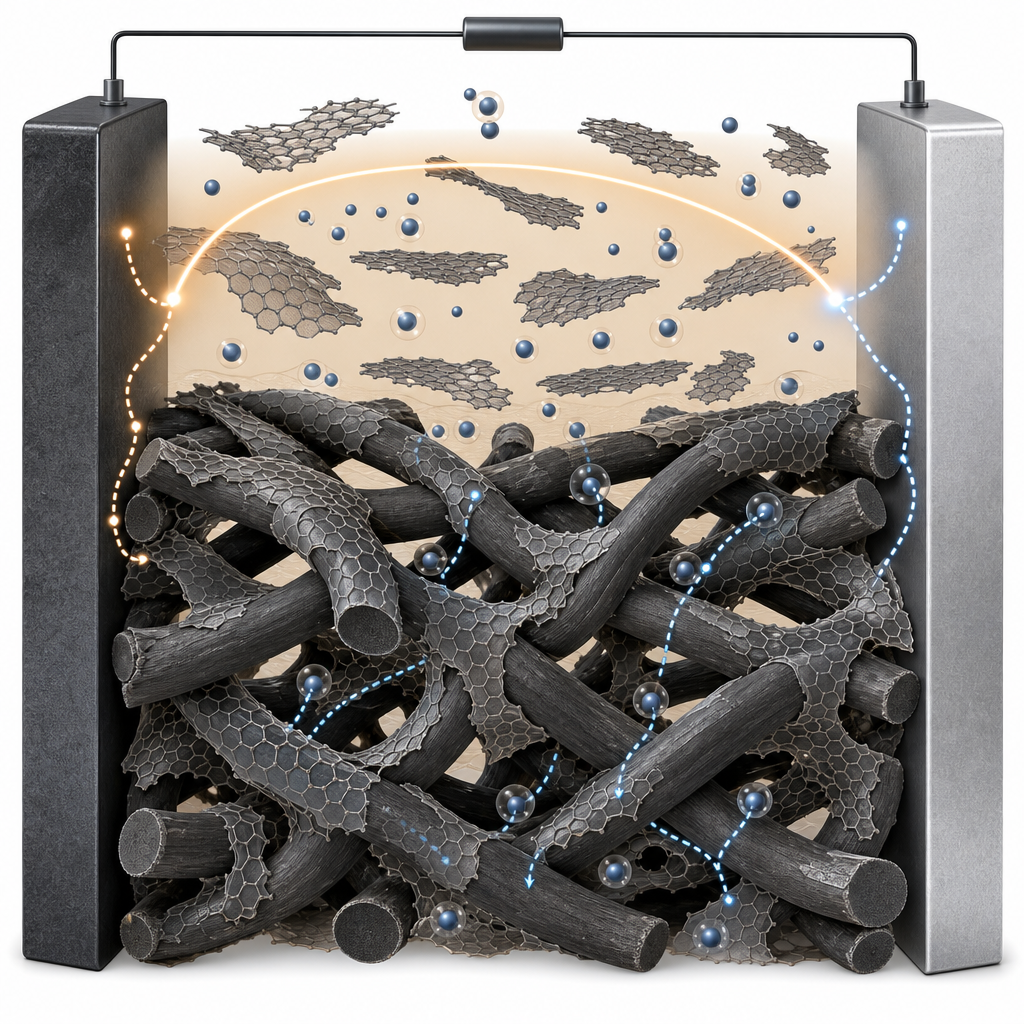
The rGO from ACS Material was used as received. It was ultrasonically dispersed in DMF at 0.1 g/L for about 2 hours, and zeta-potential measurements confirmed the rGO carried a positive charge in DMF, so the carbon paper was placed at the negative pole. Electrophoretic deposition was carried out horizontally inside a PTFE reactor with a 15 mm inter-electrode distance, using a high-voltage supply at potentials up to 300 V for 30 minutes. Deposition voltage controlled mass loading: 50 V gave only about 3% rGO with insufficient coverage, 300 V produced uniform deposition at roughly 10% rGO, and 700 V resulted in about 15% rGO that blocked the carbon paper pores. Single-sided and double-sided depositions were prepared and compared with untreated and DMF-only treated samples. The 300 V single-sided deposit was identified as the optimal condition, providing thin, uniform coverage that penetrated into the substrate while leaving the pore network accessible to the vanadium electrolyte.
The rGO-modified electrodes showed clear performance gains. XMT measured a 24% increase in specific surface area for the rGO-modified carbon paper relative to untreated samples, and confirmed that deposits penetrated into the substrate. Electrochemical impedance spectroscopy in 0.5 M VOSO4 / 3 M H2SO4 showed the single-sided rGO sample reduced charge-transfer resistance from 6.5 to 2.6 Ω cm² (a 60.5% reduction), while series resistance fell from 0.5 to 0.3 Ω cm². The double-sided deposit gave a smaller improvement (4.1 Ω cm², a 37.4% reduction) because thicker coverage blocked sub-micron pores and reduced the accessible electrochemically active area, despite raising total BET surface area to 11.1 µm²/µm³ versus 2.8 for untreated paper. DMF-only treatment alone cut charge-transfer resistance by 19.4%. Cyclic voltammetry showed higher peak current densities and smaller peak separation for rGO samples. Wettability improved markedly: the modified electrode absorbed electrolyte within seconds versus about 30 minutes for untreated paper. Raman analysis revealed a higher D/G intensity ratio (rising from 0.23 to 0.48 for single-sided rGO), indicating the deposited carbon is more amorphous than the underlying graphitic substrate.
The results indicate that an optimized rGO-modified carbon paper electrode could improve the efficiency and power density of all-vanadium redox flow batteries, a benefit relevant to grid-scale and renewable-integration energy storage. The work also demonstrates EPD as a flexible, binder-free coating method applicable to various electrode geometries, and shows that XMT can quantitatively characterize 3D deposit distribution in porous carbon electrodes. The authors point to future work quantifying full-cell efficiency and power density gains, and exploring the role of oxygenated functional groups and DMF treatment on electrochemical surface activation.
For researchers working on flow batteries, electrocatalysis, or porous carbon electrode modification, this study illustrates how commercially available reduced graphene oxide can enhance charge-transfer kinetics and wettability without complex synthesis. The reduced graphene oxide used here is part of ACS Material's Graphene Series and is available to laboratories pursuing similar energy-storage and electrode-engineering objectives.How ACS Material products were used
- Reduced Graphene Oxide (RGO) (Graphene Series) — “Reduced graphene oxide (rGO) was purchased from ACS Material (USA) and used as received.”
Product Performance in this Study
The ACS Material rGO, electrophoretically deposited on carbon paper, increased specific surface area (24% by XMT) and reduced charge-transfer resistance of the VO2+/VO2+ couple by about 60%, improving electrode wettability and electrochemical activity.
Related product categories
Frequently asked questions
How does reduced graphene oxide improve vanadium redox flow battery electrodes?
Reduced graphene oxide deposited on carbon paper increases the electrochemically active surface area, improves electrolyte wettability, and offers better electronic conductivity than bare carbon. In this study, a single-sided rGO coating cut the VO2+/VO2+ charge-transfer resistance by about 60% and raised specific surface area by 24%, yielding higher peak current densities in cyclic voltammetry.
Why does single-sided rGO deposition outperform double-sided deposition on carbon paper?
Although double-sided deposition raises total BET surface area, thicker rGO coverage blocks sub-micron pores and reduces the accessible electrochemically active surface. The single-sided 300 V deposit gave thinner, uniform coverage that penetrated the substrate while keeping pores open, achieving a 60.5% charge-transfer resistance reduction versus 37.4% for the double-sided sample.
What deposition voltage gives the best rGO coating on carbon paper electrodes?
In this work, electrophoretic deposition at 300 V produced uniform coverage with about 10% rGO mass loading. A lower 50 V gave insufficient deposition (around 3%), while 700 V resulted in about 15% rGO that blocked the carbon paper pores. The 300 V single-sided condition was identified as optimal for lowering charge-transfer resistance.