-
rGO Buffer for Phosphorene K-Ion Anodes - Rensselaer Polytechnic Institute, 2019
May 28, 2026 | ACS MATERIAL LLCJain, R. et al. (2019). Reversible alloying of phosphorene with potassium and its stabilization using reduced graphene oxide buffer layers. *ACS Nano*. https://doi.org/10.1021/acsnano.9b06680
Rensselaer Polytechnic Institute · ACS Nano · 2019
Researchers at Rensselaer Polytechnic Institute used ACS Material reduced graphene oxide to stabilize phosphorene anodes in potassium-ion batteries, forming K4P3.
About this research
Researchers at Rensselaer Polytechnic Institute demonstrated that reduced graphene oxide (rGO) purchased from ACS Material can stabilize few-layer phosphorene (FLP) as a high-capacity anode for potassium-ion batteries, where FLP reversibly alloys with potassium to form K4P3. Without a carbon buffer, FLP delivers ~1,200 mAh g⁻¹ but retains only ~9% of its capacity after a few cycles due to massive volume expansion. Wrapping FLP in 2D rGO sheets suppresses pulverization, yielding stable cycling and enabling a working full-cell potassium-ion battery against a spherical K0.6CoO2 (s-KCO) cathode.
This research matters because lithium-ion batteries face long-term constraints from the scarcity and uneven geographic distribution of lithium (0.0017 wt% of Earth's crust). Potassium-ion batteries (KIBs) are an attractive alternative: potassium is abundant (2.09 wt%), inexpensive, and has a reduction potential (-2.97 V vs SHE) close to lithium's. However, KIB anodes lag in specific capacity. Carbonaceous anodes typically deliver only 200–300 mAh g⁻¹, so alloying anodes such as Sn, Sb, Bi, and P are being explored. Red phosphorus has shown high but inconsistent capacities because of its amorphous structure and varying purity. The Rensselaer team turned to crystalline phosphorene, a 2D allotrope, to establish a clean picture of the K-P alloying chemistry while solving the well-known pulverization problem that plagues alloy anodes.
The ACS Material reduced graphene oxide served as the 2D mechanical buffer and conductive matrix for the phosphorene sheets. Few-layer phosphorene was first prepared by tip-sonicating bulk black phosphorus in anhydrous NMP, followed by centrifugation. The authors then dispersed ACS Material rGO in anhydrous NMP at ~1 mg/mL, bath-sonicated it for 30 minutes, and combined it with the FLP solution. After 90 minutes of additional bath sonication, the mixed dispersion was vacuum-filtered and dried at 70 °C overnight in an argon glove box. The resulting FLP/rGO powder was blended with super-P carbon black and PVDF binder (80:10:10) and slurry-coated onto Cu foil. ACS Material single-walled carbon nanotubes (sCNTs) were processed identically to make FLP/sCNTs composites for comparison. TEM, SAED, and XPS confirmed that the rGO sheets encapsulate the FLP layers through van der Waals interactions only, with no chemical bonding, while the 2D geometry of rGO produced more complete coverage than 1D sCNTs.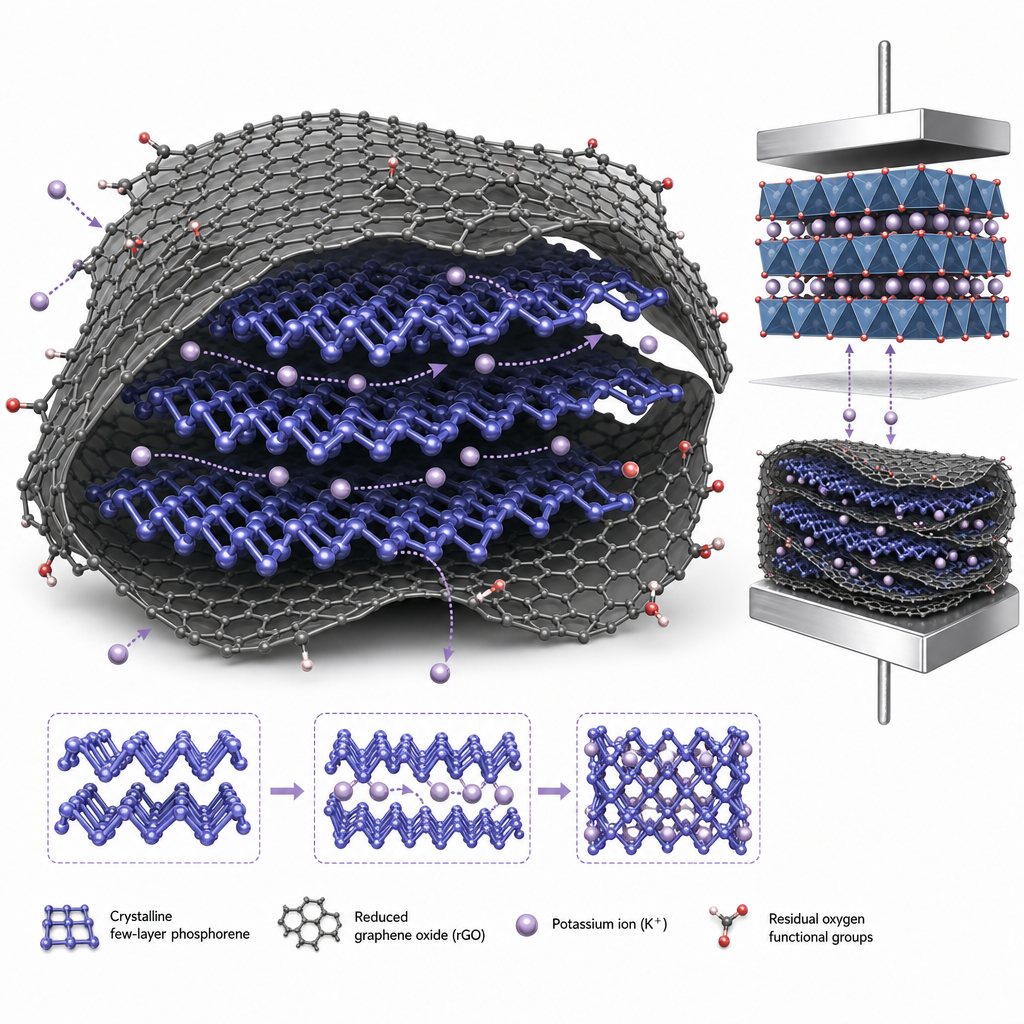
Electrochemically, FLP/rGO (1:3) delivered a first discharge capacity of ~910 mAh g⁻¹ with ~81% initial coulombic efficiency, compared to ~613 mAh g⁻¹ and ~50% CE for FLP/sCNTs (1:3) and only ~200 mAh g⁻¹ for pure rGO. Pure FLP without any buffer reached ~1,200 mAh g⁻¹ but collapsed within a few cycles. The FLP/rGO (1:3) electrode delivered ~650 mAh g⁻¹ over the first 15 cycles, ~550 mAh g⁻¹ at 50 cycles, and ~230 mAh g⁻¹ at 0.5 C for 300 cycles. Rate capability tests showed 400 mAh g⁻¹ at 0.6 C and ~200 mAh g⁻¹ at 1.2 C. Ex-situ XPS and XRD verified formation of the K4P3 alloy rather than K3P (which would have given ~2,500 mAh g⁻¹), and DFT calculations confirmed K4P3 as the thermodynamically favored phase. GITT measurements yielded K⁺ diffusion coefficients of 10⁻¹¹ to 10⁻¹³ cm² s⁻¹, two to three orders of magnitude lower than Li⁺ or Na⁺ in analogous systems, reflecting the larger ionic radius of K⁺. A full-cell built with FLP/rGO anode and s-KCO cathode delivered ~420 mAh g⁻¹ at 0.5 C, 180 mAh g⁻¹ at 2.5 C, 150 mAh g⁻¹ at 4 C, and ~230 mAh g⁻¹ retained for 100 cycles at 0.5 C.
The work points toward practical low-cost potassium-ion batteries that could reduce reliance on lithium for grid storage, electric mobility, and consumer electronics. By unambiguously identifying K4P3 as the reaction product, the study clears up earlier conflicting reports on red phosphorus that variously claimed KP, K2P3, K3P, or K4P3, depending on amorphous structure and purity. The 2D-on-2D buffer concept generalizes to other alloying anodes (Sn, Sb, Bi) where volume expansion drives capacity fade, and the FLP/rGO architecture is compatible with conventional slurry-coating processes. Future work suggested by the authors includes optimizing electrolyte chemistry to reduce SEI resistance and exploring alternative cathodes such as Prussian blue analogues, polyanionic compounds, and layered K-cobaltates.
For researchers developing KIB anodes, supercapacitor electrodes, or composite carbon scaffolds, the reduced graphene oxide grade used in this study is available from ACS Material along with single-walled carbon nanotubes and a broad portfolio of graphene-series products. The reliable buffer-layer performance demonstrated here makes ACS Material rGO a practical starting point for building 2D-encapsulated alloy electrodes in next-generation potassium- and sodium-ion battery research.How ACS Material products were used
- Highly Purified Single-Walled Carbon Nanotubes (Carbon Series) — “Reduced graphene oxide (rGO) and single walled carbon nanotubes (sCNTs) were purchased from ACS materials.”
- Reduced Graphene Oxide (RGO) (Graphene Series) — “Reduced graphene oxide (rGO) and single walled carbon nanotubes (sCNTs) were purchased from ACS materials.”
Product Performance in this StudyrGO functioned as a 2D buffer layer that mechanically encapsulated few-layer phosphorene, suppressing pulverization during K-ion alloying/de-alloying and enabling stable cycling (~230 mAh g⁻¹ at 0.5 C for 300 cycles). It outperformed 1D sCNTs as a buffer material.
Related product categories
Frequently asked questionsWhy is reduced graphene oxide used as a buffer layer in phosphorene potassium-ion battery anodes?
Few-layer phosphorene undergoes ~412% volume expansion when alloying with potassium to form K4P3, which pulverizes the electrode and causes rapid capacity loss. Reduced graphene oxide encapsulates phosphorene sheets in a 2D sandwich geometry, mechanically buffering the volume change, suppressing restacking, and providing electrical conductivity. The result is greatly improved cycle stability, with ~230 mAh g⁻¹ retained at 0.5 C for 300 cycles.
What alloy phase does phosphorene form with potassium?
Few-layer phosphorene alloys with potassium to form K4P3 rather than the K3P phase observed with lithium and sodium. The authors confirmed K4P3 by ex-situ XPS showing P-P bond retention, ex-situ XRD matching the K4P3 reference pattern, and DFT formation energy calculations. The measured specific capacity (~1,200 mAh g⁻¹ for pure FLP) is consistent with K4P3, which is about one-third of the theoretical K3P capacity of ~2,500 mAh g⁻¹.
How does 2D rGO compare to 1D carbon nanotubes as a buffer for alloying anodes?
At the same 1:3 phosphorene-to-carbon ratio, FLP/rGO delivered ~910 mAh g⁻¹ first discharge with 81% coulombic efficiency, while FLP/sCNTs delivered only ~613 mAh g⁻¹ with 50% efficiency. The 2D sheet geometry of rGO provides more complete encapsulation of the phosphorene flakes than a 1D nanotube network, better resisting pulverization and yielding more stable solid electrolyte interface formation.