-
rGO-Modified Carbon Paper for H2/V Fuel Cells — Imperial College London, 2019
Jun 17, 2026 | ACS MATERIAL LLCChakrabarti, B. et al. (2019). Charge/discharge and cycling performance of flexible carbon paper electrodes in a regenerative hydrogen/vanadium fuel cell. *International Journal of Hydrogen Energy*. https://doi.org/10.1016/j.ijhydene.2019.09.151
International Journal of Hydrogen Energy · 2019
Imperial College London used ACS Material single-layer reduced graphene oxide to modify Freudenberg carbon paper electrodes, achieving 92% cycling efficiency in a regenerative hydrogen/vanadium fuel cell.
About this research
Researchers at Imperial College London demonstrated that single-layer reduced graphene oxide (rGO) supplied by ACS Material can significantly enhance the performance of flexible Freudenberg carbon paper electrodes in a regenerative hydrogen/vanadium fuel cell (RHVFC), achieving 92% round-trip energy efficiency and 99% electrolyte utilization at 50 mA cm⁻². The work, published in the International Journal of Hydrogen Energy in 2019, combined electrophoretic deposition of rGO at 300 V with mild thermal treatment to produce a stable, catalytically active vanadium-side electrode. The team, which included collaborators from RFC Power Ltd. and Addionics Ltd., directly tested the modified electrodes in a commercial Scribner flow cell assembly rather than a three-electrode half-cell, providing performance data directly relevant to practical RHVFC stacks.
Large-scale electrochemical energy storage is one of the most pressing problems in the transition to renewable electricity. All-vanadium redox flow batteries (VRFBs) are well established, but the regenerative hydrogen/vanadium fuel cell offers a higher theoretical energy density by pairing a vanadium electrolyte with a hydrogen gas electrode. The bottleneck for RHVFCs lies on the vanadium side, where the V(IV)/V(V) and V(II)/V(III) redox couples require electrodes with sufficient electrocatalytic activity, surface oxygen functionality, and chemical stability in 5 M H₂SO₄. Carbon papers are attractive substrates because they are flexible, conductive, and porous, but pristine fibers offer limited active sites. Surface engineering — through heat treatment, acid functionalization, or nanocarbon coatings — is therefore the central research question, and the choice of nanocarbon directly determines both performance and cost.
In this study, the rGO obtained from ACS Material was described as "single layered rGO produced by thermal exfoliation followed by thermal reduction in H₂ atmosphere." The material was dispersed at 0.1 g L⁻¹ in N,N-dimethylformamide (DMF) and electrophoretically deposited onto Freudenberg H23 carbon paper (210 µm thick) using a horizontal EPD reactor for 30 minutes at 300 V. A custom cylindrical reactor constructed from graphite and quartz allowed the team to avoid contamination from the corrosive DMF solvent. Four electrode types were prepared and compared: untreated Freudenberg CP, DMF-only control, rGO-deposited CP, and rGO-deposited heat-treated CP (calcined in air at 450 °C for 5 hours). The rGO-coated face was assembled against a Nafion 115 membrane, with a platinized SGL 29BC carbon paper on the hydrogen side, forming the membrane-electrode-assembly (MEA). SEM, HR-TEM (FEI TITAN 80/300), and XRD confirmed that rGO coverage was higher and more uniform on heat-treated fibers, with the deposited rGO appearing more crystalline and transparent, consistent with few-layer 2D crystals.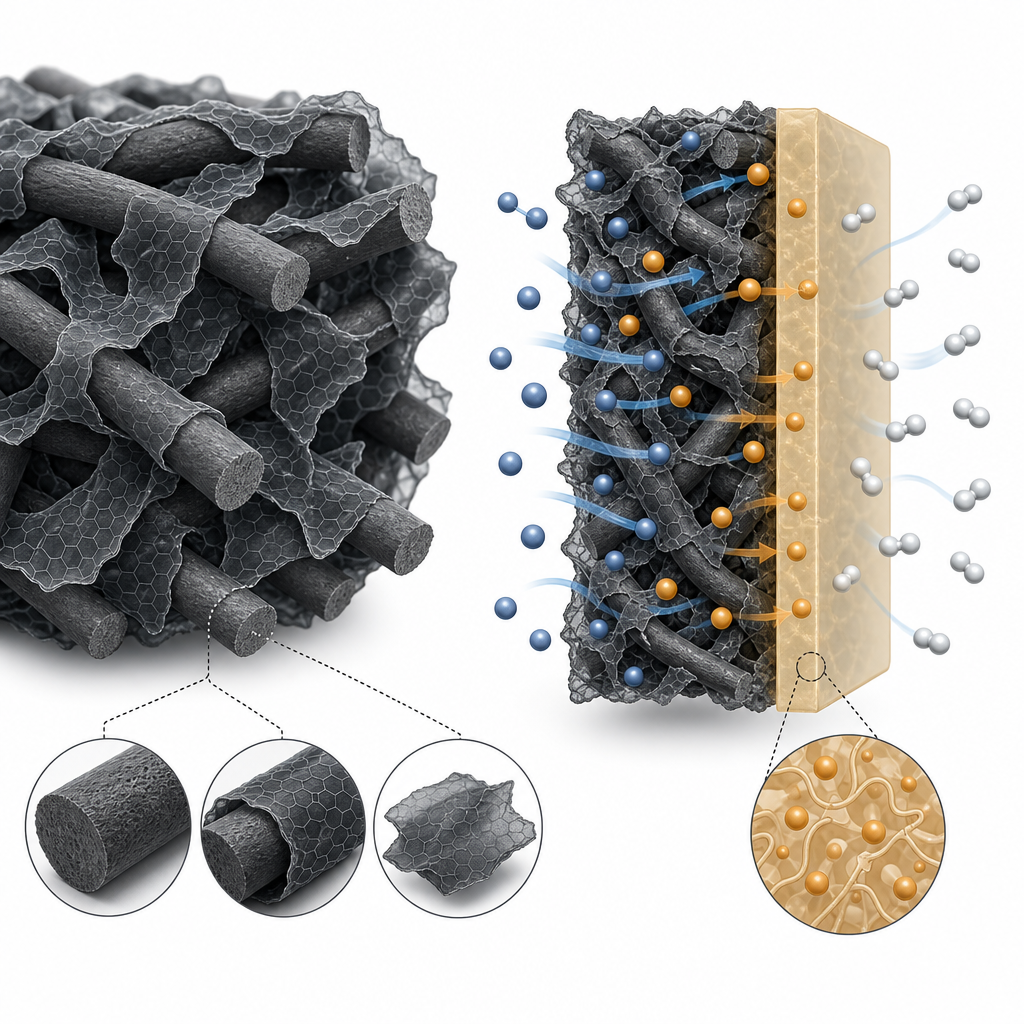
Galvanostatically tested between 0.4 V and 1.4 V at 50–200 mA cm⁻², the rGO-modified heat-treated Freudenberg CP delivered the best overall performance among all configurations. At 50 mA cm⁻², the cell reached round-trip energy efficiencies near 92% and electrolyte discharge utilization near 99%, both of which are highly competitive figures for hydrogen/vanadium chemistries. Untreated Freudenberg CP samples performed comparably to rGO-only modified samples at 50 mA cm⁻², highlighting that the synergy between thermal activation and rGO coating — not rGO alone — drives the improvement. The Freudenberg substrate also out-performed SGL 10AA carbon paper, the more commonly used baseline. Polarization curves recorded from 40 to 450 mA cm⁻² (30 s discharge / 120 s rest) and EIS measurements at 99% state-of-charge corroborated the trend, showing lower charge-transfer resistance for the rGO-modified heat-treated electrode. In-situ X-ray nanotomography (Phoenix Nanotom 180) at 0.6 µm voxel size provided a 3D view of the fiber/binder architecture and confirmed that the EPD process did not block porosity needed for electrolyte transport.
These results have direct implications for grid-scale and off-grid hydrogen-based energy storage. RHVFCs are being explored as a higher-energy-density complement to all-vanadium flow batteries, with applications spanning renewables integration, hydrogen refueling stations, and long-duration backup power. The work also points toward broader use of EPD-deposited 2D carbons (graphene, rGO, MXenes) on commercial gas-diffusion-layer substrates for fuel cells, electrolyzers, CO₂ reduction reactors, and other electrochemical devices in which surface area, oxygen functionality, and electronic conductivity must be balanced. Follow-up work suggested by the authors includes longer-term cycling (hundreds of cycles), operation at elevated temperatures, and integration of the rGO-modified electrodes into multi-cell RHVFC stacks targeting >1 W cm⁻² power densities.
For researchers working on flow batteries, regenerative fuel cells, and carbon electrode engineering, this paper provides a clear, reproducible recipe: single-layer rGO available from ACS Material, deposited at modest EPD voltages on heat-treated carbon paper, can deliver near-state-of-the-art round-trip efficiency without exotic catalysts. Reduced graphene oxide and related graphene-series materials are available from ACS Material in dispersion, powder, and functionalized forms suitable for electrochemical, composite, and coating applications.How ACS Material products were used
- Reduced Graphene Oxide (RGO) (Graphene Series) — “rGO was purchased from ACS Material (USA) and all chemicals were used as received. These were single layered rGO produced by thermal exfoliation followed by thermal reduction in H2 atmosphere.”
Product Performance in this StudyThe single-layer rGO from ACS Material was electrophoretically deposited onto Freudenberg carbon paper and, when combined with thermal treatment, produced the best charge/discharge response in the regenerative hydrogen/vanadium fuel cell, delivering cycling efficiencies of ~92% and electrolyte utilization of ~99%.
Related product categories
Frequently asked questionsHow does reduced graphene oxide improve carbon paper electrodes for vanadium flow batteries?
Reduced graphene oxide deposited on carbon paper increases active surface area and introduces oxygen functional groups that catalyze the V(IV)/V(V) and V(II)/V(III) redox couples. In this Imperial College London study, rGO from ACS Material was electrophoretically deposited at 300 V on heat-treated Freudenberg carbon paper, lowering charge-transfer resistance and raising round-trip energy efficiency to about 92% at 50 mA cm⁻² in a regenerative hydrogen/vanadium fuel cell.
What is electrophoretic deposition of graphene oxide and why use 300 V in DMF?
Electrophoretic deposition (EPD) uses an electric field to drive charged nanosheets from a stable dispersion onto a conductive substrate. The authors dispersed 0.1 g L⁻¹ rGO in N,N-dimethylformamide and applied 300 V across a graphite/quartz reactor for 30 minutes. DMF supports stable rGO colloids, and the high voltage produces dense, uniform coverage on porous carbon paper fibers without damaging the substrate.
What cycling efficiency can a regenerative hydrogen vanadium fuel cell achieve with treated carbon paper?
Using rGO-modified, heat-treated Freudenberg carbon paper on the vanadium side and platinized SGL 29BC on the hydrogen side, the cell achieved approximately 92% round-trip energy efficiency and 99% electrolyte discharge utilization at 50 mA cm⁻². These values are competitive with the best reported RHVFC results and indicate that the synergistic combination of thermal activation plus rGO coating, rather than rGO alone, drives the improvement.