-
RGO/ZnO Hybrid Solar Cells - CSIR-NPL, 2014
Jun 17, 2026 | ACS MATERIAL LLCSharma, R. et al. (2014). ZnO anchored graphene hydrophobic nanocomposite-Based bulk heterojunction solar cells showing enhanced short-circuit current. *J. Mater. Chem. C*. https://doi.org/10.1039/c4tc01056f
CSIR-National Physical Laboratory · J. Mater. Chem. C · 2014
CSIR-National Physical Laboratory used ACS Material reduced graphene oxide to build ZnO-decorated graphene nanocomposites, boosting PCPDTBT:PCBM solar cell efficiency to 3.65%.
About this research
Researchers at CSIR-National Physical Laboratory, working with collaborators at IIT Delhi and IIT Bombay, used reduced graphene oxide (RGO) supplied by ACS Material to synthesize a ZnO-decorated graphene (Z@G) nanocomposite that boosted the power conversion efficiency of PCPDTBT:PCBM bulk heterojunction solar cells to 3.65%, more than double the 1.76% obtained with hydrophobic ZnO nanoparticles alone. The work, published in the Journal of Materials Chemistry C in 2014, demonstrates that anchoring ZnO onto an RGO scaffold via a fast microwave-assisted hydrothermal route yields surfactant-free, hydrophobic inorganic acceptors that blend cleanly with conjugated polymer solutions and substantially enhance short-circuit current density (JSC) in hybrid organic-inorganic solar cells.
Hybrid bulk heterojunction (BHJ) photovoltaics aim to overcome two intrinsic limitations of all-organic devices: short exciton diffusion lengths (10-15 nm), and low charge carrier mobilities (10^-7 to 1 cm² V^-1 s^-1) that lead to recombination losses and modest photocurrents. Replacing or supplementing fullerene acceptors with inorganic semiconductors such as ZnO can broaden absorption, improve electron mobility, and provide percolating pathways to the cathode. However, ZnO nanoparticles synthesized by conventional aqueous routes are typically hydrophilic and require surfactants, which disrupt film morphology when blended with hydrophobic polymers dissolved in chlorobenzene. This paper directly addresses that compatibility problem with a one-pot microwave route and adds a graphene component to further enhance charge transport.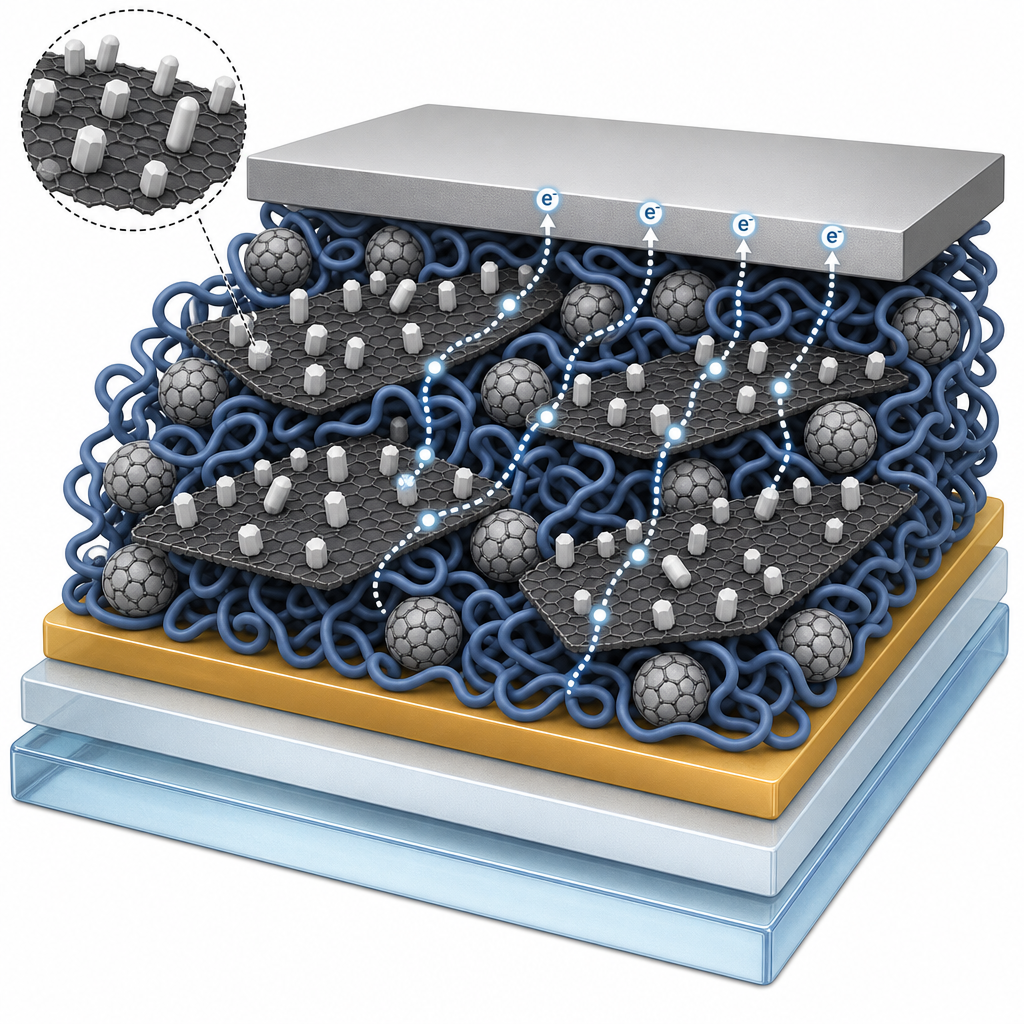
The ACS Material RGO was used as the carbonaceous scaffold onto which ZnO nanoparticles nucleate during the microwave-assisted reaction. In the experimental procedure, 5 mg of commercial RGO from ACS Material was dispersed in 10 mL of ethanol and ultrasonicated for 10-15 minutes. This RGO suspension was then combined with a zinc acetate dihydrate / potassium hydroxide / methanol precursor solution, sonicated again, and transferred to a Teflon-lined microwave reactor (Monowave 300, Anton Paar) operated at 160 °C for one hour. The product was centrifuged at 10,000 rpm and annealed at 100 °C, yielding Z@G powder that disperses stably in a 9:1 chloroform/ethanol mixture. The hydrophobic surface chemistry of the Z@G composite enabled uniform blending with PCPDTBT and PCBM in chlorobenzene, which is essential for casting continuous, pinhole-free active layers in the ITO/PEDOT:PSS/PCPDTBT:PCBM:Z@G/Al device stack.
The key results center on the J-V characteristics of the BHJ devices measured under standard test conditions with a class AAA Oriel Newport solar simulator. Adding hydrophobic ZnO nanoparticles to the PCPDTBT:PCBM blend raised power conversion efficiency to 1.76%, with concurrent increases in open-circuit voltage (VOC) and short-circuit current density (JSC) relative to the polymer:fullerene baseline. Substituting the Z@G nanocomposite for plain ZnO produced a further large improvement, reaching 3.65% PCE after optimizing the weight ratio of polymer, fullerene and nanocomposite. The graphene component contributes additional electron acceptor character, faster charge transport, and improved film morphology, all of which translate to the enhanced JSC highlighted in the title. Structural and optical characterization including TEM and HRTEM (Tecnai G2 F30 at 300 kV), XRD (Bruker D8-Advance, Cu Kα), Raman (Renishaw inVia, 514.5 nm), FTIR, AFM and UV-Vis spectroscopy confirm uniform ZnO decoration on the RGO sheets, narrow size distribution, and retention of the graphene D and G bands.
The outcomes are relevant to several adjacent application areas: low-cost solution-processed organic photovoltaics, hybrid tandem cells, semi-transparent and flexible photovoltaic modules, and organic-inorganic interfaces in photodetectors and light-emitting diodes. The hydrophobic Z@G synthesis route is also a template for designing nanocomposite electron-transport layers and acceptor materials compatible with non-fullerene polymer donors. The authors point toward further work on optimizing the graphene-to-ZnO ratio and exploring other low-bandgap donor polymers to push efficiency higher.
For researchers building hybrid bulk heterojunction devices, electron transport layers, or graphene-metal-oxide composites for photocatalysis and sensing, the reduced graphene oxide grade used in this paper is available from ACS Material's Graphene Series catalog. The paper's results show that commercial RGO can serve as a reliable scaffold for inorganic nanoparticle decoration via microwave hydrothermal chemistry, with reproducible performance gains in functional devices.How ACS Material products were used
- Reduced Graphene Oxide (RGO) (Graphene Series) — “RGO was procured from ACS Materials... A solution of RGO in ethanol was prepared by adding 5 mg of commercial RGO (ACS materials) in 10 ml of ethanol and ultrasonication for 10–15 minutes.”
Product Performance in this StudyCommercial RGO from ACS Material served as the graphene scaffold onto which ZnO nanoparticles were anchored via microwave-assisted hydrothermal synthesis. The resulting Z@G nanocomposite enabled a power conversion efficiency of 3.65% in PCPDTBT:PCBM-based bulk heterojunction solar cells, more than double that of the ZnO-only reference (1.76%).
Related product categories
Frequently asked questionsHow does reduced graphene oxide improve ZnO-based hybrid solar cells?
Reduced graphene oxide acts as a conductive scaffold that anchors ZnO nanoparticles, creating a Z@G nanocomposite with faster electron transport and improved film morphology when blended with PCPDTBT and PCBM. In this paper, replacing pure ZnO nanoparticles with the Z@G composite raised the power conversion efficiency of bulk heterojunction solar cells from 1.76% to 3.65%, with a notable increase in short-circuit current density.
Why is hydrophobicity important for ZnO nanoparticles in organic solar cells?
Conjugated polymers such as PCPDTBT are dissolved in nonpolar solvents like chlorobenzene. If ZnO nanoparticles are hydrophilic, they aggregate or phase-separate, disrupting the active-layer film. The surfactant-free hydrophobic ZnO and Z@G nanocomposite synthesized here disperse stably in chloroform mixtures and blend cleanly with the polymer solution, allowing smooth, continuous bulk heterojunction films to be spin coated.
What is the role of microwave-assisted hydrothermal synthesis in making Z@G nanocomposites?
Microwave-assisted hydrothermal reaction in a Monowave 300 reactor at 160 °C provides rapid, uniform heating that produces ZnO nanoparticles with narrow size distribution directly on the RGO sheets within an hour. The fast reaction kinetics avoid the need for surfactants and yield a hydrophobic Z@G nanocomposite ready for solution processing into hybrid photovoltaic active layers.