-
Riboflavin-Grafted SBA-15 Fluorescence Sensor - Adam Mickiewicz University, 2015
Jul 09, 2026 | ACS MATERIAL LLCLewandowski, D. et al. (2015). Fluorescence properties of riboflavin-Functionalized mesoporous silica SBA-15 and riboflavin solutions in presence of different metal and organic cations. *Journal of Physics and Chemistry of Solids*. https://doi.org/10.1016/j.jpcs.2015.04.007
Journal of Physics and Chemistry of Solids · 2015
Researchers covalently grafted riboflavin onto ACS Material SBA-15 mesoporous silica and probed fluorescence responses to 14 metal and 6 organic cations.
About this research
Researchers led by Dawid Lewandowski at Adam Mickiewicz University (Poznań, Poland), together with collaborators at the Polish Academy of Sciences and the University of Gdańsk, used SBA-15 mesoporous silica purchased from ACS Material as the structural scaffold for a covalently grafted riboflavin fluorescence platform whose emission responds selectively to a wide range of metal and organic cations. The team functionalized the silica surface in two steps - first anchoring (3-isocyanatopropyl)triethoxysilane, then linking riboflavin (Vitamin B2) through the resulting isocyanate - and compared the optical response of the solid material with that of aqueous riboflavin under identical cation exposures. The work, published in the Journal of Physics and Chemistry of Solids in 2015, is among the first to characterize fluorescence behavior of covalently immobilized riboflavin.
Riboflavin is a well-studied natural fluorophore that emits strong green-yellow light around 520-530 nm, but in aqueous solution it is rapidly degraded by visible light and shows only modest sensitivity to most metal ions. Immobilizing the molecule on a high-surface-area solid offers two practical advantages: it stabilizes the fluorophore against photodegradation and brings the dye into a confined chemical environment where coordination events can produce stronger optical signatures. Mesoporous silicas such as SBA-15, with hexagonally ordered pores in the 5-30 nm range, are excellent hosts because they can both accommodate the riboflavin molecule and provide abundant surface silanols for covalent grafting. The motivation is broadly relevant to optical chemosensing, controlled drug release, heavy-metal monitoring and bio-detection, where stable, reusable, solid-state fluorescent probes are in demand.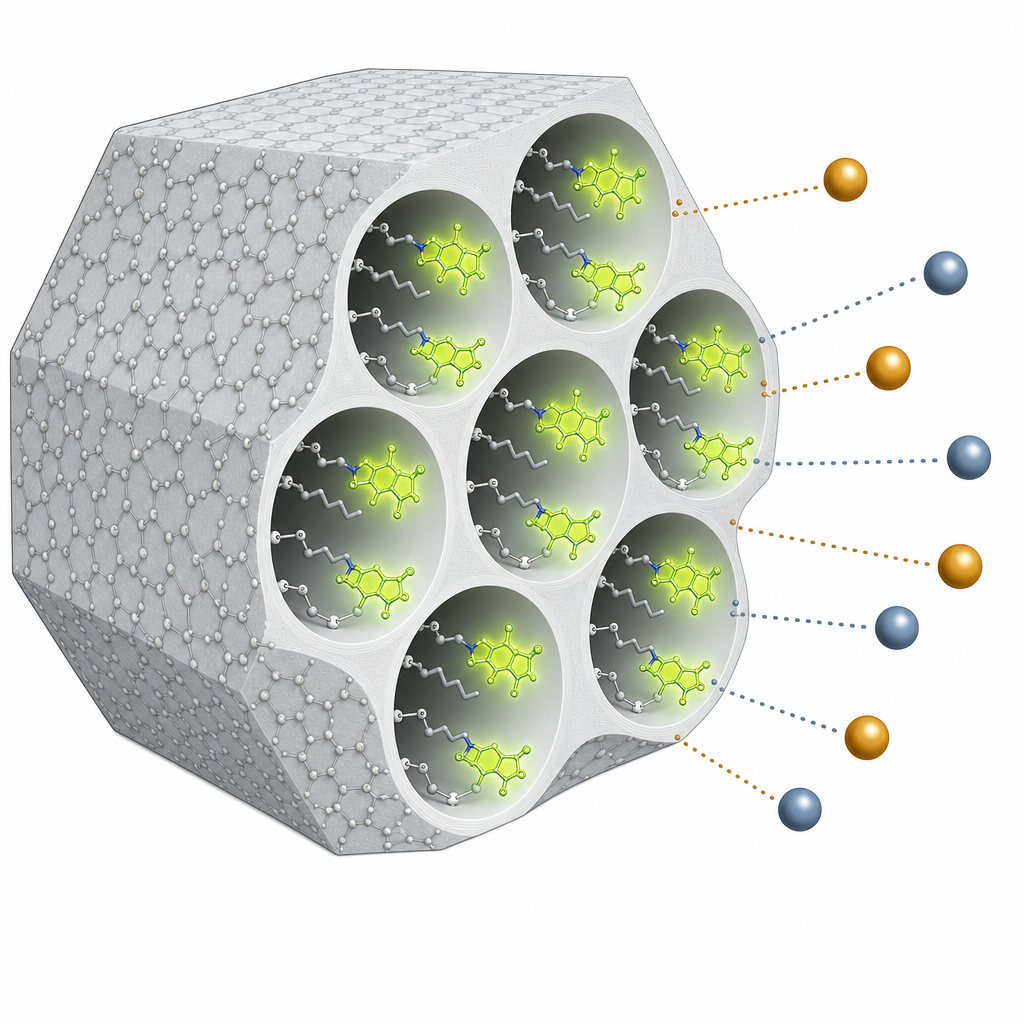
The ACS Material SBA-15 was specified at 8-11 nm pore diameter, 600 m² g⁻¹ surface area and 1-2 μm particle size. The authors measured a BET surface area of 555.9 m² g⁻¹, a BJH pore diameter of 8.1 nm and a pore volume of 0.902 cm³ g⁻¹ for the as-received material, confirming the supplier specification. A 0.4 g portion was refluxed in toluene with 6 mmol of (3-isocyanatopropyl)triethoxysilane for 3 hours and stirred a further 21 hours, then washed and dried. Riboflavin (0.266 mmol) was dissolved in hot DMF and coupled to the isocyanate-modified silica under stirring at 90 °C for 5 hours, after which physisorbed dye was removed by hot DMF washing. FTIR confirmed disappearance of the -NCO stretch at 2280 cm⁻¹ and emergence of C=O carbamate and amide bands. Elemental analysis gave 1.163% N and 4.943% C, corresponding to 3.46 mmol of riboflavin grafted per 100 g of starting silica, roughly 4-5% of the isocyanate groups. Nitrogen sorption after each step (SBA-15 → +isocyanate → +riboflavin) showed BET dropping from 555.9 to 482.2 to 470.6 m² g⁻¹ and pore diameter narrowing to 6.8 nm, consistent with surface functionalization without pore blockage.
Fluorescence measurements were collected on aqueous riboflavin solutions and on the solid riboflavin-SBA-15 conjugate after 24 h contact with 0.05 M cation solutions. In solution, most cations produced only small intensity changes around the ~514 nm maximum, with notable exceptions: Ag+ quenched fluorescence to 9.6% of the reference value, Hg²⁺ to 32.6% and benzocaine hydrochloride to 64%. The solid platform exhibited a richer response. The bare-functionalized material in water emitted at 517.8 nm, but cation contact produced both enhancements and quenching plus emission shifts of up to ±20 nm. Cd²⁺ raised intensity to 183% and shifted emission to 535.2 nm (+17.4 nm); Mg²⁺ gave 150% intensity at 509.0 nm; Sr²⁺ enhanced to 138.5% with a +5.1 nm red shift. Conversely Co²⁺ dropped to 10.8%, Cr³⁺ to 12.3%, Ni²⁺ to 14.8% and Hg²⁺ to 16.3%. Several organic cations - L-alanine methyl ester, L-leucine and D-glucosamine hydrochlorides - produced intensities between 150% and 185% of the reference and characteristic blue shifts of 10-30 nm, demonstrating discrimination between cation classes that solution-phase riboflavin cannot achieve.
The demonstrated platform is directly relevant to optical chemosensors for trace metal contamination (Ag+, Hg²⁺, Cd²⁺ are common targets in environmental and food safety monitoring), to luminescent labels for amino-acid and aminosugar detection, and to fundamental studies of fluorophore-cation coordination in confined pore environments. The dramatic intensity contrast between Mg²⁺/Cd²⁺ enhancement and Co²⁺/Cr³⁺/Ni²⁺/Hg²⁺ quenching suggests selectivity can be tuned through linker chemistry and pore size. The authors point toward extension to additional grafted chromophores and to drug-release studies that exploit the same mesoporous architecture.
For researchers building solid-state optical sensors, drug-delivery vehicles or grafted-functionality silica composites, this paper is a useful demonstration that ACS Material SBA-15 mesoporous silica provides a reproducible, high-surface-area substrate compatible with isocyanate-silane chemistry and DMF processing. The same SBA-15 grade is available from ACS Material, along with related ordered mesoporous silicas (SBA-16, MCM-41, MCM-48, KIT-6) for groups exploring alternative pore geometries.How ACS Material products were used
- SBA-15 mesoporous silica (8–11 nm pore diameter, 600 m²/g surface area, 1–2 μm particle size) (Molecular Sieves) — “SBA-15 mesoporous silica (8–11 nm pore diameter, 600 m2 g−1 surface area and 1–2 μm particle size) was purchased from ACS Material”
Product Performance in this Study
The ACS Material SBA-15 provided the high-surface-area mesoporous scaffold (measured BET 555.9 m²/g, 8.1 nm pore diameter) onto which isocyanate linkers and riboflavin were grafted, enabling the solid-state fluorescence sensing platform that is the entire focus of the paper.
Related product categories
Frequently asked questions
Why use SBA-15 mesoporous silica as a host for fluorescent dyes like riboflavin?
SBA-15 has hexagonally ordered pores of 5-30 nm and surface areas around 550-600 m²/g, providing abundant silanol groups for covalent grafting and enough internal space to host moderately sized molecules without blocking the channels. Confining a fluorophore on its surface stabilizes the dye against photodegradation, restricts diffusion of analytes, and amplifies fluorescence changes caused by metal-ion coordination, making it useful for solid-state optical chemosensors.
How does grafting riboflavin onto SBA-15 change its cation-sensing behavior?
In aqueous solution, riboflavin emission near 514 nm only changes strongly with Ag+ (down to 9.6%) and Hg²⁺ (32.6%). Once covalently grafted on SBA-15, the same dye shows much broader discrimination: Cd²⁺ and L-leucine HCl boost intensity to ~183-185%, Mg²⁺ to 150%, while Co²⁺, Cr³⁺, Ni²⁺ and Hg²⁺ quench to 10-16%, with emission shifts of up to ±20 nm depending on the cation.
How much riboflavin can be covalently anchored on SBA-15 via isocyanate-silane chemistry?
Using (3-isocyanatopropyl)triethoxysilane as a linker followed by reaction with riboflavin in hot DMF, the authors achieved 3.46 mmol of riboflavin grafted per 100 g of SBA-15, covering roughly 4-5% of available isocyanate sites. Higher temperatures increased loading but caused thermal degradation of riboflavin in solution, so mild grafting conditions gave the best balance of coverage and dye integrity.