-
RuO2/Graphite Oxide Catalyst for Imine Synthesis - Shinshu University, 2017
Jul 09, 2026 | ACS MATERIAL LLCYuan, G. et al. (2017). Interconnected ruthenium dioxide nanoparticles anchored on graphite oxide: Highly efficient candidate for solvent-Free oxidative synthesis of imines. *Journal of Industrial and Engineering Chemistry*. https://doi.org/10.1016/j.jiec.2016.10.040
Journal of Industrial and Engineering Chemistry · 2017
RuO2 nanoparticles anchored on ACS Material graphite oxide deliver up to 98% yield and 100% selectivity for solvent-free oxidative imine synthesis.
About this research
Researchers at Shinshu University, working with collaborators at Konkuk University and POSTECH, developed an interconnected RuO2 nanoparticle catalyst anchored on graphite oxide (RuO2/GO) using graphite oxide purchased from ACS Material, and demonstrated that the resulting nanocatalyst achieves up to 98% imine yield with 100% selectivity under solvent-free, open-air conditions. The catalyst exhibited a BET surface area of 285 m2/g and tolerated a broad scope of primary amines, including the typically unreactive aliphatic ones. The authors describe it as the most efficient RuO2-based nanocatalyst reported to date for imine synthesis.
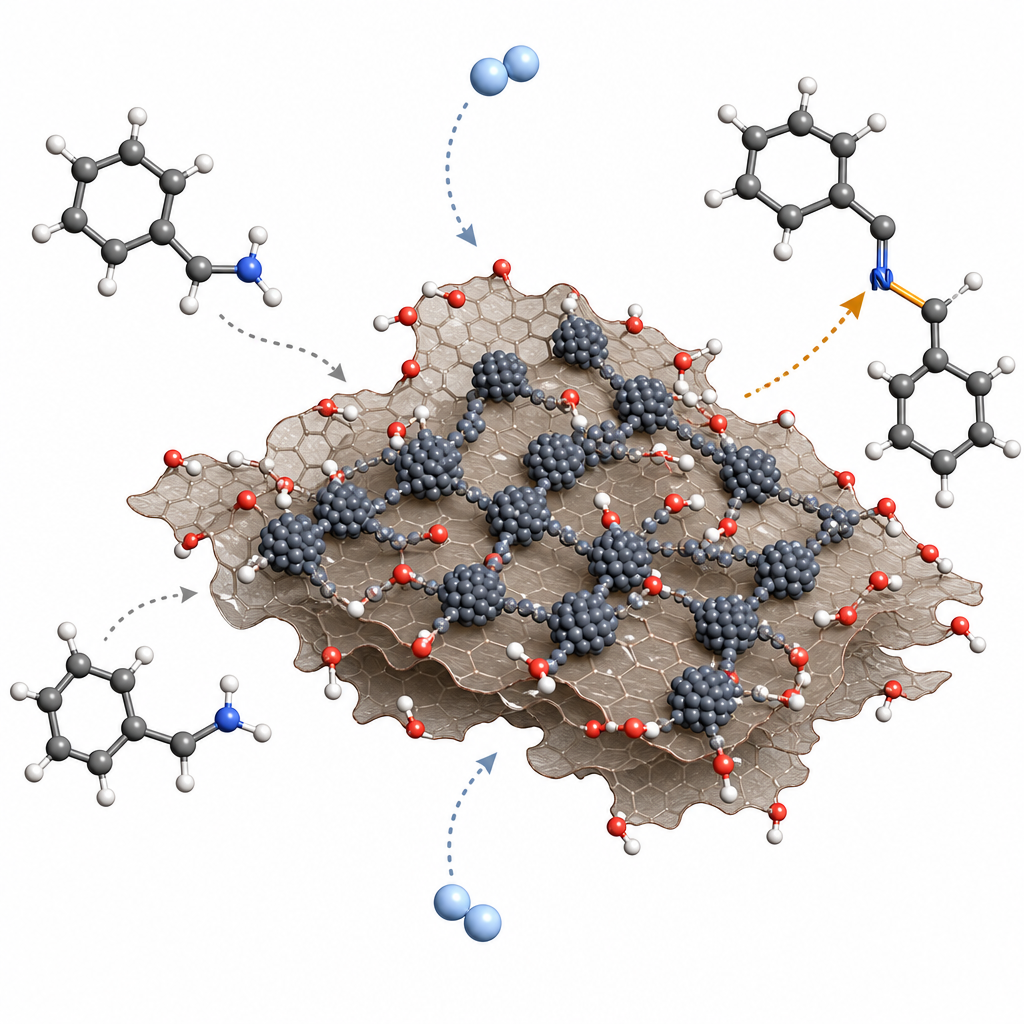
Imines are central intermediates in fine chemical, agrochemical and pharmaceutical manufacturing because the reactive C=N motif participates in condensation, addition and cycloaddition chemistry. Classical condensation routes rely on dehydrating agents and Lewis acid catalysts, while modern oxidative coupling of alcohols or amines typically requires precious metal catalysts working under inert or pure O2 atmospheres, with frequent drawbacks in catalyst loading, time and reusability. Although ruthenium has wide oxidation-state flexibility and RuO2 is known to be a strong oxidation catalyst, prior supported Ru systems often diverted benzylamines toward nitriles or failed entirely for amine self-coupling. This paper addresses that gap by combining the oxidation activity of RuO2 with the high surface area and chemical inertness of a carbon support.
The ACS Material graphite oxide (>90% purity) was the structural backbone of the catalyst. In the synthesis, 0.398 g of Ru(acac)3 and 1.0 g of graphite oxide were dispersed in methanol, sonicated, and stirred at 65 °C to remove the solvent. The resulting homogeneous powder was held under vacuum for 24 h and then calcined in a muffle furnace at 600 °C under N2 for 3 h with a 5 °C/min ramp. The oxygen-rich functional groups on the graphite oxide surface anchor and disperse the RuO2 nanoparticles, producing an interconnected network rather than isolated islands. Comparative samples of pure GO and pure Ru(acac)3 were calcined under the same conditions to give RGO and bulk RuO2 references. The composite was characterized by TEM, XPS, XRD, Raman, SEM-EDS, BET and ICP-MS, confirming nanoparticle dispersion and a high specific surface area of 285 m2/g. The carbon scaffold also stabilizes the active phase against sintering during repeated catalytic runs.
Catalytic testing focused on three reaction classes. In the self-coupling of primary amines, 25 mg of RuO2/GO (0.98 mol% Ru) converted 2 mmol of benzylamine at 100 °C in 3 h under air, giving (E)-N-benzylidene-1-phenylmethanamine in high yield and 100% selectivity, confirmed by GC-MS (m/z 195.4) and 1H/13C NMR. Across a broader amine substrate scope, isolated yields ranged from 98% down to 58% for the least reactive aliphatic amines, with selectivity maintained at 100%. Cross-coupling of benzylamine with aniline at 100 °C for 3 h cleanly produced (E)-N-benzylideneaniline. An indirect two-step protocol coupling benzyl alcohol with benzylamine, first oxidizing benzyl alcohol at 110 °C for 29 h before adding the amine for a 10 min condensation, also performed well. Critically, reusability tests, heterogeneity tests and hot-filtration experiments showed that the catalyst remained active across cycles without the leaching or active-site blocking that hampers many solvent-free systems.
The results are relevant to fine chemical and pharmaceutical intermediate manufacturing, where imine formation is a recurring step in routes to amines, alkaloids and Schiff-base ligands. Because the catalyst works in air without solvent and avoids pure O2 atmospheres, it lowers both safety and operational costs at scale. Carbon-supported RuO2 systems of this type are also of interest for related oxidation chemistry, including alcohol oxidation, alcohol-amine N-alkylation, and tandem heterocycle synthesis. The graphite-oxide scaffold itself is widely used in electrocatalysis and energy-storage research, so the same starting material could be repurposed by groups exploring supercapacitor electrodes or oxygen evolution catalysts.
For researchers planning similar work, the study illustrates how a well-defined commercial graphite oxide can serve as a reproducible support for transition-metal oxide nanoparticles. Graphite Oxide is available from ACS Material in the Graphene Series catalog, alongside reduced graphene oxide, functionalized graphene grades and graphene oxide dispersions that suit related synthesis workflows. Sourcing a consistent, high-purity oxidized carbon support is one of the practical levers that makes nanocatalyst studies like this one reproducible across labs.How ACS Material products were used
- Graphite Oxide (Graphene Series) — “Graphite oxide (GO) with >90% purity was purchased from ACS materials, USA.”
Product Performance in this Study
The graphite oxide served as the support framework onto which RuO2 nanoparticles were anchored, yielding a nanocatalyst with a BET surface area of 285 m2/g that delivered up to 98% imine yield with 100% selectivity under solvent-free conditions.
Related product categories
Frequently asked questions
Why is graphite oxide a useful support for RuO2 nanoparticles in catalysis?
Graphite oxide offers a high specific surface area and abundant oxygen-containing functional groups that anchor and disperse metal precursors during synthesis. After calcination, these anchoring points hold RuO2 nanoparticles in an interconnected network rather than isolated clusters, giving the RuO2/GO catalyst in this study a BET surface area of 285 m2/g and stabilizing the active phase against sintering during repeated catalytic cycles.
How efficient is RuO2/GO for solvent-free oxidative imine synthesis?
Using only 25 mg of catalyst (0.98 mol% Ru) at 100 °C in open air for 3 h, RuO2/GO converted benzylamine and a broad scope of primary amines into the corresponding imines in 98 to 58% yield with 100% selectivity. The authors report it as the most efficient RuO2-based nanocatalyst for imine synthesis published to date, and it remains active across multiple reuse cycles without leaching.
What reaction conditions did the authors use to prepare the RuO2/GO catalyst?
The team dispersed 0.398 g of Ru(acac)3 and 1.0 g of ACS Material graphite oxide in methanol, sonicated the mixture, then stirred at 65 °C to evaporate the solvent. After 24 h under vacuum, the powder was calcined in a muffle furnace under N2 at 600 °C for 3 h with a 5 °C/min heating ramp, producing interconnected RuO2 nanoparticles anchored on the graphite oxide support.